Pest Control in Eagle Mountain, Utah

Pest control in eagle mountain, utah

Eagle Mountain, Utah is a city built out into open ground, and the pests follow the ground. Fifty square miles of Cedar Valley, west of the Lake Mountains at 4,885 feet, with sagebrush and open range running up against the back fences. When a town goes from 2,157 people in 2000 to better than 43,000 by 2020, the animals already on that ground do not leave.

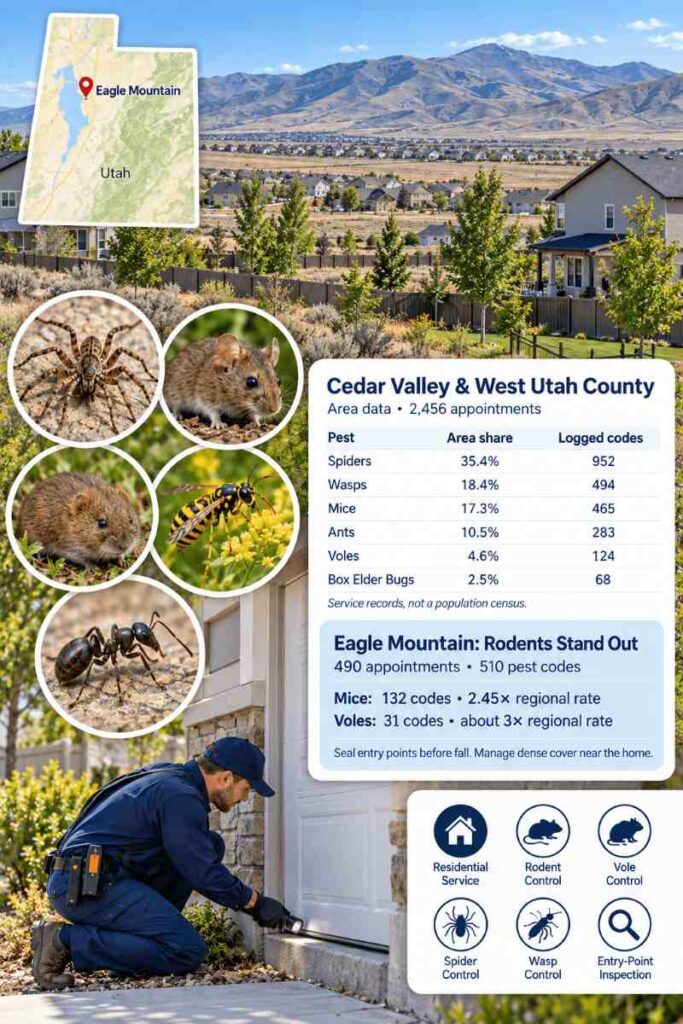
Our records say so plainly. On 490 Eagle Mountain appointments we have logged 132 mouse codes, about two and a half times the rate across the rest of our Utah service area. That is the clearest thing our data says about this city.

We Are in Eagle Mountain Most Weeks

Beeline is locally owned, we have treated Utah homes for 25+ years, and Eagle Mountain is a regular stop rather than a favor. Those 490 appointments are the proof: real work logged over years, out into The Ranches, City Center, and the newer stretches toward Pole Canyon.

We schedule in routes, so a technician is already crossing the valley on the day you need one. Distance inside Eagle Mountain is the planning problem, not distance to it. A city this spread out means we book neighborhoods together, so call a few days ahead rather than the morning you find droppings.

Because Eagle Mountain Sits Further Out, We Look at the Whole Area

Eagle Mountain carries 510 logged pest codes on its own. That is enough to be confident about mice, which show up in big numbers, and not enough to say much about anything rare. So for the broader picture we pool it with Cedar Valley and west Utah County: Lehi, Saratoga Springs, Eagle Mountain, Cedar Fort, and Fairfield (2,456 total appointments).

What the Cedar Valley Pest Mix Looks Like

Across those 2,456 area appointments the top of the list is ordinary: spiders at 952 logged codes (35.4% of the area mix), and wasps at 494 codes (18.4%). Every Utah city gives us those two first. The interesting part sits underneath:

  • Mice: Account for 465 area codes (17.3% of the mix), about 1.65 times the rest of our service area.

  • Voles: Represent 124 area codes (4.6%), roughly 2.45 times our rest-of-area rate.

  • Ants: Represent 283 area codes (10.5%), sitting slightly under our regional average.

  • Box Elder Bugs: Account for 68 area codes (2.5%), about a quarter of our rest-of-area rate.

What Cedar Valley and west Utah County call us about Area data, not city data. Share of pest codes logged across 2,456 service appointments in Cedar Valley and west Utah County (Lehi, Saratoga Springs, Eagle Mountain, Cedar Fort and Fairfield), compared with the rest of our Utah service area. The multiple on the right is how many times more, or less, of the area mix each pest is. These are our service records, not a survey of the local insect population.
Cedar Valley and west Utah County (area data) Rest of our Utah service area

Scroll the chart sideways to see the full scale →

Share of Beeline service calls by pest: Cedar Valley and west Utah County vs. the rest of our Utah service areaThe Cedar Valley and west Utah County area runs far higher on mice, voles, snails and mosquitoes, and far lower on box elder bugs, rats, earwigs and elm seed bugs.0%10%20%30%Spiders35.4%32.0%· 1.11xWasps18.4%16.7%· 1.10xMice17.3%10.5%▲ 1.65xAnts10.5%13.6%▼ 0.77xVoles4.6%1.9%▲ 2.43xBox elder bugs2.5%10.2%▼ 0.25xSnails1.7%0.4%▲ 3.91xMosquitoes1.4%0.7%▲ 1.91xEarwigs1.2%3.0%▼ 0.40xElm seed bugs1.2%2.9%▼ 0.42xRats0.3%2.2%▼ 0.14xCrickets0.3%0.1%▲ 2.98x

Key Takeaway: Cedar Valley is a heavy rodent area that runs quiet on tree-and-shade insects. That is the primary difference between here and the Wasatch Front.

What Makes This Area Different From the Wasatch Front

Along the Front, the classic fall complaint is box elder bugs on a sunny south wall. That pest needs mature female boxelder trees, and older Davis and Salt Lake County neighborhoods are full of them. Cedar Valley is not: this housing went up after 2000 on former range ground, so the canopy is young. Earwigs and elm seed bugs run low for the same reason.

What this area has instead is edge. Thousands of homes back onto undeveloped sagebrush, dry wash, pasture, and open range, and that boundary is where rodent pressure comes from. The Wasatch Front has that edge too, but only as a thin strip at the canyon mouths. Out here the edge is most of the city.

Eagle Mountain’s Own Numbers: Mice First, Voles Second

Back to the city, where the sample is good enough to stand on:

    • Mice: Represent 132 of Eagle Mountain’s 510 logged pest codes (about 2.45 times the rest of our service area). Eagle Mountain is not the average of the Cedar Valley pattern, it is the far end of it: the area runs 1.65x, the city 2.45x. That is the best-supported local number on this page.

    • Voles: Represent 31 Eagle Mountain codes (roughly three times our rest-of-area rate). USU Extension notes five vole species in Utah, the meadow vole most common, nesting in groundcover and thick litter and cutting runways about two inches wide through turfgrass, with three to five litters a year. You usually find them in March, when snow pulls back and the lawn looks like somebody ran a cable through it.

Field experience, not measurement: it is the houses on the open-ground edge that call us. A home backing sagebrush or a vacant parcel gets rodents in October. The same floor plan four streets into a finished subdivision usually does not. Service records cannot prove that, but our technicians say it every year.

Rodent Exclusion & Habitat Checklist:

    • Mice Exclusion: Mice get through anything wider than a quarter inch. Seal garage door corners, weep holes, utility penetrations, dryer vents, and the sill plate gap.

    • Vole Habitat Management: Mow short, pull weeds and tall grass back from the foundation, thin mulch near tree trunks, and wrap young trunks in quarter-inch hardware cloth.

Eagle mountain's own numbers mice first, voles second 


Eagle Mountain Seasonal Schedule

March – April: Vole damage becomes visible in the lawn; wasp queens begin scouting eaves.

May – August: Spider and wasp activity peaks; mosquitoes emerge near retention basins and irrigated turf.

September – October: Critical window when mice move toward warm buildings; exterior exclusion should be completed.

November – February: Interior rodent monitoring and exclusion maintenance.

Why Eagle Mountain Homeowners Call Beeline

Locally owned, 25+ years in Utah, 2,300+ five-star reviews, with no hidden charges. Our regular service is a quarterly exterior program with free re-treats between visits, which matters more out here, because rodent pressure on the open edge recurs rather than ending. Rodent work is exclusion plus control, not just bait.

Get a Free Quote: Call (801) 544-9200 or text us at (385) 425-1766.

Eagle Mountain pest control questions we actually get asked

Do you actually come out to Eagle Mountain, or is this a service area on paper?

We come out. We have logged 490 Eagle Mountain appointments and run a regular route here. You are not a special trip.

Does it cost more because I am further out?

No. Pricing is the same in Eagle Mountain as in Clearfield. What changes is scheduling: we group Eagle Mountain stops, so a few days of notice gets you a better window.

What if mice come back between quarterly visits?

Call us and we come back at no extra charge. On the open-ground edge a re-treat between visits is normal, not a sign something went wrong.

Why does my house get mice when my friend across town never does?

Most likely the ground behind you. In our experience the Eagle Mountain homes that call about rodents are the ones backing sagebrush, open range, or an unbuilt parcel. Service records cannot prove it, but it is what our technicians find.

Are voles the same thing as mice?

No. Voles live outside in runways under the grass and chew bark and roots. Mice come indoors. Eagle Mountain runs high on both, 132 mouse codes and 31 vole codes out of 510, so plenty of homes here get one problem in October and the other in March.

Should I worry about box elder bugs here?

Less than your relatives on the Wasatch Front do. Across Cedar Valley and west Utah County box elder bugs are 68 of 2,691 logged pest codes, well under our service-area rate. Eagle Mountain’s own count is only 9, too small to make a claim on. Young trees are the likely reason.

Do you treat the sheds, coops and outbuildings?

Yes. On large lots the detached structures are usually where rodent activity starts. Tell us what is out there when you book.

Beeline Pest Control has served the state of Utah for over 29 years. Call now for your quick FREE quote.