
Key Points
- Silent Destruction: Termites eat wood from the inside out, meaning severe structural damage can happen entirely out of sight.
- Utah-Specific Risks: Subterranean termites are the primary local threat, driven indoors by freezing winters and emerging in massive spring swarms.
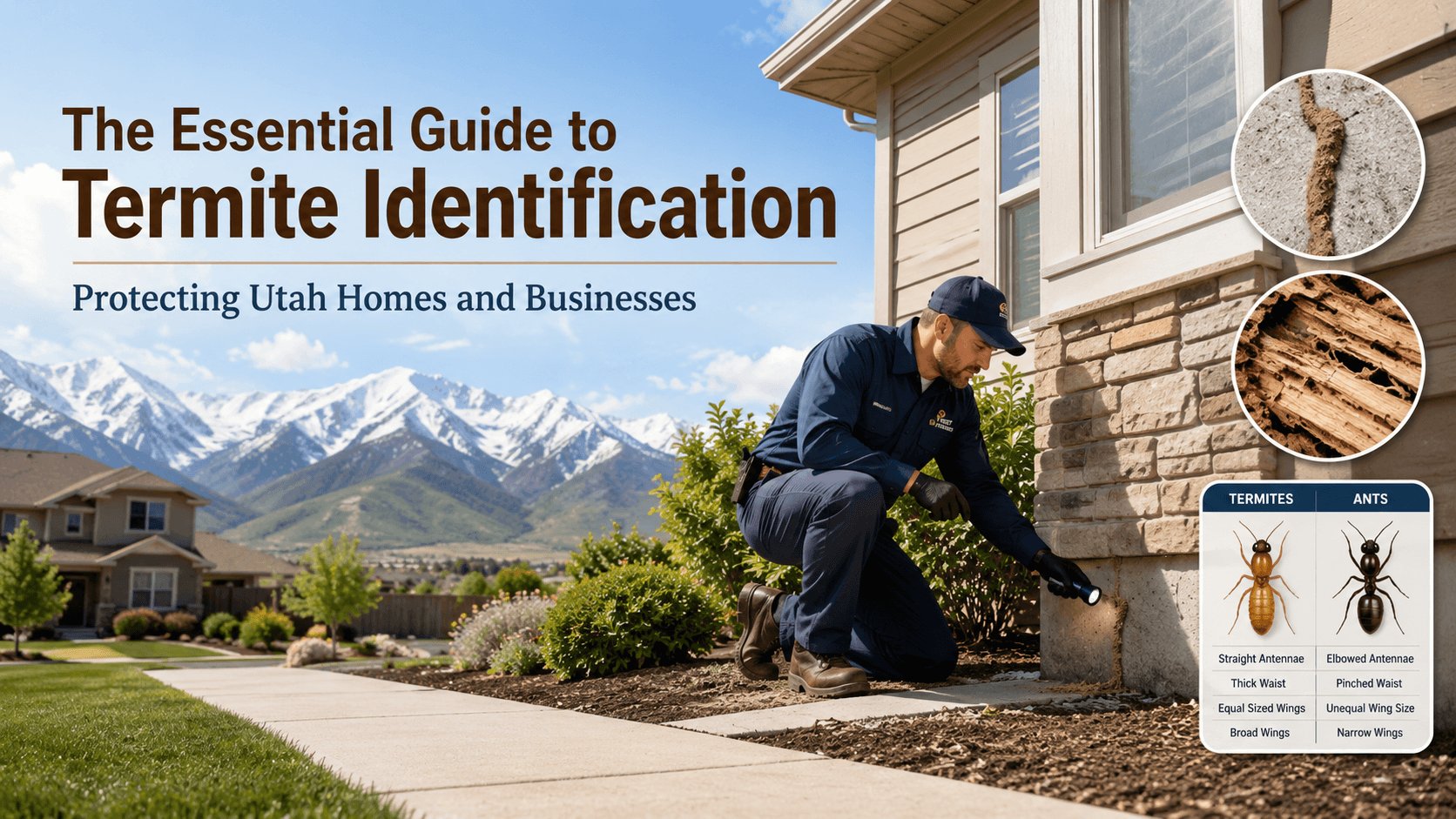
- Anatomy Identifiers: You can tell termites apart from ants by looking for straight antennae, thick waists, and wings of equal length.
- Professional Defense: Standard DIY retail sprays fail because they do not eliminate the deep underground queen, which can live for decades.
- Family & Pet Safety: Utah Beeline uses low-toxicity, targeted applications that strictly adhere to EPA standards to protect your family, pets, or clients.
Introduction: The Hidden Threat to Utah Properties
Owning property in the Beehive State comes with incredible rewards, from beautiful mountain views to vibrant local communities. However, our distinct four-season climate presents a unique set of pest challenges. As winter snow melts and spring temperatures rise, a hidden threat begins to stir beneath the soil. Termites silently target residential neighborhoods and commercial developments from Salt Lake City to Provo.
For homeowners, a termite infestation threatens their greatest financial investment and family sanctuary. For business owners, it jeopardizes structural safety, inventory, and your hard-earned commercial reputation. When it comes to protecting your property, understanding the basics of Pest Control Utah is your first line of defense. Knowing how to identify these silent destroyers before they cause severe structural damage ensures long-term peace of mind.
Understanding the Pests in Utah Homes and Businesses
Utah is primarily home to subterranean termites. Unlike pests that leave highly visible trails, these insects live in massive underground colonies and tunnel through the soil to reach structural wood.
Seasonal Shift Alert: The seasonal shifts in Utah accelerate termite activity. During late spring and early summer, mature colonies release winged “swarmers” to reproduce and establish new nests.
Property Vulnerability Checklist
This seasonal behavior poses distinct risks across different properties:
- For Homeowners: Termites compromise the structural integrity of your house by chewing through support beams, subflooring, wall studs, and roof trusses.
- For Business Owners: An undetected infestation can breach strict health regulations, damage structural elements in warehouses, and cause severe financial strain through forced operational closures.
How to Spot the Silent Destroyer
The immediate risk of a termite infestation is its invisibility. They consume wood from the inside out, meaning a structure can look perfectly sound on the outside while being hollowed out on the inside. Relying on simple retail sprays or DIY bait stations typically fails because these methods only target individual workers, leaving the main underground queen completely unharmed.
Identification Markers: Termites vs. Ants
To truly protect your property, you must know exactly what these insects look like in our region. In Utah, worker termites are small, creamy-white, and completely wingless. They are often mistaken for “white ants,” but they possess distinct anatomical differences.
| Feature | Termite Anatomy | Ant Anatomy |
| Antennae | Straight, looks like tiny beads | Elbowed or bent |
| Waistline | Thick, broad, and uniform | Pinched, narrow, and distinct |
| Wings (Swarmers) | Two pairs of equal length | Front wings longer than hind wings |
Utah Beeline provides specialized localized treatments designed to penetrate deep beneath concrete slabs, foundation walls, and crawl spaces. We treat the root source of the colony to ensure they never return to your structural wood.
Section 3: Related Topics Property Owners Often Ask About
The Importance of Year-Round Quarterly Pest Management
Many property owners ask whether pest defense is necessary during our freezing winter months. While cold weather slows down outdoor insect activity, the warmth radiating from your heated basement or commercial facility creates an ideal sanctuary for pests. A consistent Quarterly Pest Management plan builds an uninterrupted protective barrier around your perimeter, stopping pests before they ever find a way inside.
General Pest Control vs. Specialized Termite Services
Standard pest maintenance covers common seasonal invaders like spiders, boxelder bugs, and ants. Termite management, however, requires specialized tools, specialized liquid barriers, and localized monitoring systems.
What Makes a Plan Truly Eco-Friendly?
Modern property owners want to protect their investments without introducing harsh, volatile chemicals to their living or working spaces. Choosing Eco-Friendly pest control means utilizing targeted, low-toxicity products that eliminate specific target pests while remaining completely safe for your surrounding soil, local water tables, and native wildlife.
Section 4: DIY vs. Expert Protection with Utah Beeline
Attempting to treat a termite colony on your own frequently backfires. Disturbed termites often fragment their colony, moving to deeper, less accessible parts of your home or commercial building to continue their damage unseen.
“Termites are master survivalists. A single colony can contain hundreds of thousands of individuals working nonstop. If you don’t eliminate the underground queen, the colony will simply bypass your DIY treatments and find another way into your structure.”
— Licensed Technician, Utah Beeline
Professional intervention ensures that your treatments utilize solutions that prioritize family and pet safety by strictly adhering to EPA application standards and utilizing low-toxicity, targeted parameters. This means your kids, dogs, and cats remain entirely safe during and after application. Licensed experts know exactly how to inspect hidden entry points, such as mud tubes running along concrete foundations or subtle blisters in drywall.
Section 5: Utah Beeline Property Protection Plans
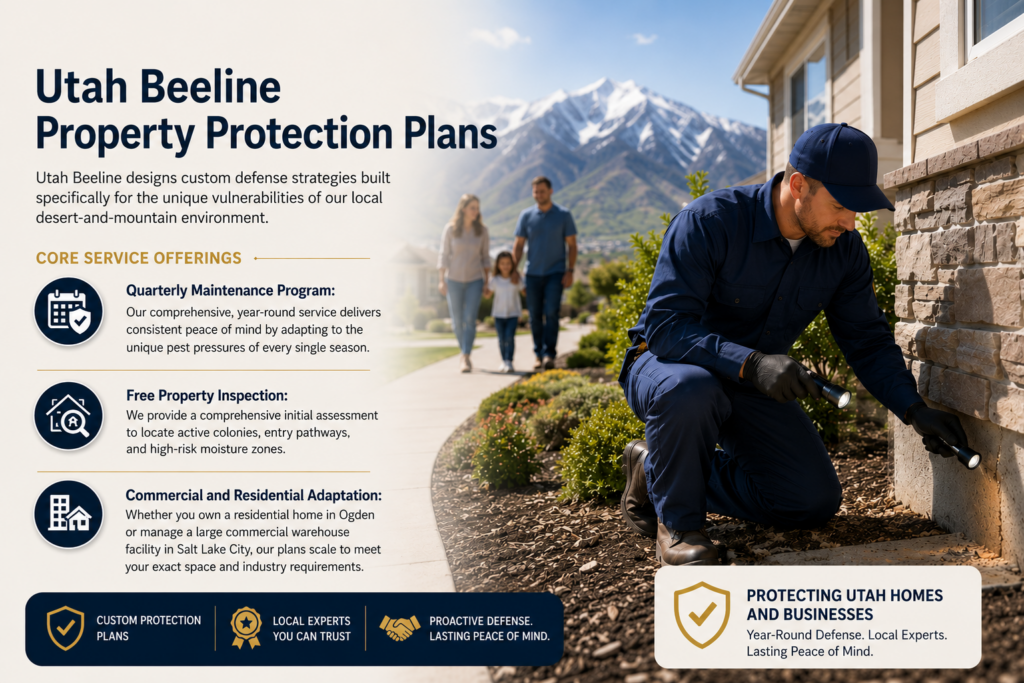
Utah Beeline designs custom defense strategies built specifically for the unique vulnerabilities of our local desert-and-mountain environment.
Core Service Offerings
- Quarterly Maintenance Program: Our comprehensive, year-round service delivers consistent peace of mind by adapting to the unique pest pressures of every single season.
- Free Property Inspection: We provide a comprehensive initial assessment to locate active colonies, entry pathways, and high-risk moisture zones.
- Commercial and Residential Adaptation: Whether you own a residential home in Ogden or manage a large commercial warehouse facility in Salt Lake City, our plans scale to meet your exact space and industry requirements.
Section 6: Safety and Compliance Assurance for All Properties
Is the treatment safe for my family, pets, or commercial clients? > Yes. At Utah Beeline, we strictly utilize state-approved products registered with the Environmental Protection Agency (EPA). Our precise application techniques target specific pest biology, ensuring your living areas and commercial spaces remain clean, safe, and fully compliant with all local health codes.
Section 7: Proactive Tips for a Pest-Free Environment
Residential Property Tips
- Manage Moisture: Divert downspouts at least 3 feet away from your home’s foundation to prevent moist soil conditions.
- Clear Direct Wood Contact: Ensure wooden siding, deck posts, and firewood piles do not directly touch the soil.
- Seal Foundation Cracks: Seal gaps in concrete basements and utility line entry points.
Tip: Inspect window screens and foundation walls before the seasonal shifts to catch mud tubes or potential entry points early.
Commercial Property Tips
- Clear Pallet Storage: Keep wooden shipping pallets raised off the ground and stored away from exterior walls.
- Schedule Annual Inspections: Ensure regular structural inspections according to Utah State University Extension guidelines to catch wood-boring insects early.
- Fix Plumbing Leaks: Repair commercial HVAC condensation lines and plumbing leaks immediately to reduce hidden internal moisture.
Conclusion: Secure Your Property’s Future Today
Termites never stop working, which means your property protection shouldn’t either. Securing professional pest defense is the smartest way to safeguard your equity, protect your family, and preserve your commercial business reputation.
Don’t let Utah pests compromise your property’s safety or value. Contact Utah Beeline today for a free inspection and customized, guaranteed protection.
Utah’s Favorite Pest Control Company
- Serving Utah Since 1997
- Locally owned and operated
- Top rated with 2,300+ five-star reviews!
- Safer pest control treatments prioritizing kids and pets
To find out more about our residential pest control services and commercial pest control services, visit our Contact Us page to fill out our form, or call us directly at (801) 544-9200.
Frequently Asked Questions
How to identify termites
Termites can be identified by their soft, creamy-white to light-brown bodies, straight antennae, and broad waistlines. If you see winged swarmers, they will have two pairs of equal-length wings that fold flat over their backs. If you suspect an infestation, contacting Utah Beeline for a professional assessment is the safest way to accurately identify them.
What are the first signs of termites?
The earliest signs include the appearance of pencil-thin mud tubes climbing up your concrete foundation, discarded insect wings near windowsills, and hollow-sounding wood when tapped. You might also notice localized blistering or sagging in your drywall or flooring. Utah Beeline can quickly inspect these subtle signs to confirm if active wood-destroying insects are present.
What do termites look like in Utah?
In Utah, the most common variety is the subterranean termite, which features pale, wingless workers measuring about an eighth of an inch long. The reproductive swarmers are dark brown or black and possess four translucent wings. Because they are easily confused with ants, having a Utah Beeline expert inspect them ensures you receive the correct treatment.
How do termites survive through seasonal changes?
During freezing Utah winters, subterranean termites migrate deeper into the earth below the frost line to stay warm. They will also readily exploit the consistent heat radiating from your home’s heated basement or crawl space to remain active all year long. Utah Beeline’s quarterly services ensure your property remains protected through every seasonal temperature shift.
Are termites blind?
Worker and soldier termites spend their entire lives in the dark underground or inside walls, meaning they are completely blind and rely on pheromones to navigate. Only the winged reproductive swarmers develop functional eyes to help them find mates and establish new colonies. Regardless of their vision, Utah Beeline uses advanced baiting and liquid barriers that track down the colony effectively.
Are termites attracted to light?
Winged termite swarmers are highly attracted to light sources when they emerge to mate during the spring season. You will often find them or their shed wings clustered around windowsills, glass doors, and exterior light fixtures. If you notice these signs around your property, call Utah Beeline immediately to intercept the swarmers before they establish a new nest.
What is a termite’s favorite food?
A termite’s primary food source is cellulose, an organic compound found abundantly in wood, paper, cardboard, and drywall. They prefer damp or decaying wood because it is much easier to chew and digest. Utah Beeline can help you identify and eliminate these wood-to-soil contact points to make your property less attractive to foraging colonies.
What is the lifespan of a termite?
Standard worker and soldier termites typically live for one to two years under ideal environmental conditions. However, a healthy subterranean termite queen can survive for decades with entomological studies showing lifespans ranging from 25 to 50 years under peak conditions—continuously producing eggs to sustain her colony. Utah Beeline targets the entire colony structure, ensuring the queen is eliminated to stop reproduction completely.
Where do termites nest?
Subterranean termites build their primary nests deep underground in moist soil, often several feet below the surface. They construct intricate mud tubes to travel safely between their subterranean home and the wood structures of your building. Utah Beeline specializes in applying targeted treatments directly into the soil to disrupt these nesting networks.
How do termites start?
A new termite colony starts when winged swarmers leave their original nest, find a mate, and shed their wings to burrow into moist soil. Once established underground, the new king and queen begin reproducing rapidly to build a worker force. Enlisting Utah Beeline for preventative perimeter treatments stops these pioneering swarmers from choosing your property.
Next: Are Boxelder Bugs Harmful? | Pest Control Utah Expert Guide