
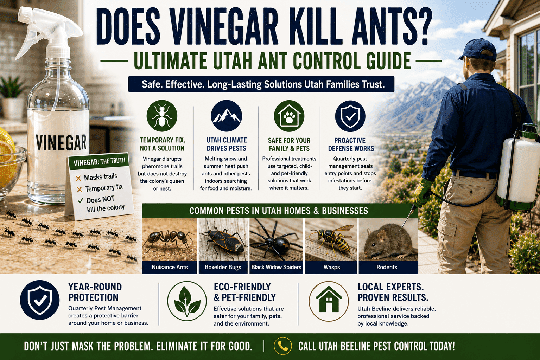
Key Takeaways
- Temporary Fix vs. Permanent Solution: Vinegar disrupts trailing pheromones but does not destroy the colony’s queen or nesting structure.
- Utah Climate Dynamics: Melting winter snow and intense late-summer heat force common local ants indoors in search of moisture and food.
- Safety First: Effective long-term management requires targeted, child- and pet-friendly protocols that household pantry items cannot replicate.
- Proactive Defense: Year-round quarterly pest management seals critical property vulnerabilities like basement entry points, eaves, and weeping holes.
The Great Spring and Summer Invasion
Every year, property owners across the Wasatch Front experience a familiar pattern. As the heavy winter snow melts off the mountains or when the late-summer heat bakes the soils of Salt Lake City, Ogden, and Provo, a tiny army begins its march. Suddenly, kitchen counters, bathroom baseboards, and commercial breakrooms are alive with trailing ants.
When facing an unexpected pest invasion, it is incredibly tempting to reach into the pantry for a quick, natural remedy. The internet is full of DIY blogs claiming a simple spray bottle of household vinegar is the ultimate weapon against an ant infestation. But does vinegar actually solve your problem, or does it simply hide a growing colony beneath your floorboards?
Protecting your family’s health, your home’s structural integrity, and your business’s hard-earned reputation requires reliable answers. When managing persistent local species, understanding the limits of home remedies is the first step toward achieving true peace of mind. For a lasting solution, establishing a reliable baseline of professional Pest Control Utah properties depend on is essential.
Understanding Pests in Utah Homes and Businesses
Utah’s distinct four-season climate creates a dynamic environment for household pests. During our freezing winters, insects and rodents seek refuge from the cold, overwintering inside crawl spaces, attics, and deep wall voids. When spring arrives and temperatures climb, these colonies wake up hungry and eager to expand.
Residential property owners frequently battle aggressive black widow spiders in dark window wells, common boxelder bugs clustering on sun-warmed south walls, and resilient nuisance ants tracking through kitchens. For a homeowner, these pests represent genuine health concerns and frustrating property vulnerabilities.
For business owners – especially those operating restaurants, commercial warehouses, or office complexes – the stakes are completely different. A visible pest issue can instantly shatter customer trust, lead to devastating online reviews, and trigger strict regulatory compliance failures. Whether it is a kitchen island or a commercial food storage pallet, pests look for the same entry points: unsealed eaves, foundation cracks, and worn door sweeps.
Does Vinegar Actually Solve the Problem?
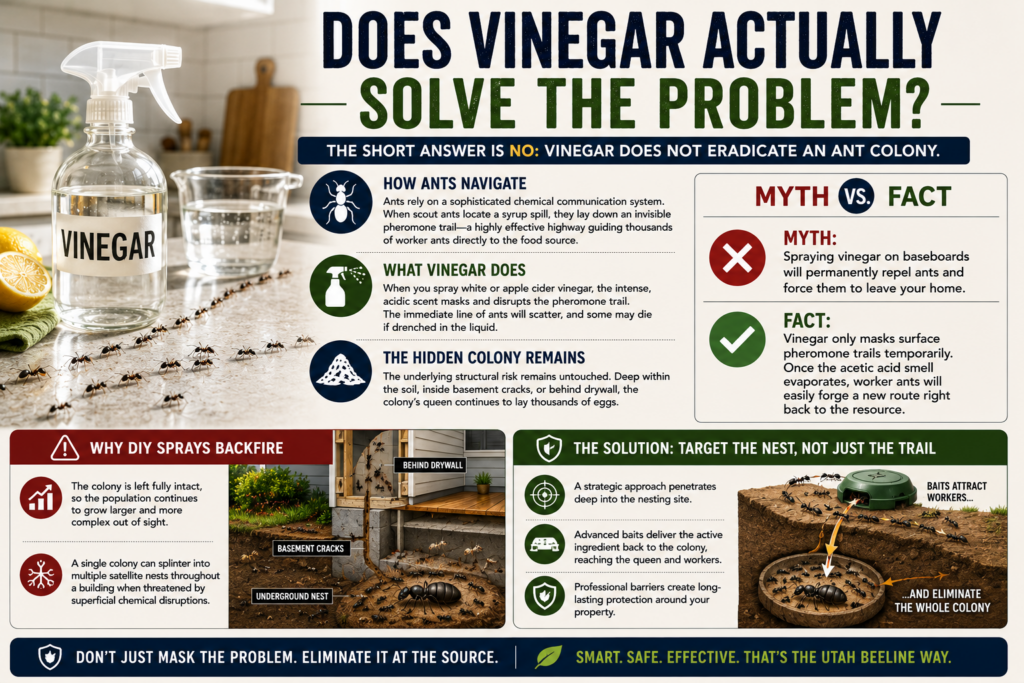
The short answer is no: vinegar does not eradicate an ant colony.
To understand why, it helps to examine how ants navigate. Ants rely on a sophisticated chemical communication system. When scout ants locate a syrup spill on your counter, they lay down an invisible chemical line known as a pheromone trail. This trail acts as a highly effective highway guiding thousands of worker ants directly to the food source.
When you spray a solution of white or apple cider vinegar across your countertop, the intense, acidic scent completely masks and disrupts that pheromone trail. The immediate line of ants will scatter, and some may die if they are directly drenched in the liquid.
However, the underlying structural risk remains untouched. Deep within the soil, inside your basement concrete cracks, or nestled behind a commercial drywall void, the colony’s queen continues to lay thousands of eggs.
Myth vs. Fact
- Myth: Spraying vinegar on baseboards will permanently repel ants and force them to leave your home.
- Fact: Vinegar only masks surface pheromone trails temporarily. Once the acetic acid smell evaporates, worker ants will easily forge a new route right back to the resource.
Relying strictly on DIY pantry sprays often backfires. Because the underlying colony is left fully intact, the population continues to grow larger and more complex out of sight. A single colony can quickly splinter into multiple satellite nests throughout a building if they feel threatened by superficial chemical disruptions.
To permanently halt an invasion, you need a strategic approach that penetrates deep into the nesting site, utilizing advanced baits and barriers that neutralize the entire colony safely.
Specialized, Year-Round Pest Protection
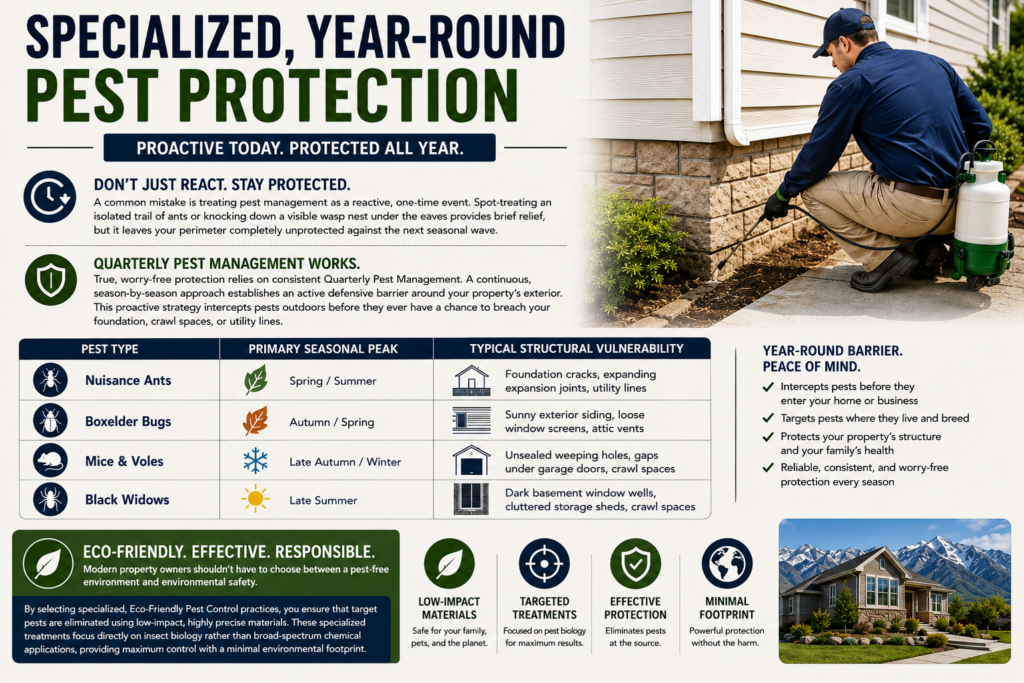
A common mistake is treating pest management as a reactive, one-time event. Spot-treating an isolated trail of ants or knocking down a visible wasp nest under the eaves provides brief relief, but it leaves your perimeter completely unprotected against the next seasonal wave.
True, worry-free protection relies on consistent Quarterly Pest Management. A continuous, season-by-season approach establishes an active defensive barrier around your property’s exterior. This proactive strategy intercepts pests outdoors before they ever have a chance to breach your foundation, crawl spaces, or utility lines.
| Pest Type | Primary Seasonal Peak | Typical Structural Vulnerability |
| Nuisance Ants | Spring / Summer | Foundation cracks, expanding expansion joints, utility lines |
| Boxelder Bugs | Autumn / Spring | Sunny exterior siding, loose window screens, attic vents |
| Mice & Voles | Late Autumn / Winter | Unsealed weeping holes, gaps under garage doors, crawl spaces |
| Black Widows | Late Summer | Dark basement window wells, cluttered storage sheds, crawl spaces |
Modern property owners shouldn’t have to choose between a pest-free environment and environmental safety. By selecting specialized, Eco-Friendly Pest Control practices, you ensure that target pests are eliminated using low-impact, highly precise materials. These specialized treatments focus directly on insect biology rather than broad-spectrum chemical applications, providing maximum control with a minimal environmental footprint.
DIY Mitigation vs. Expert Local Protection
Trying to manage an active pest infestation on your own frequently turns into a stressful cycle of trial, error, and unexpected expense. Many over-the-counter retail sprays contain harsh, repellent chemicals that cause ant colonies to panic and undergo a process called “budding,” where they split into several independent nests, multiplying your original problem.
Turning to a licensed professional ensures your property is treated with the highest degree of safety and precision.
“We don’t just look at where the pests are standing today; we look at why they are there in the first place. By understanding local nesting behaviors and using specialized, pet-friendly products, we fix the root problem without turning your living space into a chemistry experiment.”
– Licensed Utah Beeline Field Technician
Why Local Expertise Matters:
Comprehensive Colony Elimination: Professionals utilize undetectable, slow-acting baits that worker ants willingly carry deep back to the queen, wiping out the source of the infestation.
Targeted Visual Diagnostics: Experienced technicians know exactly how to read subtle tracking patterns and identify hidden entry points unique to Utah building styles.
True Pet-Friendly Applications: Professional products are mixed and applied with strict precision, keeping treatments locked away from curious children, pets, and sensitive restaurant environments.
Utah Beeline Property Protection Plans
Utah Beeline designs customized service plans tailored directly to the specific architecture and environmental pressures of your property.
- Quarterly Maintenance Program: Our signature recurring service is the best value for year-round defense. It features scheduled perimeter treatments tailored to combat changing seasonal threats across Salt Lake City, Ogden, and Provo.
- Free Inspection: The first crucial step to reclaiming your space. We conduct a zero-obligation, wall-to-wall assessment of your residential or commercial space to uncover vulnerability zones.
Safety and Compliance Assurance for All Properties
Are professional pest control treatments safer for my family, pets, or commercial kitchen?
Absolutely. Modern professional pest management prioritizes targeted safety over old-school, heavy-handed spraying. Utah Beeline utilizes advanced, eco-friendly materials applied strictly to precise cracks, crevices, and exterior perimeters. This ensures pests are completely eliminated while keeping your living spaces, pets, children, and food-preparation surfaces entirely free from unnecessary exposure.
Safety and Compliance Assurance for All Properties
Safety Q&A: Are your treatments safer for my family, pets, or business customers?
Absolutely. At Utah Beeline, safety is our absolute priority. We utilize premium, modern products that are rigorously tested and approved for use in sensitive environments, including residential homes, schools, and commercial food establishments. Our technicians are meticulously trained to apply treatments precisely where pests travel, keeping your loved ones, pets, and patrons completely safer.
Proactive Tips for a Pest-Free Environment
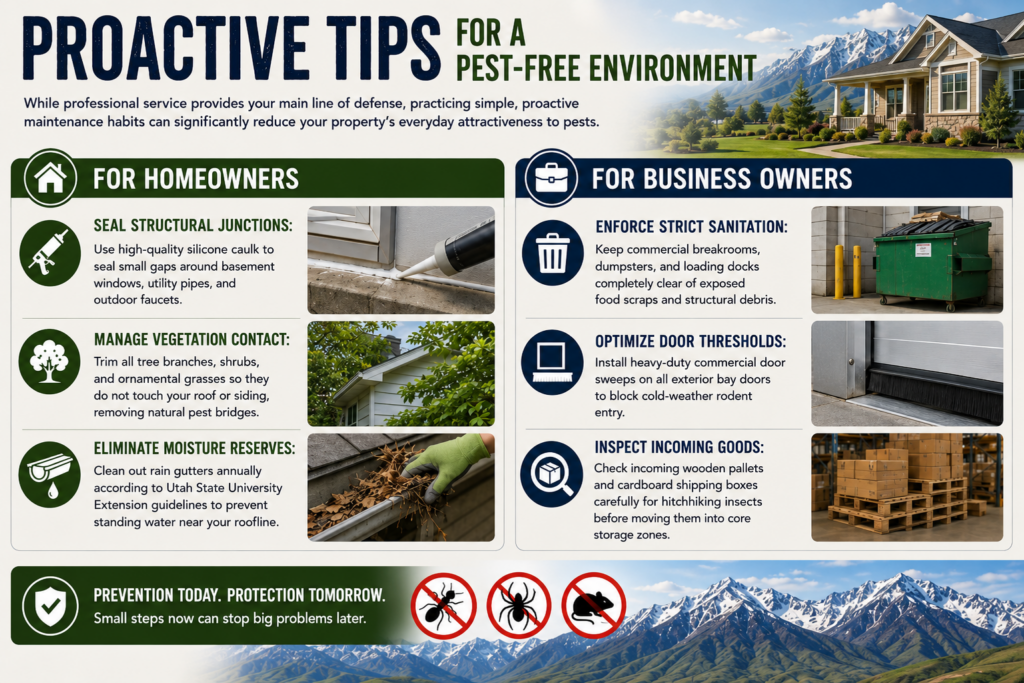
While professional service provides your main line of defense, practicing simple, proactive maintenance habits can significantly reduce your property’s everyday attractiveness to pests.
For Homeowners
- Seal Structural Junctions: Use high-quality silicone caulk to seal small gaps around basement windows, utility pipes, and outdoor faucets.
- Manage Vegetation Contact: Trim all tree branches, shrubs, and ornamental grasses so they do not touch your roof or siding, removing natural pest bridges.
- Eliminate Moisture Reserves: Clean out rain gutters annually according to Utah State University Extension guidelines to prevent standing water near your roofline.
For Business Owners
- Enforce Strict Sanitation: Keep commercial breakrooms, dumpsters, and loading docks completely clear of exposed food scraps and structural debris.
- Optimize Door Thresholds: Install heavy-duty commercial door sweeps on all exterior bay doors to block cold-weather rodent entry.
- Inspect Incoming Goods: Check incoming wooden pallets and cardboard shipping boxes carefully for hitchhiking insects before moving them into core storage zones.
Protect Your Investment
At the end of the day, simple pantry items like vinegar are great for a quick countertop cleanup, but they cannot replace a comprehensive, scientifically backed pest management plan. Leaving your home or business exposed to persistent local pests can lead to costly structural damage, real health risks, and unnecessary frustration. Investing in a professional, locally managed shield is the smartest way to preserve your property’s long-term value and ensure daily comfort.
Don’t let pests take over – Call us today for expert pest control!
Utah’s Favorite Pest Control Company
- Serving Utah Since 1997
- Locally owned and operated
- Top rated with 2,300+ five-star reviews!
- Safer pest control treatment for kids and pets
To find out more about our residential pest control services and commercial pest control services, click the links or visit our Contact Us page and fill out our form or call us at (801) 544-9200.
Frequently Asked Questions
Does vinegar kill ants?
Vinegar can kill individual ants on contact due to its acidic nature, which breaks down their outer skeletal layer. However, it does not act as a colony treatment because it cannot reach the queen or destroy the nest hidden deep underground or within walls. For lasting results, a professional treatment from Utah Beeline is highly recommended.
Does vinegar kill carpenter ants?
No, vinegar will not kill a carpenter ant colony or stop them from boring into your property’s structural wooden framing. Because carpenter ants nest deep inside structural lumber, a topical household spray will never reach the heart of the infestation. Eradicating them requires targeted professional intervention from Utah Beeline to protect your woodwork.
Does vinegar kill sugar ants?
Vinegar will only kill the individual sugar ants that you spray directly on your countertops or floors. It provides no residual protection, meaning the rest of the underground colony will continue foraging inside your home once the scent fades away. Partnering with Utah Beeline ensures a pet-friendly baiting system eliminates the entire colony source.
Does vinegar and water kill ants?
A mixture of vinegar and water will kill exposed foraging ants on contact, but it is entirely ineffective at destroying the hidden nest. The diluted mixture functions primarily as a temporary surface cleaner rather than an actual pest control solution. To eliminate an entire infestation permanently, call the experts at Utah Beeline.
Does vinegar get rid of ants?
Vinegar does not get rid of an ant problem permanently; it merely shifts their movement temporarily by disrupting their surface trails. Once the ants locate an alternate path around the sprayed zone, they will quickly return to your kitchen or business. Utah Beeline offers specialized quarterly plans that keep them away for good.
Does vinegar work better than chemical ant sprays?
While vinegar is a safer, non-toxic cleaner, it does not work better than professional-grade materials because it completely lacks residual clearing power. Over-the-counter retail chemical sprays can also cause colonies to panic and split into multiple nests. Utah Beeline uses advanced, undetectable baits that safely wipe out the entire colony without scattering them.
Does vinegar disrupt ant trails?
Yes, vinegar temporarily disrupts ant trails by overpowering the invisible pheromone tracking scents left behind by scout ants. While this causes the current line of ants to scatter in confusion, it does not stop them from creating a new trail nearby. Professional exterior barriers from Utah Beeline are required to stop them from entering entirely.
Does vinegar repel ants?
Vinegar acts as a very brief, localized repellent purely because of its sharp, intense odor while wet. Once the solution dries and the smell dissipates into the air, its mild repellent properties completely disappear. Lasting protection requires the robust, long-term exterior barriers provided by Utah Beeline’s quarterly service.
Does vinegar keep ants away?
No, vinegar will not keep ants away from your property for more than a few hours at a time. It cannot address the underlying structural entry points or the outdoor nesting sites that drive pests inside during seasonal weather shifts. Securing your perimeter requires the professional tools and expertise of Utah Beeline.
Does vinegar remove ant trails?
Vinegar is an excellent natural cleaning agent for removing the physical pheromone trails that ants use to navigate across indoor surfaces. However, cleaning a single trail does nothing to reduce the population of the active colony breeding behind your walls. Comprehensive elimination requires a professional inspection and treatment from Utah Beeline.
Does vinegar deter ants?
Vinegar deters ants only for the brief window of time that the liquid remains strong and wet on a surface. It provides no long-term structural deterrent and fails to address deep entry cracks or seasonal migration patterns. Utah Beeline specializes in creating true, long-lasting pest deterrents tailored to Utah properties.
Does vinegar stop ants?
Vinegar does not stop ants from invading your home or commercial space; it simply alters their immediate path of travel. The root colony will remain fully active and will continue searching for alternative ways into your kitchen or storage areas. Contact Utah Beeline to safely and effectively stop infestations at the source.
Does vinegar attract ants?
Plain white distilled vinegar does not attract ants due to its highly acidic and pungent aroma. However, certain flavored or sweet apple cider vinegars can occasionally attract curious pests once the initial sharp smell begins to settle. To avoid accidental pest attraction, rely on professional, scent-free barrier techniques from Utah Beeline.
How does vinegar kill ants?
Vinegar kills ants on contact because its high level of acetic acid compromises their protective outer cuticles and dries them out. This contact kill only applies to the few ants you can see, leaving 99% of the underground colony completely unharmed. True colony elimination requires the advanced, deep-reaching baiting systems used by Utah Beeline.
What does vinegar do to ants?
Vinegar neutralizes the chemical scent messages that ants use to talk to one another and navigate through your home. While it isolates individual foraging workers, it does not damage the reproductive capability of the main nest. Trust Utah Beeline to deliver comprehensive treatments that neutralize the entire population safely.
How does vinegar affect an ant’s scent trail?
Vinegar completely masks the scent trail by covering up the delicate pheromone signals with a heavy layer of acidic odor. This breaks the link between the nest and your food sources, forcing the ants to look for new pathways into your home. Utah Beeline permanently removes these invaders by stopping them outside your foundation lines.
How often should I reapply vinegar to keep ants away?
To use vinegar as a daily deterrent, you would need to reapply it to your baseboards and counters multiple times a day as the scent evaporates. This quickly becomes a tedious, ineffective chore that never truly resolves the core pest issue. Save time and energy by letting Utah Beeline install a long-lasting, quarterly barrier instead.
What is the best way to apply vinegar for ant control?
The most common way to apply vinegar is spraying a 50/50 mix of white vinegar and water directly onto visible indoor ant lines. While this helps clean up immediate surface tracking, it will not protect your property’s exterior perimeter from future seasonal pest invasions. For a complete defense, schedule a professional evaluation with Utah Beeline.
Will vinegar prevent ants from coming back?
No, vinegar has zero residual efficacy and will not prevent ants from returning to your living or workspace in the future. Once weather conditions shift or food becomes scarce outside, new colonies will easily find their way in. Utah Beeline provides guaranteed, year-round protection that keeps pests out through every season.
Should I use white vinegar or apple cider vinegar for ants?
White distilled vinegar is preferred for basic surface cleaning because its higher acidity disrupts pheromone tracking lines slightly better. Apple cider vinegar contains trace residual sugars that could inadvertently draw specific foraging pests once the initial sharp smell begins to settle. For certain, professional results without any guesswork, call Utah Beeline today.