Pest Control in Provo, Utah

Provo, Utah was settled in 1849, which makes it one of the oldest cities we work in, and it shows. Mature street trees, houses built when Eisenhower was president, and a city where roughly six in ten housing units are rented rather than owned. Utah Lake sits west, the Provo River cuts through, and the Wasatch comes down hard at Rock Canyon. All of it lands in our service records. Beeline has serviced Utah homes for more than 25 years, and 2,646 of those appointments were in Provo.

What 2,646 Provo Appointments Actually Show

First, what these numbers are. They come from our own service records: 2,646 Provo appointments measured against the rest of our Utah work, with every ranking drawn from the 36 cities where we log enough volume for a fair comparison. It is a record of what people call us about, not a census of the local insect population.

Spiders, wasps, ants, and mice are the bulk of what we treat everywhere in Utah. The interesting part is where Provo pulls away:

    • Elm seed bug calls: Run nearly twice the rest of our service area, putting Provo in the top five among the cities we service at volume.

    • Snail calls: Run about two and a half times higher, also top five on that list.

    • Centipede calls: Run roughly a third above average, top ten on the same list.

    • Mice: Are a bigger share of our Provo work than in most cities, top ten of the 36 cities.

Then the absences. Vole calls run about a third of our service-area rate, and rat calls a little over a third, which is odd for a city this old and this dense. Ants are the real surprise: Provo has the second-lowest ant share of any city we service at volume.

What Provo actually calls us about Share of pest codes logged across 2,646 Provo service appointments, compared with the rest of our Utah service area. The multiple on the right is how many times more, or less, of the Provo mix each pest is. These are our service records, not a survey of the local insect population.
Provo Rest of our Utah service area

Scroll the chart sideways to see the full scale →

Share of Beeline service calls by pest: Provo vs. the rest of our Utah service areaProvo runs higher on elm seed bugs, snails, centipedes and mice, and lower on ants, box elder bugs, rats and voles.0%10%20%30%Spiders37.4%32.0%· 1.17×Wasps15.8%16.8%· 0.94×Mice13.1%10.6%▲ 1.24×Ants9.5%13.7%▼ 0.69×Box elder bugs6.7%10.2%▼ 0.66×Elm seed bugs5.3%2.8%▲ 1.90×Snails1.1%0.4%▲ 2.52×Rats0.8%2.2%▼ 0.38×Voles0.7%2.0%▼ 0.35×Centipedes0.5%0.3%▲ 1.37×Aphids0.2%0.3%▼ 0.60×

Key Observations: Two primary drivers account for most of this mix: the age of Provo’s street canopy and housing stock, and who lives in them (high student/renter turnover).

Elm Seed Bugs: The Bill for a Beautiful Canopy

This is the clearest signal Provo has. Elm seed bugs are 5.3 percent of our Provo pest codes against 2.8 percent across the rest of our service area, fifth among the 36 cities we service at volume.

Trees almost certainly explain it. USU Extension describes the elm seed bug as an invasive first detected in Utah in 2014, and it breeds on elm seed. Provo has been a Tree City USA for 42 years and maintains more than 13,000 street trees. The older neighborhoods north and east of downtown, including the Tree Streets below Rock Canyon, were largely built out in the 1950s and 1960s. Seventy-year-old street trees are the host material this bug wants.

Why They Get Inside, and Why Old Windows Lose

Box elder bugs are a fall pest. Elm seed bugs are not. USU puts peak nuisance activity from mid-June through August, when the bugs leave the trees in the heat looking for somewhere cooler. They come in through windows and doors, especially where weather stripping has given up. A 1958 house with original sliders and a swamp cooler pulling air is a doorway. Then there is the smell: crush one and you get a sour odor that lingers.

Preventative Action: Seal windows facing mature trees, fit door sweeps, screen all exterior vents, and apply a perimeter foundation treatment before mid-June rather than after.

Spiders and Mice: What an Old Rental City Calls About

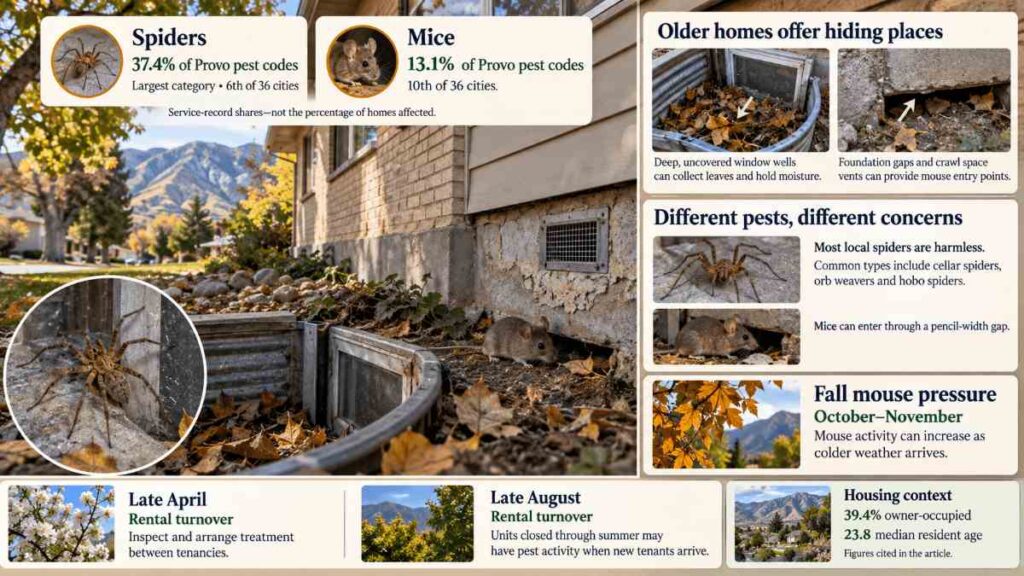
Spiders are 37.4 percent of our Provo pest codes, the biggest single category here and the sixth-highest share among the 36 cities we service at volume. Mice are 13.1 percent, tenth on that list.

The housing stock probably has a lot to do with it. Census figures put Provo’s owner-occupied rate at 39.4 percent and the median resident age at 23.8, and BYU alone enrolls more than 30,000 students. Renters call about what alarms them, and a spider in the shower alarms people. They call less often about the slow structural problems an owner chases down.

Provo’s spiders are overwhelmingly harmless: hobo spiders, cellar spiders, orb weavers on eaves and in window wells. The wells matter, because mid-century basements have deep, often uncovered ones that fill with leaves and hold moisture. Mice are a different old-house problem. A mouse needs a gap the width of a pencil, and seventy-year-old foundations and crawl space vents offer plenty. Pressure builds hard in October and November.

The Turnover Problem

Much of this housing changes occupants at the end of April and again in late August, and a unit that sat closed up through the summer greets its new tenants with company. In our experience the cleanest fix is treating between tenancies, not after the complaints start.

Spiders and mice what an old rental city calls about

Snails and Centipedes: The Damp Corners of a Mature Yard

Snail calls run about two and a half times our service-area rate, fourth among the 36 cities we service at volume. Centipede calls run roughly a third above average, eighth on that list. The counts behind both are modest, so read them as a tilt rather than an emergency.

Both want the same conditions. USU Extension notes that snails and slugs need moisture and spend daylight hidden under plants, rocks, wood, and compost. Provo yards supply that generously: seventy years of accumulated shade, deep established beds, thick groundcover, and a water table sitting high on the west side toward Utah Lake and the Provo River bottoms. Centipedes follow the same logic indoors, hunting insects in old basements and crawl spaces.

Both answer to drainage as much as to treatment: pull mulch off the foundation, reduce night watering, and thin groundcover against the house.

The Pests Provo Mostly Escapes

    • Voles: Represent about a third of our service-area rate, well down the list of the 36 cities we service at volume. Voles move in when pasture and hayfield become subdivision, the Syracuse, Clinton, and Park City story. Provo finished that conversion decades ago.

    • Rats: Also represent about a third of our rate, in the bottom third of the 36 cities, which surprises people because Norway rats like old, dense, plumbing-heavy cities and Provo is one. In our records rat pressure concentrates in the Salt Lake valley: Holladay, Millcreek, and Salt Lake City all run high and Provo does not.

    • Ants: Represent the second-lowest share of any city we service at volume, 9.5 percent here against 13.7 percent elsewhere. When spiders and mice take up as much of a city’s calls as they do here, everything else is a smaller slice of the same pie.

    • Box Elder Bugs: Represent two-thirds of our service-area rate, against the rule that old towns get them worst. They need female seed-bearing boxelder trees, and boxelder is a volunteer of river bottoms and fence lines more than a planted street tree. Provo’s old canopy is a planted one.

What About Utah Lake and the Provo River?

Not what people expect: Provo mosquito calls run below our service-area average, not above it.

The Utah County Mosquito Abatement District works the source, treating standing water, truck spraying most summer nights between 9 p.m. and 1 a.m., and running drones over wetlands hard to reach on foot. What it does not do is treat your yard. Mosquitoes that drift in rest by day in shade on your property, under the deck and inside dense shrubs. Getting bitten in your own backyard at dusk is a harborage problem, and that one is ours.

A Provo Pest Control Calendar

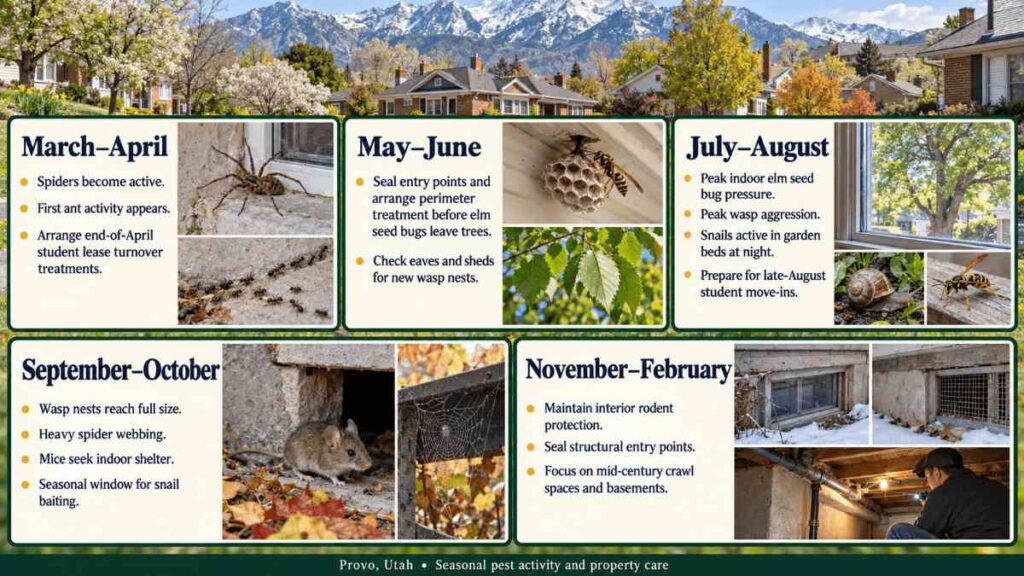
March – April: Spiders wake up; first ant activity appears; end-of-April student lease turnover treatments.

May – June: Seal and treat perimeters before elm seed bugs leave trees; wasp nests begin forming on eaves and sheds.

July – August: Peak elm seed bug pressure indoors; peak wasp aggression; snails active in beds at night; late-August student move-in turnarounds.

September – October: Wasp nests reach full size; heavy spider webbing; mice press indoors; optimal month to bait snails.

November – February: Interior rodent protection and structural exclusion, focusing on mid-century crawl spaces and basements.

A provo pest control calendar

Why Provo Homeowners, Landlords and Property Managers Call Beeline

We run Provo on a regular route, so you are not waiting on a truck dispatched from the other end of the state. We are here most weeks, our technicians know what these yards and old basements produce, and 2,646 completed appointments is the proof. Much of Provo property is tenanted and some owned from out of state, so we can service between tenancies and work with your property manager.

Beeline is locally owned, office based in Clearfield, more than 25 years in Utah, 2,300+ five-star reviews, with no hidden charges. Our quarterly service covers everything on this page, and if something comes back between visits, so do we.

Get a Free Quote: Call (801) 544-9200 or text us at (385) 425-1766.

Provo Homeowners, Landlords and Property Managers pest control questions we actually get asked

What are the red and black bugs all over my window frames in July?

Almost certainly elm seed bugs, about a third of an inch long with a black triangle set inside two rusty red triangles. They breed on elm seed, and USU Extension puts peak season from mid-June through August. Provo is fifth for them among the cities we service at volume. Try not to crush them: the smell is the worst part.

My parents in Bountiful get box elder bugs every fall and I barely see them. Why?

Different trees. Box elder bugs need female seed-bearing boxelder trees, which tend to be volunteers along river bottoms and fence lines rather than planted street trees, and Provo’s canopy is mostly planted. Our box elder bug call share here is about two-thirds of our rate elsewhere, while Bountiful’s is near the highest of the cities we service at volume.

Provo is old and dense. Why do you say rats are not a big problem here?

Because our records say so. Rat calls here are roughly a third of our service-area rate, putting Provo in the bottom third of the 36 cities we compare. In our work rat pressure concentrates in the Salt Lake valley, where Holladay, Millcreek, and Salt Lake City all run high.

I own a Provo rental. When should it be treated?

Between tenancies, in the gap at the end of April or in August, rather than after your new tenants call you. The unit that sat closed up through the summer is the one producing complaints in week two, and that gap is the only window when a technician can work the whole place without scheduling around anybody.

The mosquito abatement district sprays my street. Do I still need mosquito service?

Possibly not. Provo mosquito calls run below our service-area average, unusual for a city this close to a lake. The Utah County Mosquito Abatement District treats standing water and runs truck and drone spraying all summer. If you are still bitten in your own yard at dusk, that is adults resting in your shrubs and under your deck.

I keep finding snails in my flower beds. Is that a Provo thing?

More than you would guess. Snail calls here run about two and a half times our service-area rate, fourth among the cities we service at volume, and Provo’s Utah County neighbors run high too. Mature shade, established beds, and generous watering are what they want. Bait in fall.

Do you service the student housing near campus?

Yes, including Joaquin and the blocks off 900 East and University Avenue. Shared walls mean one unit’s mice or bed bugs become everybody’s, and turnover resets the clock twice a year, so we work with owners on whole-building schedules rather than unit by unit.