Pest Control in Payson, Utah

Pest control in payson, utah

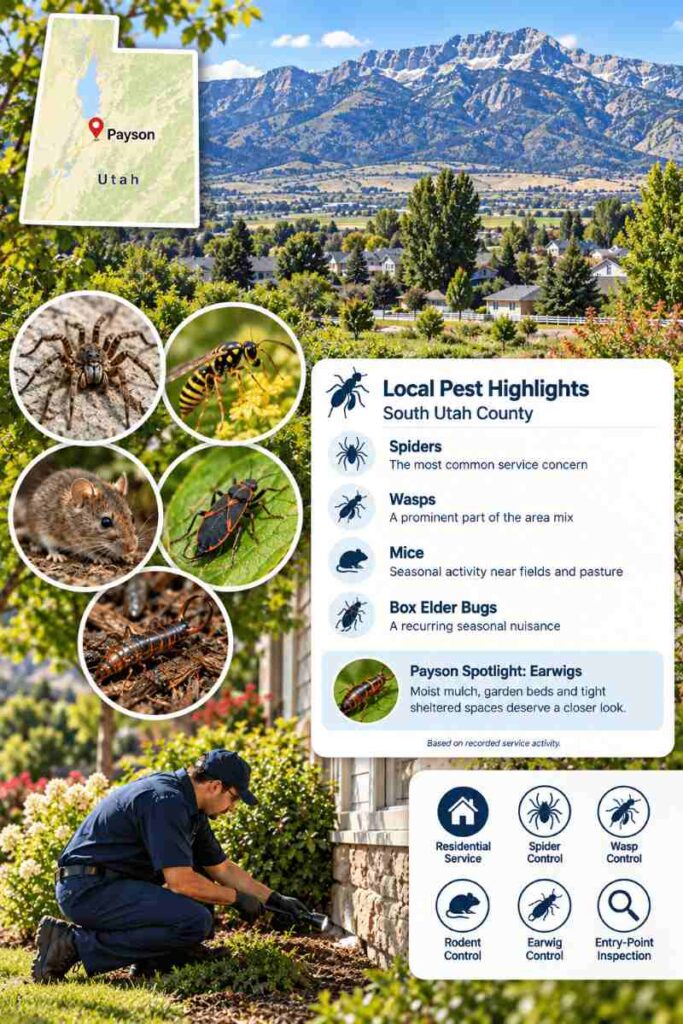
Payson, Utah sits at the south end of Utah Valley, under Mount Nebo, where the subdivisions thin out and the orchards start.

We are already down here. Our records carry 397 Payson appointments, and the route keeps going: Spanish Fork, Springville, Mapleton, Salem, Santaquin, Elk Ridge, and Woodland Hills are all on it. Our office is in Clearfield and we are not going to pretend otherwise. What we will tell you is that the south end of the county is scheduled, not squeezed in.

Because Payson Sits Further Out, We Look at the Whole South End of the Valley

Payson by itself gives us 397 appointments carrying 444 logged pest codes. That is enough to tell you what we actually treat in town. It is not quite enough to build stable rates on, and we would rather say so than dress up a thin number.

So the data below covers south Utah County: Springville, Spanish Fork, Payson, Mapleton, Santaquin, Salem, Elk Ridge, Woodland Hills, Genola, Goshen, and Benjamin. That pool is 2,477 service appointments carrying 2,741 pest codes. Everything that follows is area data, and it is labelled that way every time it appears.

What south Utah County actually calls us about Area data, not Payson alone. Share of pest codes logged across 2,477 service appointments in south Utah County, compared with the rest of our Utah service area. We pool the area because Payson on its own is too small for reliable rates. The multiple on the right is how many times more, or less, of the area mix each pest is. These are our service records, not a survey of the local insect population. South Utah County here means Springville, Spanish Fork, Payson, Mapleton, Santaquin, Salem, Elk Ridge, Woodland Hills, Genola, Goshen and Benjamin.
south Utah County (area data) Rest of our Utah service area

Scroll the chart sideways to see the full scale →

Share of Beeline service calls by pest: south Utah County vs. the rest of our Utah service areaAcross south Utah County, wasp calls run about a third above our rest-of-area rate, while rats, elm seed bugs, mosquitoes and ants all run well below it. Rats are the widest gap, at about one sixth of our rest-of-area rate.0%10%20%30%40%Spiders32.9%32.1%· 1.03xWasps21.8%16.7%▲ 1.31xMice13.0%10.6%· 1.23xBox elder bugs11.2%10.1%· 1.11xAnts8.9%13.7%▼ 0.65xEarwigs3.5%3.0%· 1.17xElm seed bugs1.3%2.9%▼ 0.45xMosquitoes0.4%0.8%▼ 0.58xAphids0.4%0.3%▲ 1.45xRats0.4%2.2%▼ 0.17xCrickets0.3%0.1%▲ 3.31x

Key Observations: Four pests that drive heavy call volume across the rest of our Utah service area barely register in south Utah County: rats, elm seed bugs, mosquitoes, and ants all run significantly below regional averages.

The Interesting Thing About Down Here Is What You Do Not Get

Most pest control pages tell you what is crawling on your house. The honest headline for south Utah County is the other direction. Four of the pests that drive calls across the rest of our service area barely register here.

Rats are 0.36% of the area mix, on 10 logs across 2,741 pest codes. Across the rest of our Utah service area they run 2.19%. That is 0.17 times the rate, and it is the widest gap in either direction in this area’s data. Elm seed bugs run 0.45 times, on 36 logs. Mosquitoes run 0.58 times, on 12 logs, which is a thin count and we will say so rather than lean on it. Ants run 0.65 times, on 244 logs, and that one is well supported.

Our read is density and age of housing, not luck. According to USU Extension, Norway rats nest in ground burrows, very commonly under concrete slabs, and favor low-growing vegetation and rock piles, with dumpsters and accessible food driving the pressure. That is a description of an older, tighter, more commercial streetscape than most of south Utah County has. Elm seed bugs follow the same logic from a different direction: USU Extension notes they gather in and around buildings where elm seeds have accumulated, and mature elm canopy is thinner south of Spanish Fork than it is in the hundred-year-old neighborhoods up north.

Practically, it means a south valley home usually does not need the heavy rodent exclusion work that a Salt Lake City or Ogden home does. We will tell you that on site rather than sell it to you.

What We Do Treat Here, in Order

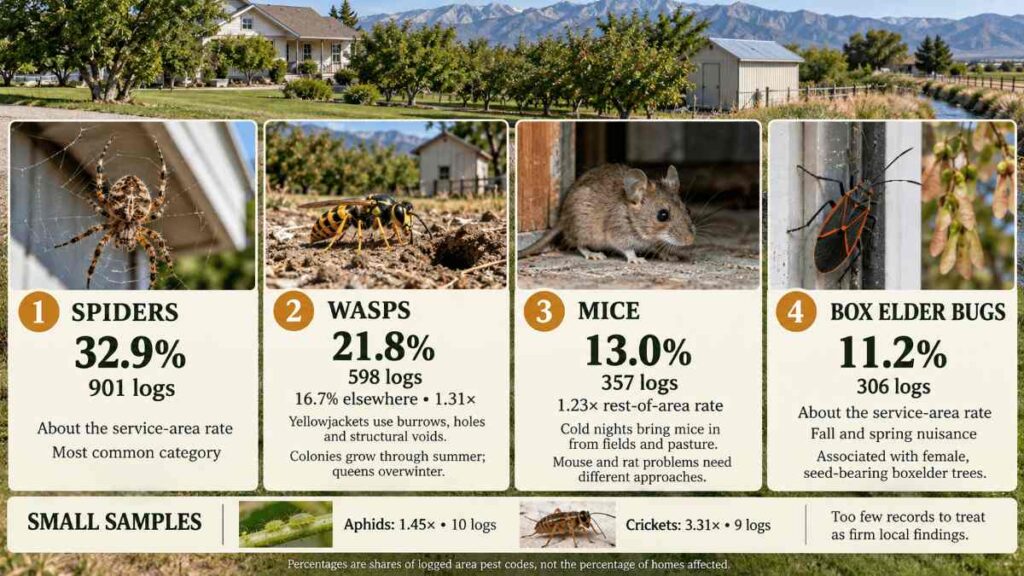
    • Spiders: Represent 32.9% of the area mix, on 901 logs. That is about the same as everywhere else we work, and it is the single most common thing anyone in Utah calls a pest company about.

    • Wasps: Represent 21.8% of the area mix, on 598 logs (against 16.7% across the rest of our service area, 1.31 times the rate). Wasps are the second most common call down here by a clear margin. USU Extension notes that western yellowjackets nest in old rodent burrows, holes, and structural voids, that colonies grow through the summer and die off every fall, and that the queens overwinter to start again in spring. Open ground, canal banks, outbuildings, and orchard edges give them more harborage than a dense subdivision does.

    • Mice: Represent 13.0% of the area mix, on 357 logs (1.23 times our rest-of-area rate). Mice and rats are not the same problem. Mice come in from fields and pasture when the nights turn cold. Rats need the kind of permanent urban harborage this area mostly does not have.

    • Box Elder Bugs: Represent 11.2% of the area mix, on 306 logs, right about the service area rate. These are a fall and spring nuisance driven by female boxelder trees rather than anything about your house.

Two more rows sit above the service area rate and both are too thin to build on: aphids at 1.45 times on 10 logs, and crickets at 3.31 times on 9. We mention them for completeness and we are not going to call either one a finding.

What we do treat here, in order 


Payson’s Own Numbers

Of the 444 pest codes logged inside Payson:

    • Spiders: 173 logged calls

    • Wasps: 87 logged calls

    • Box Elder Bugs: 46 logged calls

    • Mice: 39 logged calls

    • Ants: 32 logged calls (7.2% of city total vs 13.6% regional average)

    • Earwigs: 26 logged calls (5.9% of city total vs 3.0% regional average)

The one city-level number that stands out is earwigs. 26 of Payson’s 444 pest codes are earwigs (5.9% of what we log in town against 3.0% across the rest of our service area). USU Extension describes European earwigs as hiding in dark, tight, and moist places during the day and congregating where they find that shelter. Irrigated yards against dry ground, heavy bark mulch, and garden beds will do it.

Why South Utah County Homeowners Call Beeline

Locally owned, 25+ years in Utah, more than 2,300 five-star reviews, no hidden charges. We quote the price before we start, and there is no surcharge for being at the south end of the valley. If something comes back between services, we retreat it free.

Get a Free Quote: Call (801) 544-9200 or text us at (385) 425-1766.

Payson pest control questions we actually get asked

Do you actually come to Payson, or do I wait until somebody is down this way?

We run the south end of the valley on a regular route. Across the area we have logged 2,477 appointments, 397 of them inside Payson. You are on the schedule rather than an exception to it.

Is it more expensive down here than in Provo or Salt Lake?

No. Same pricing, and no travel or fuel charge for Payson, Santaquin, Salem, Spanish Fork, Mapleton, Elk Ridge, or Woodland Hills. These towns sit on an established route, not a special trip.

Should I be worried about rats in Payson?

Based on our records, far less than you would be further north. Rats are 0.36% of every pest code we log across south Utah County, on 10 calls out of 2,741, against 2.19% across the rest of our service area. We still check for them, because a barn or a feed shed can change the answer on one property. We just do not sell rodent exclusion here as though it were a given.

Why do we get so many wasps?

Our area data puts wasps at 21.8% of every pest code on 598 calls, 1.31 times our rest-of-area rate. USU Extension notes that western yellowjackets nest in old rodent burrows, holes, and structural voids and that colonies build all summer. Open ground, canal banks, and outbuildings supply more of that than a tight subdivision.

When is the right time to treat for wasps?

Spring, before the colony is big. Queens overwinter and start new nests each spring, and a nest knocked down in May is a ten-minute job. The same nest in August is a full treatment and a bad afternoon.

I have earwigs in the garden beds every year. Is that a house problem?

Usually a moisture and mulch problem first. Earwigs want dark, tight, and damp cover during the day, so deep bark right against the foundation, a drip line that runs long, and plant debris at the wall are what keep them there. Pull the cover back off the foundation and the treatment lasts a lot longer.

Do you treat orchards, outbuildings and shops?

Sheds, shops, detached garages, and barns are where a lot of the pressure starts down here, so yes, tell us what is on the property when you book and we will walk it. We are a structural pest company rather than a commercial orchard applicator, so for a producing orchard we will be straight with you about what we do and do not cover.

Trusted by Utah for over 29 years – Proven Pest Control with Guaranteed Results