

Key Takeaways
- Multifamily and rental property pest control has to account for multiple units, shared common areas, and varying occupancy, which means it works differently than a single-family plan even when the same company handles both.
- The guarantee only covers a building fully when every unit gets treated; one skipped unit can undermine coverage for the rest.
- Liability, documentation, and coordinating tenant access matter here in a way they simply do not for a homeowner, and this guide walks through all of it.
Introduction
Picture two callers on the same day. One is a homeowner with an ant trail on the kitchen counter. The other manages a 60-unit apartment complex, three tenant complaints this month, and an owner who wants proof pest issues are handled, not hoped away. Almost everything written about pest control online is aimed at the first caller.
That leaves a real gap for the second one. A property manager is managing liability, lease compliance, and a building’s reputation across dozens of units at very different stages of occupancy. This guide is built for that reader: how commercial pest control works across a property, how the guarantee and scheduling apply at a building level, what pricing looks like once it is not one house, and how to get started. Beeline Pest Control Utah put this together because property managers deserve better than a homeowner article with the word commercial pasted on top.
How Commercial Pest Control Is Different for Rental and Multifamily Properties
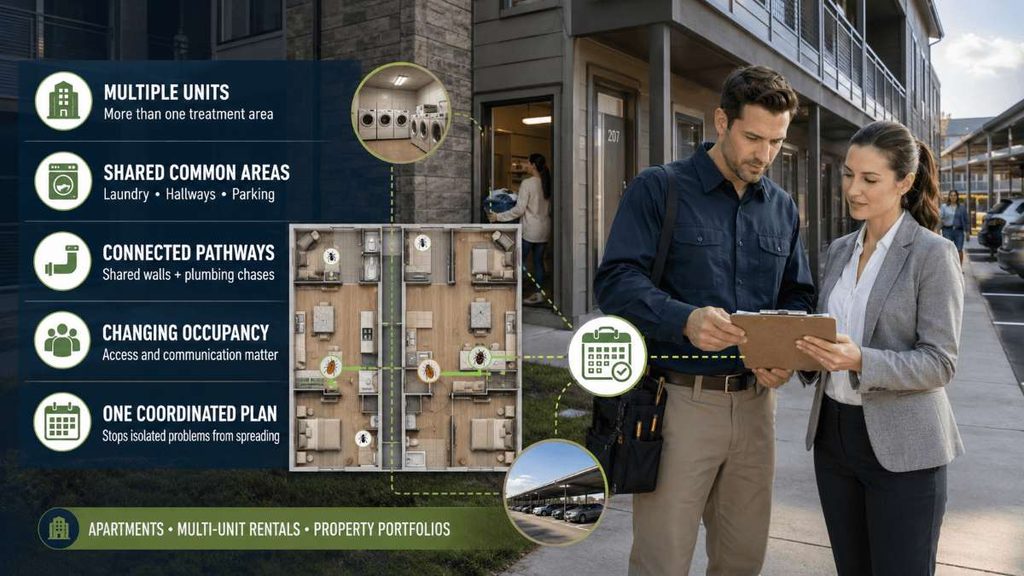
A single-family quarterly plan treats one property, one point of contact, one set of walls. Multifamily service has to account for multiple units, shared common areas like laundry rooms and parking structures, and occupancy that shifts constantly. There is also a reality a single house never deals with: a pest problem in one unit rarely stays there; ants and cockroaches travel through shared walls and plumbing chases in ways they cannot between two houses. Take a homeowner plan, make it bigger, call it commercial service, and you have missed most of what matters.
This applies to apartment complexes, multi-unit rental properties, and portfolios run by a property management company or a landlord with more than one unit. Homeowners associations and townhome communities come up too, but deserve their own dedicated guide.
Does the Guarantee Cover an Entire Apartment Building
Our standard guarantee applies fully to a multi-unit building when every unit gets treated. Skip even one, whether a tenant declined access or a vacant unit slipped through, and pest activity there can work its way back into units treated correctly, undermining coverage for the whole building. Our guarantee article covers the full terms; the logic that matters here is that a building-wide guarantee runs on building-wide treatment, not on one that simply covers more square footage.
How Does Scheduling Work Across Multiple Units
The same roughly 90-day quarterly rhythm used for homeowners applies here, just coordinated across an entire property instead of one household. What changes at that scale is coordination. Instead of one household confirming one visit, a technician works through a schedule of individual units, and a few will not be reachable if a tenant is not home or never responded. Ask directly how notification and rescheduling work at the unit level, worth confirming before you sign, since it determines whether unreachable tenants ever hold up service to the rest of the building.
What Liability and Compliance Considerations Should Property Managers Know About
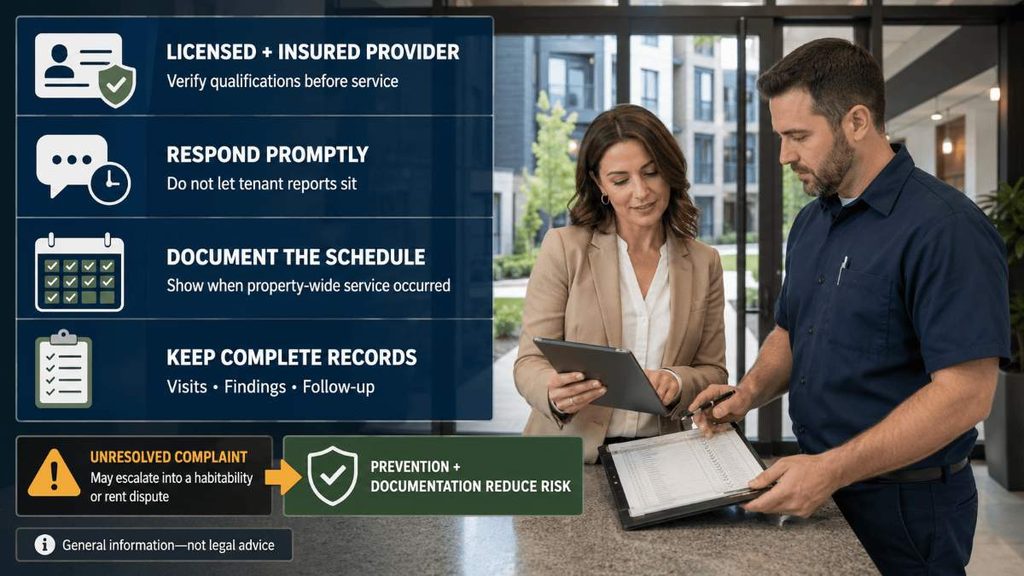
This is territory a homeowner never has to think about. Licensed, insured pest control matters because an unresolved problem can turn into the property owner’s legal exposure the moment a tenant is affected; a pest complaint that sits too long can become a rent withholding dispute or a habitability complaint filed with the city. The National Apartment Association lists pest management among the baseline maintenance standards residents expect from a well-run building, which is why a documented, property-wide schedule matters more than a reactive one: calls placed unit by unit only after complaints roll in, leaving no record that anything happened on schedule rather than in reaction to a problem. None of this is legal advice; it is simply why this decision deserves more scrutiny than picking whichever company answers first.
How Much Does Commercial Pest Control Cost for Multi-Unit Properties
Our cost guide covers what drives a single-family quote: square footage, severity, and access. That logic does not disappear here; it is just not the whole story. Multi-unit pricing typically gets structured differently, often per unit, per building, or across a portfolio, with volume affecting the rate. Ask directly how pricing works for a property your size before assuming a homeowner range applies.
How Does Treatment Work Around Occupied Units and Tenants
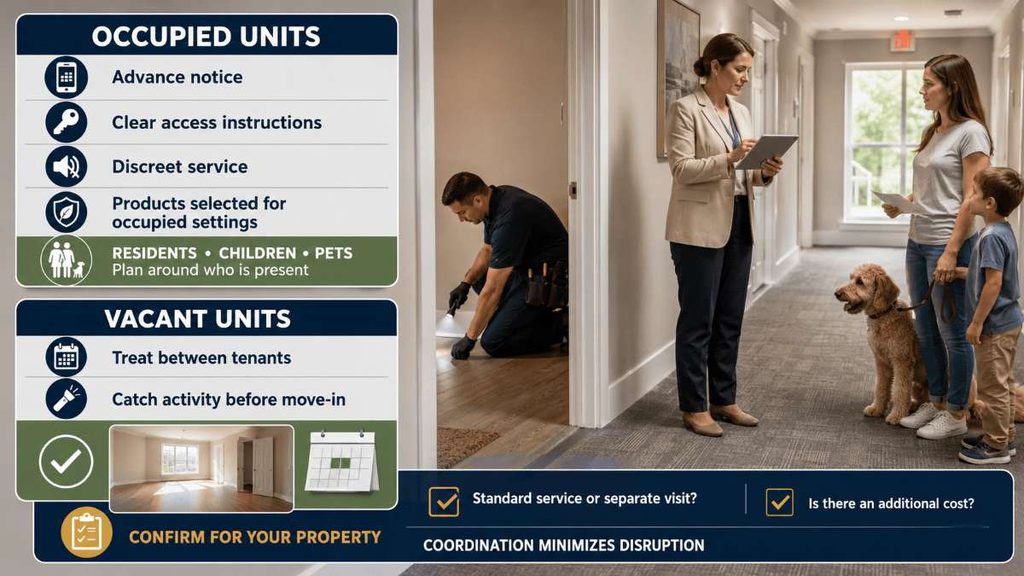
Notice matters more here than almost anywhere else in this guide. Tenants should know a visit is coming, understand access for their unit versus shared common areas, and trust that whatever gets used is safe around residents, pets, and kids included. This is our minimum inconvenience approach in action: coordinated notice, discreet work, and products chosen with an occupied building in mind.
That same coordination matters when a unit sits empty. A vacant stretch between tenants is one of the best, and most overlooked, moments to schedule service, catching a problem before a new tenant ever notices rather than after move-in. Ask whether this fits your account as standard or gets scheduled separately, what that structure is, and whether it carries its own cost, is worth confirming for your property.
What Documentation Should You Keep or Request
Two things belong in your files, tied to the liability point above: proof of current licensing and insurance, and a service record showing when each unit and common area was last treated. Holding onto both yourself, rather than trusting they live in a vendor’s system, is a reasonable ask of any provider, and it is the paper trail this guide has been building toward.
How Do You Get Started With Commercial Pest Control in Utah
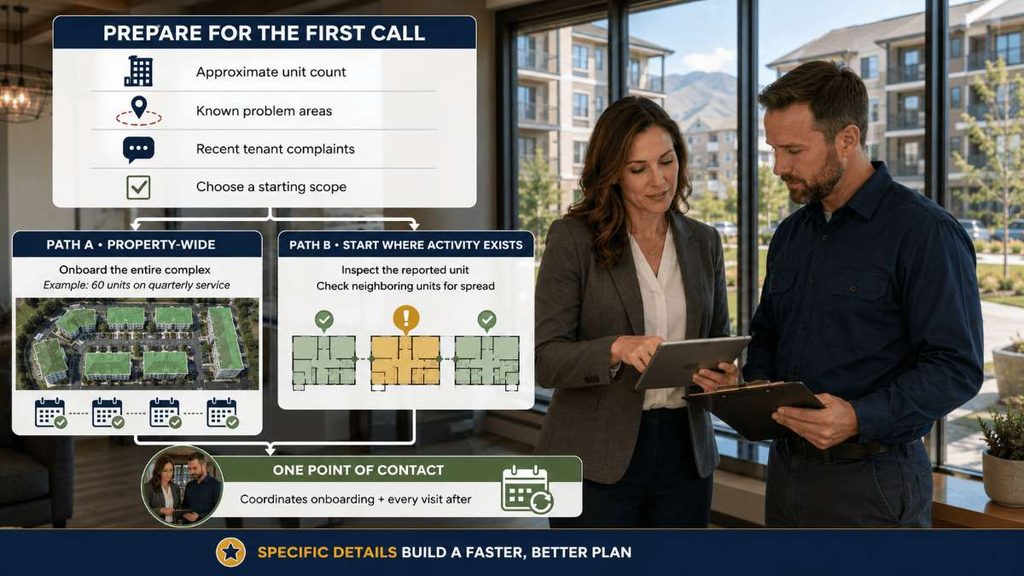
With that documentation habit in mind, getting started is just as straightforward. Come to that first call with a few things ready: an approximate unit count, known problem areas or recent complaints, and whether you want the whole property onboarded at once or would rather start with units already showing issues. The more specific you are, the faster you land on a plan built for your property.
A 60-unit complex, the kind we opened with, might onboard quarterly service property-wide from the start. A manager fielding one cockroach complaint might begin there instead, only to discover the same activity in two neighboring units once checked, exactly why treating a single unit rarely tells the whole story. Either way, one point of contact coordinates your account from onboarding through every visit after.
Expert Tips
Keep your own written service schedule on file; do not rely on your vendor’s records alone. Bring your leasing team into the loop on notice requirements early. And treat a pest complaint as a building-level signal, not just a unit-level one.
Conclusion
A homeowner article with the word commercial pasted on top was never going to answer what keeps a property manager up at night: who is liable, what is documented, and whether a schedule holds up under real occupancy. Those questions deserve real answers, and now you have them. The next step is simple: a conversation about your property, not a form filled out blind.
Ready to talk about pest control for your property? Request a commercial consultation from Beeline Pest Control, and we will build a plan around your building, not a generic one.
Frequently Asked Questions
Can a portfolio with properties in different cities be managed under one account?
Yes, common for management companies with holdings across the Wasatch Front, coordinated under one point of contact even as each property gets scheduled around its own units.
What happens if a tenant refuses access for their unit?
That unit gets skipped for the visit, which is why guarantee coverage depends on full building treatment. If a tenant stays consistently unavailable, loop in your leasing team early.
Is there a minimum unit count to qualify for commercial pricing?
Not really; even a duplex counts as a multi-unit property. What changes with size is how the account gets structured, not whether you qualify.
How quickly does a new complaint in an occupied unit get addressed outside the regular schedule?
It gets treated as a priority call rather than queued behind the next scheduled visit, since waiting would defeat the purpose of catching a problem early.
Is an inspection or service report provided for a property manager’s own files?
Yes, a service record showing what was treated and when comes with each visit, worth keeping on hand yourself too.
Does the guarantee apply differently to common areas than to individual units?
Common areas count as part of a fully treated building the same as any unit, scheduled alongside unit by unit service.
Can we start with just the units that have active problems instead of the whole property?
Yes, though full guarantee coverage still depends on eventually treating every unit.
Are the products used safe for buildings with families, pets, or medically sensitive residents?
Yes, the same pet and kid safe standard applies in a multifamily setting as in any home. Flag specific sensitivities when you schedule.
Who is our point of contact once service is set up?
A single, consistent point of contact is standard here, coordinating scheduling and communication so you are not repeating your property’s history to someone new each visit.
How is this different from the pest control our maintenance team already handles?
Routine maintenance response is reactive. A scheduled, property wide plan works the other way, catching problems before they spread between units or turn into a lease dispute, with documentation a maintenance log never provides.
Next: Why Wasp Nests Peak in Late Summer Along the Wasatch Front