
Key Takeaways
- Summer Activity Peak: Utah scorpions are highly temperature-dependent, reaching their absolute peak of activity during the scorching summer months of July and August.
- Strictly Nocturnal Habits: These arachnids hide in dark, cool crevices during the day to prevent dehydration and emerge exclusively after dark to hunt insect prey.
- Species and Geography: While the highly venomous Arizona Bark Scorpion is strictly confined to extreme Southern Utah, the native Northern Scorpion is common along the Wasatch Front.
- Why Traditional Treatments Fail: A thick, waxy outer cuticle shields scorpions from retail surface sprays, necessitating professional-grade microencapsulated barrier solutions.
- Continuous Defensive Strategy: Shifting from emergency treatments to a systematic quarterly pest management framework prevents pest infestations across all seasonal transitions.
Taking Back Your Yard from Utah’s Toughest Pests
The Seasonal Shift of Utah’s Toughest Pests
Utah is famous for its stunning four-season climate. We get beautiful snowy winters that blanket the Wasatch Front, followed by blazing summer heat that bakes our valleys. But while we are out enjoying the mountain air, local pests are constantly shifting their behavior to survive the elements. When the winter snow melts and the summer heat turns up, certain pests emerge with a vengeance. Among the most resilient and unnerving of these are scorpions.
For homeowners trying to keep their kids and pets safe, or business owners protecting their commercial reputation, a scorpion sighting can cause instant panic. Whether you are running a restaurant in downtown Salt Lake City or raising a family in a quiet Provo neighborhood, understanding when these prehistoric-looking pests are active is the first step to keeping them out. When searching for reliable Pest Control Utah, property owners need a partner who understands exactly how our local climate influences pest behavior. That is where Utah Beeline steps in with localized, experienced expertise.
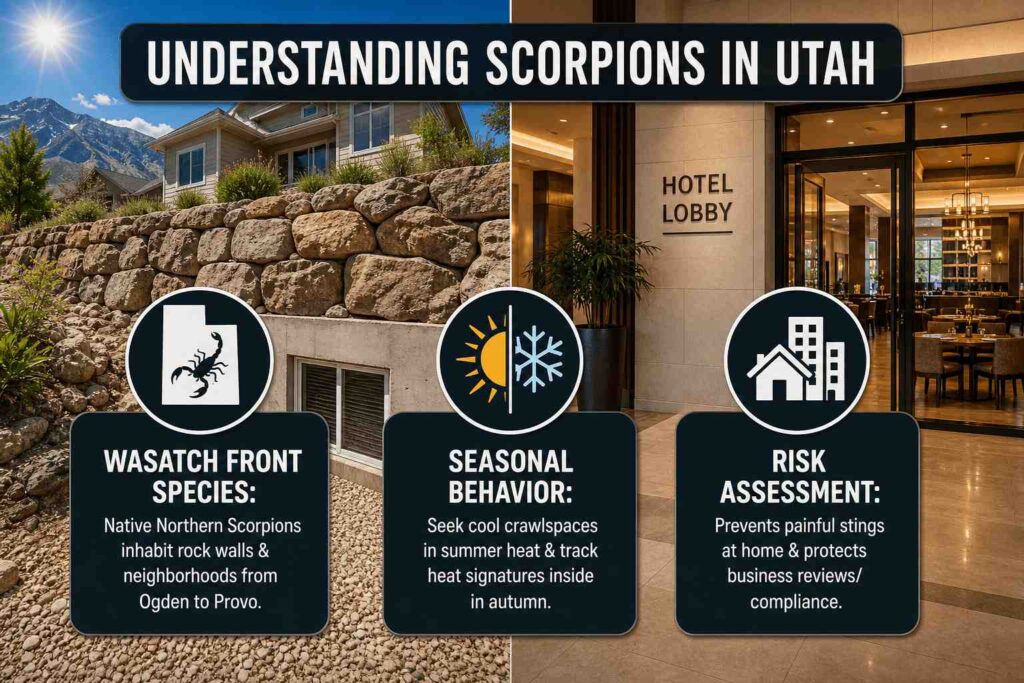
While many people associate scorpions exclusively with the deep southern deserts, Utah has its fair share of native populations. The Northern Scorpion (Paruroctonus boreus) is found throughout parts of the state, frequently making appearances in rock walls, construction zones, and established neighborhoods in Provo, Ogden, and the Salt Lake Valley. Conversely, the medically significant Arizona Bark Scorpion is restricted entirely to extreme Southern Utah around St. George.
Our distinct seasons dictate exactly how these arachnids interact with human structures:
- Spring and Summer: The extreme summer heat drives scorpions to look for cool, damp places to hide during the day, which often brings them straight into crawl spaces, basements, and commercial air-conditioned properties.
- Fall and Winter: As the crisp autumn air takes over, scorpions look for warm overwintering sites, tracking internal heat signatures right through cracks in foundations or gaps under exterior doors.
The risks they pose depend entirely on your property type:
Residential vs. Commercial Risk Vulnerabilities.
For Homeowners: The primary concern is safety. A sting from a native Northern Scorpion is painful often compared to a severe hornet sting and poses a genuine threat of allergic reactions to small children, elderly family members, and curious household pets.
For Business Owners: A single scorpion spotted by a customer in a restaurant, hotel, or retail store can instantly destroy a business reputation built over decades. It can lead to severe online reviews, health department complications, and immediate revenue loss.
The core question most property owners ask is simple: When do I actually need to worry about scorpions?
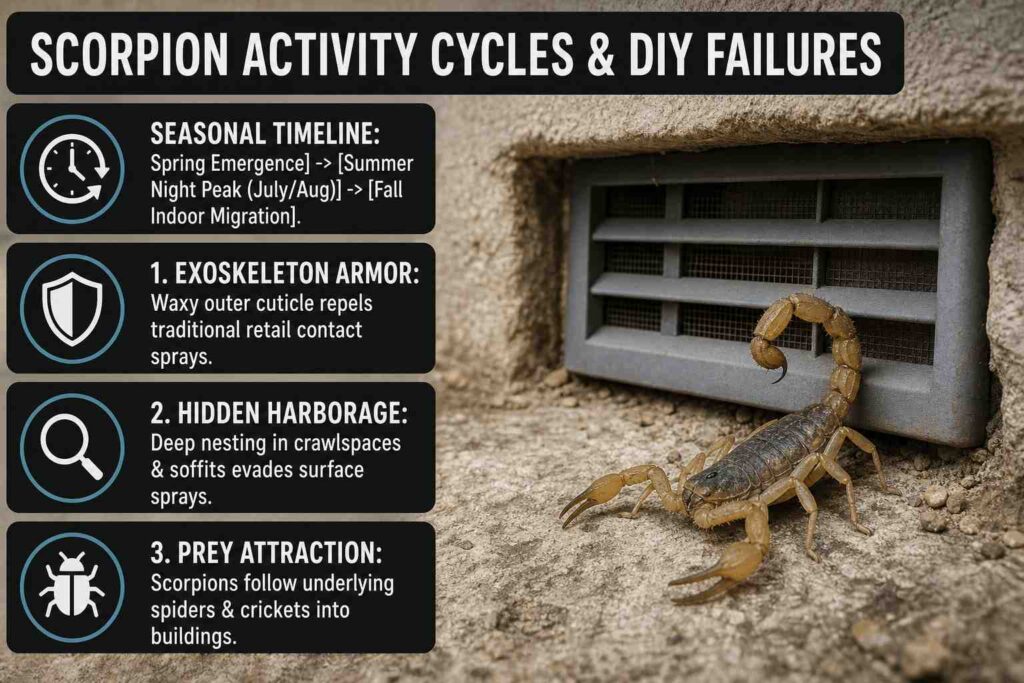
Scorpions are cold-blooded creatures that rely on external temperatures to regulate their bodies. Because of this, they are almost entirely dormant during the freezing winter months, hiding deep underground or within wall voids. They truly come alive during the late spring, peaking in activity during the intense heat of July and August. Furthermore, scorpions are strictly nocturnal. They possess a high sensitivity to light and moisture loss, meaning they spend their days tucked away in dark crevices and emerge at night to hunt for insects.
This nocturnal, hidden lifestyle makes them incredibly difficult to manage on your own. Many property owners try to solve the issue with over-the-counter sprays from local home improvement stores. Unfortunately, DIY scorpion control almost always fails due to three distinct factors:
- Exoskeleton Armor: Scorpions have a thick, waxy cuticle covering their bodies. Standard retail contact sprays rarely penetrate this barrier effectively.
- Behavioral Avoidance: Because they hide deep within eaves, soffits, and crawl spaces, general surface sprays miss their primary nesting zones entirely.
- Food Source Supply: If your property has an underlying issue with spiders, crickets, or roaches, scorpions will continue to be drawn to the area for food.
Utah Beeline tackles this complexity with a multi-layered approach. Instead of just spraying baseboards, our licensed technicians trace the pests back to their entry points. We treat the specific harborages where they hide during the day, ensuring the problem is stopped at the source.
The Strategy of Continuous Quarterly Pest Management
Many property owners make the mistake of calling for a one-time pest treatment only after they see a pest crawling across the floor. However, true pest eradication requires consistency. A one-time treatment acts like a temporary band-aid. It kills the pests currently active on your property but does nothing to stop the next wave of eggs from hatching or new pests from migrating over from a neighbor’s yard.
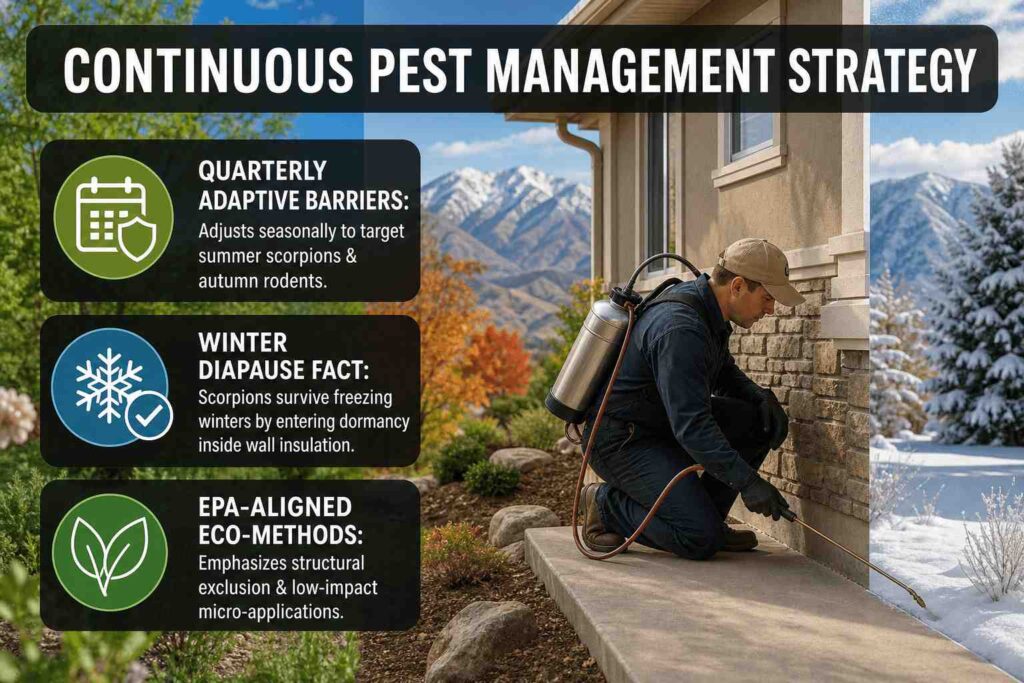
Implementing a system of Quarterly Pest Management establishes a continuous protective perimeter around your home or business. As the seasons change, the types of pests trying to enter your property change too. A quarterly plan adapts to these shifts, targeting scorpions and spiders in the summer, and rodents or boxelder bugs in the fall.
Myth vs. Fact: Scorpion Seasons
- Myth: Scorpions completely die off or leave during the cold Utah winter.
- Fact: Scorpions survive freezing temperatures by entering a state of dormancy (diapause) inside insulated structural walls or deep subterranean burrows.
What Makes a Pest Control Plan Truly Eco-Friendly?
At Utah Beeline, we recognize that a pest treatment is only as good as it is safe. According to guidelines outlined by the U.S. Environmental Protection Agency (EPA), responsible pest management should minimize risks to human health and the environment. That is why we specialize in Eco-Friendly pest control methods that utilize smart, targeted applications rather than blanket chemical spraying. We focus on structural exclusion blocking entry points alongside advanced products that eliminate target pests without leaving harsh, dangerous chemical residues behind.
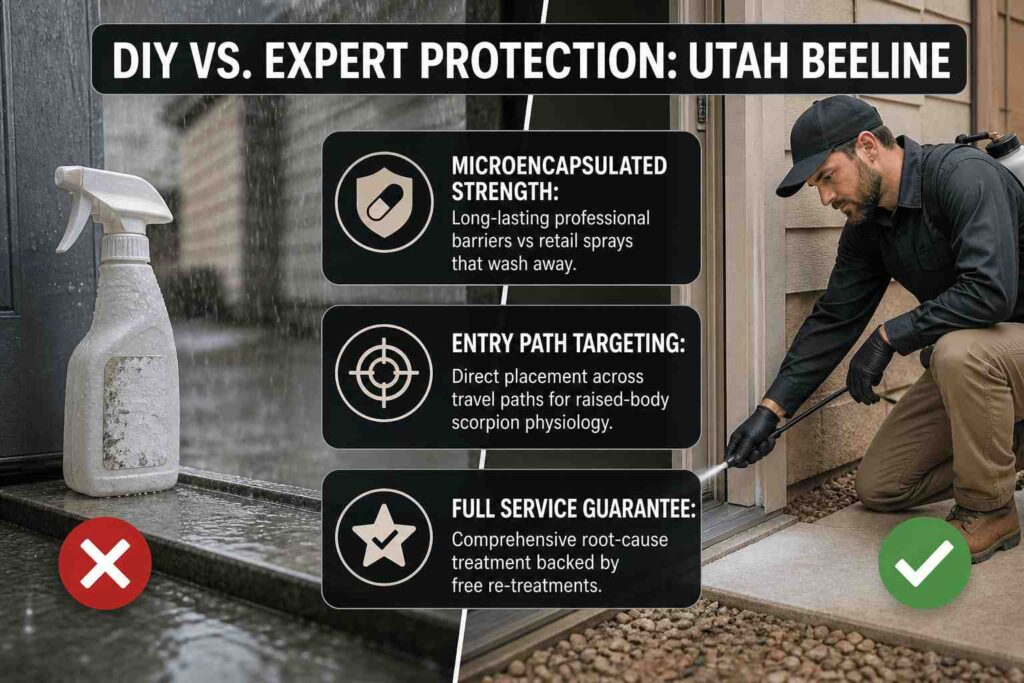
Trying to handle a scorpion or stinging insect problem on your own can quickly turn into a frustrating game of hide-and-seek. Let’s look at how DIY efforts stack up against professional intervention:
| Operational Feature | DIY Household Approaches | Utah Beeline Professional Service |
| Product Strength | Low-concentration retail sprays that wash away in the rain. | Professional-grade microencapsulated formulas designed to last. |
| Application Safety | High risk of over-application near kids, pets, or food surfaces. | Precision placement by licensed experts following strict safety protocols. |
| Root-Cause Focus | Targets only the individual bugs you can see. | Targets entry points, nesting zones, and underlying insect food sources. |
| Long-Term Guarantee | No recourse if the pests return a week later. | Full service guarantee with free re-treatments if pests pop back up. |
Expert Quote: The Reality of Scorpion Control Mechanics.
“Scorpions don’t travel like typical insects; they walk with their bodies raised completely off the ground, and they don’t groom themselves. This means they don’t ingest traditional pesticide dusts easily. To stop them, you have to apply specialized, long-lasting microencapsulated barriers directly across their hidden entry paths.”
– Jason, Licensed Utah Beeline Field Specialist

We do not believe in cookie-cutter solutions. A residential home with a backyard pool in Provo requires a completely different approach than a commercial food storage warehouse in Salt Lake City.
Residential Pest Control
Our home protection plans focus heavily on family areas. We meticulously treat entry points like window wells, door thresholds, attached garages, and winterized sheds. Our specialized Pet-friendly pest control applications ensure that your dogs, cats, and children are completely safe to play in the yard immediately after the treatment dries.
Commercial Pest Control
For businesses from Ogden to Salt Lake, our commercial plans are built around regulatory compliance and discreet service. We provide detailed documentation for health inspectors, focus heavily on commercial food storage zones, and work after-hours to ensure your customers never see a pest or a technician.
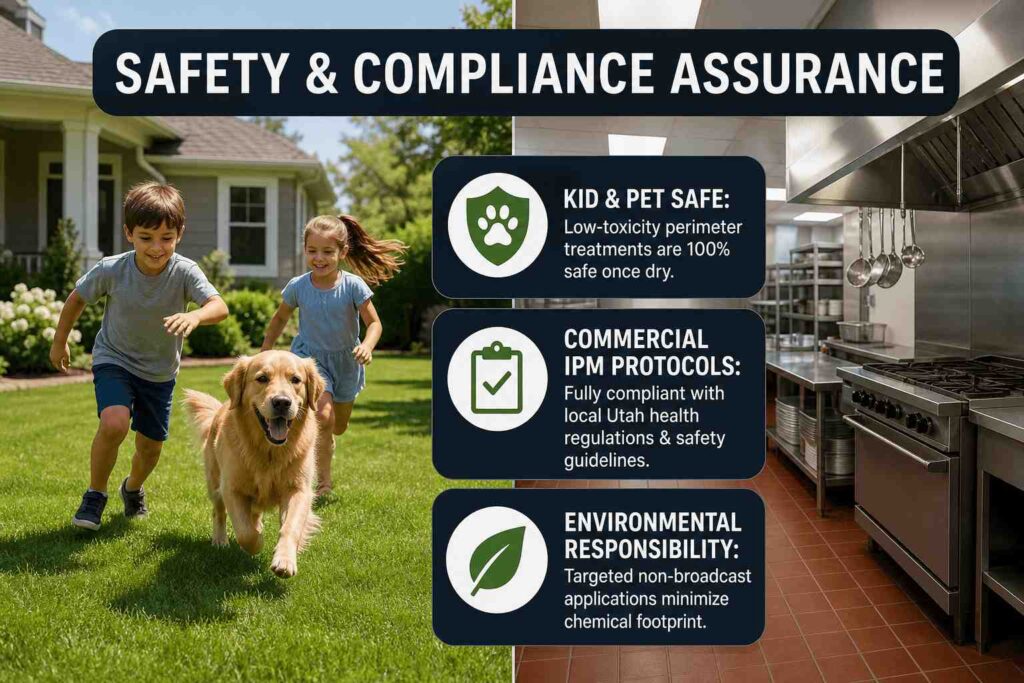
Safety and Compliance FAQ Block
What about commercial food safety? Our technicians are highly trained in Integrated Pest Management (IPM) practices, ensuring that all treatments in commercial kitchens or warehouses comply fully with local Utah health regulations and Utah State University Extension safety guidelines.
Are the products safe for my family? Yes. We use advanced, low-toxicity products that are thoroughly vetted and approved. Once dry, our perimeter treatments are completely safe for kids and pets.
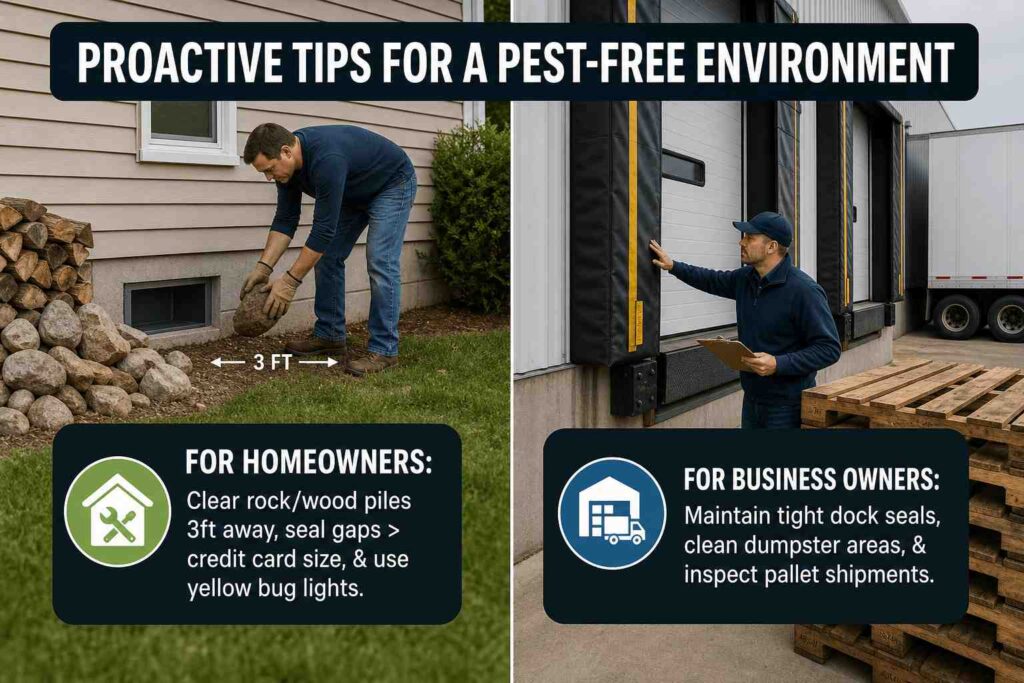
Tip: Structural Maintenance for Residential Homeowners.
- Clear the Perimeter: Keep woodpiles, rock piles, and heavy landscaping mulch at least three feet away from your home’s foundation. Scorpions love hiding under rocks and logs during the day.
- Seal the Gaps: Check your basement windows and crawl space vents. Use weatherstripping to seal any gaps larger than a credit card.
- Manage Outdoor Lighting: Switch exterior yellow “bug lights” or LED bulbs to reduce the presence of nocturnal insects that scorpions hunt for food.
Tip: Preventative Protocols for Commercial Operators.
- Maintain Loading Docks: Ensure dock seals fit tightly against delivery trucks to prevent nocturnal pests from slipping inside during night shifts.
- Keep Trash Enclosures Clean: Dumpsters should be kept clean, sealed, and positioned away from the main building structure to prevent drawing insect prey.
- Inspect Incoming Shipments: Scorpions and spiders frequently hitchhike into warehouses inside pallets, cardboard boxes, and building materials.
When it comes to managing unique desert pests like scorpions, timing and local knowledge are everything. Leaving your home or business unprotected during their peak active seasons is an open invitation for an unsettling encounter. Investing in professional, proactive pest defense is the smartest way to protect your family’s peace of mind and secure your business’s hard-earned reputation.
Don’t let pests take over, Call us today for expert pest control!
Utah’s Favorite Pest Control Company
- Serving Utah Since 1997
- Locally owned and operated
- Top-rated with 2,300+ five-star reviews!
- Safer pest control treatment for kids and pets
To find out more about our residential pest control services and commercial pest control services, click the links or visit our Contact Us page to fill out our form, or call us directly at (801) 544-9200.
Frequently Asked Questions
What season are scorpions most active?
Scorpions are most active during the summer season, specifically during the scorching months of July and August. Their metabolic rates spike with the heat, causing them to move around much more frequently in search of food and mates. Utah Beeline recommends scheduling a preventative exterior barrier service in late spring to stop them before this summer surge begins.
What time of day are scorpions most active?
Scorpions are nocturnal creatures, making them most active during the late-night hours well after the sun has gone down. They rarely move during daylight hours because bright sunlight rapidly dehydrates them. If you suspect you have an infestation, the team at Utah Beeline can perform specialized nighttime inspections using ultraviolet blacklights to locate them easily.
What time of day do scorpions come out?
Scorpions typically come out of their hiding spots shortly after dusk and remain active until dawn. They use this darkness to hunt for insects like crickets and cockroaches without being spotted by predators. To keep them from coming out inside your home at night, Utah Beeline focuses on sealing internal cracks and treating dark basement corners.
What time of year are scorpions most active?
The time of year when scorpions are most active spans from late spring through the end of summer, usually from May to September. During this window, warm nighttime temperatures provide the perfect environment for them to forage outdoors. Securing a quarterly pest management plan during this time of year ensures your property stays protected through their entire active cycle.
What time of year do scorpions come out?
Scorpions begin to come out of their winter dormancy in April and May as the ground temperature rises across Utah. They remain highly visible through August before starting to seek indoor warmth or deep underground shelters in late autumn. Utah Beeline can apply a defensive shield around your foundation during these transition months to block their movement.
When are scorpions active?
Scorpions are active primarily at night during the warmest months of the year when conditions are optimal for hunting insect prey. They become largely inactive during cold weather, slowing down their systems to survive the winter. Professional intervention from Utah Beeline is the most effective way to address them during both their active and dormant periods.
When do scorpions come out?
Scorpions come out when the outdoor temperatures consistently stay above 70 degrees Fahrenheit, which aligns with Utah’s summer months. They emerge from darkness each night from their hiding spots under rocks, logs, and concrete expansion joints. Utah Beeline technicians are experts at identifying these specific harbors and treating them directly so scorpions never make it inside.
Do scorpions come out during the day?
No, scorpions rarely come out during the day unless their hiding spot has been physically disturbed or they are suffering from extreme environmental stress. They naturally avoid daytime heat by squeezing into cool, tight spaces like crawl spaces, shoes, or wall insulation. If you do happen to spot a scorpion during daylight hours, contact Utah Beeline immediately for a comprehensive property inspection.
Next: The Truth About Vinegar and Ant Control: A Utah Property Owner’s Guide