
Salt Lake City, UT · about half an hour from our Clearfield office
Pest Control in Salt Lake City, Utah
Salt Lake City has been a city since 1847, and its bugs show it. We log rat calls at nearly twice the rate of the rest of our service area, moths at about two and a half times, and a top-three share of ants. We treat for the city you actually live in.
Text (385) 425-1766. Send a photo of the bug and we will tell you what it is, free, usually same day.
Salt Lake City has been a city since 1847, longer than anywhere else in Utah, and it shows up in the bugs. The blocks are the largest in the country at 660 feet square, the sewer under them dates to 1889, and more than half of households rent. That combination produces a pest mix nothing else on the Wasatch Front matches.
We have serviced Utah homes for 29 years, and Salt Lake City is one of the busiest cities on our map. If you moved here from a newer suburb and felt like the bugs changed, they did.
The local picture
What 15,514 Salt Lake City appointments actually show
First, what these numbers are. They come from our own service records: 15,514 Salt Lake City appointments and 16,341 logged pest codes, measured against the rest of our Utah work, with every ranking drawn from the 36 cities where we log enough volume for a fair comparison. It is a record of what people call us about, not a census of the local insect population.
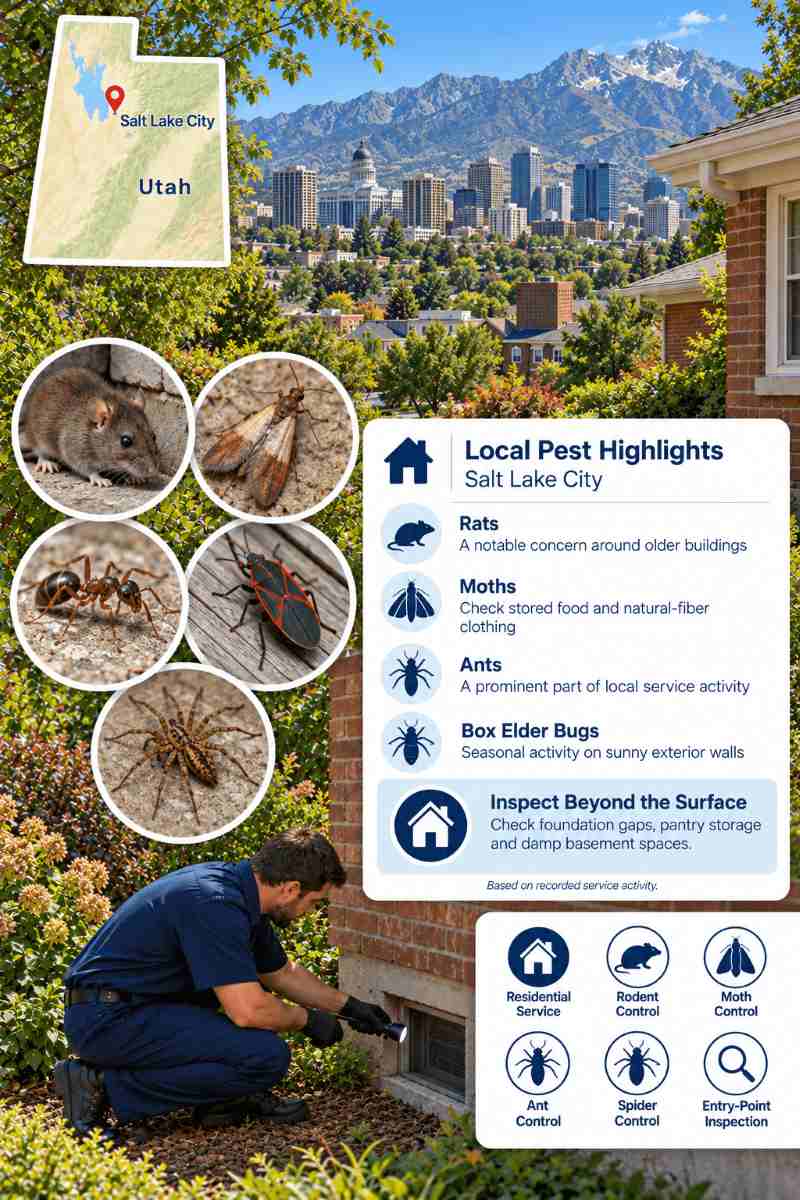
Spiders, ants, box elder bugs, wasps and mice are the bulk of the work here, as almost everywhere. The Salt Lake City story is in the rest.
- Rat calls run nearly twice as high here as across the rest of our service area, putting the city in the top five of the 36.
- Moth calls run about two and a half times our service-area rate, the second-highest share of the 36 cities.
- Ants are 18.4% of everything we log here, the third-highest share of the 36.
- Centipede calls run about 1.6 times our average, seventh of the 36.
Then the other direction. Earwigs, snails and voles all run well below our service-area rate, wasps sit in the bottom ten, and spiders rank third from the bottom as a share of the mix.
Scroll the chart sideways to see the full scale →
Put the two lists together and a pattern appears. Pests that thrive inside old, dense, permanently occupied buildings run hot here. Pests that need a damp suburban yard run cold. Service records cannot prove why, but building age and density fit every row.
Not sure what you are looking at?
Send us a photo. We will identify it and tell you whether it needs treating or not, free, usually the same day.
The big one
Rats: the pest that separates the city from the suburbs
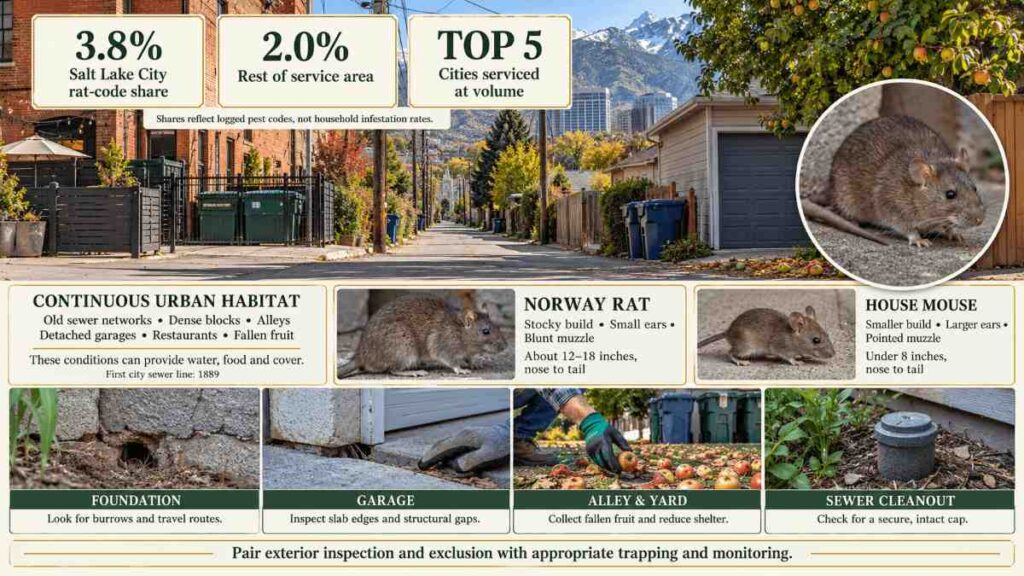
Rats are 3.8% of what we log in Salt Lake City against 2.0% across the rest of our service area, top five among the cities we service at volume. In most Utah suburbs a rat call is a rare event. Here it is a Tuesday.
Norway rats want what Salt Lake City has more of than anywhere else in the state: continuous old sewer, dense blocks, alleys, detached garages, restaurants, fruit trees and century-old buildings by the thousand. Salt Lake City Public Utilities dates the first sewer line to 1889 and now runs roughly 653 miles of sanitary sewer, 13,200 manholes and more than 49,800 service connections.
The city takes it seriously enough to have written an ordinance. Salt Lake City Municipal Code chapter 9.32 requires property owners to ratproof buildings and keep them that way, prohibits rat harborage, and lets the city inspect, order abatement, do the work itself and bill the owner.
Telling a rat problem from a mouse problem
Most people call us about mice, and some of them have rats. USU Extension puts it plainly: a Norway rat runs 12 to 18 inches nose to tail, a house mouse under 8 inches. Rat droppings run about three quarters of an inch against a quarter inch for mice, and a rat entry hole is two inches or larger where a mouse needs an inch and a half.
It matters because the jobs differ. Mice are an interior sealing and trapping problem. Rats are an exterior problem first: burrows along a foundation, a gap at the garage slab, fruit dropping into an alley, an uncapped sewer cleanout. Treat the inside, ignore the outside, and you repeat it in six weeks.
Moths: our second-highest city, and nobody expects it
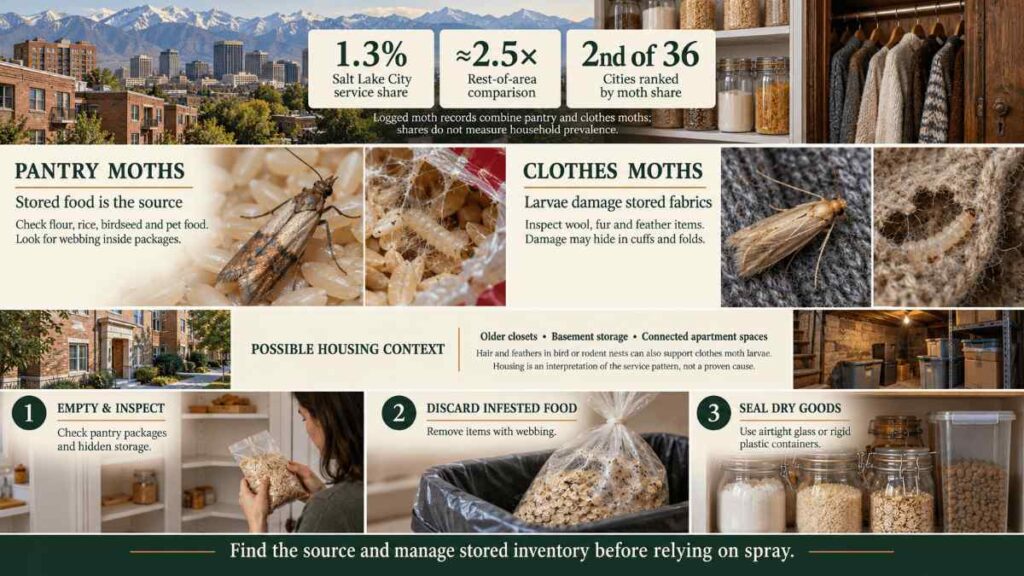
Moths are only 1.3% of our Salt Lake City work, so this will not define your summer. It is, however, the widest gap on the page: moth calls here run about two and a half times the rest of our service area, the second-highest share of the 36 cities we service at volume.
Two very different insects hide under that heading. Pantry moths come home in a bag of birdseed, flour, rice or dog food and breed in the container they arrived in. Clothes moths are the quiet, expensive one: USU Extension notes their larvae feed on wool, fur, feathers, hair and cotton, and that the damage hides in cuffs and folds.
Our best read on the gap is the housing. The city is majority renter, and by its own housing plan roughly 29% of units are mid to high rise apartments, second-highest among its peer cities in the region. Add old closets, wool stored in basements, and shared walls that let an infestation walk next door. USU also notes that clothes moth larvae feed on hair and feathers in bird and rodent nests, which draws a straight line from the last section to this one.
The fix is inventory more than spray: empty the pantry, discard anything with webbing, store the rest sealed.
Ants: the biggest number on this page
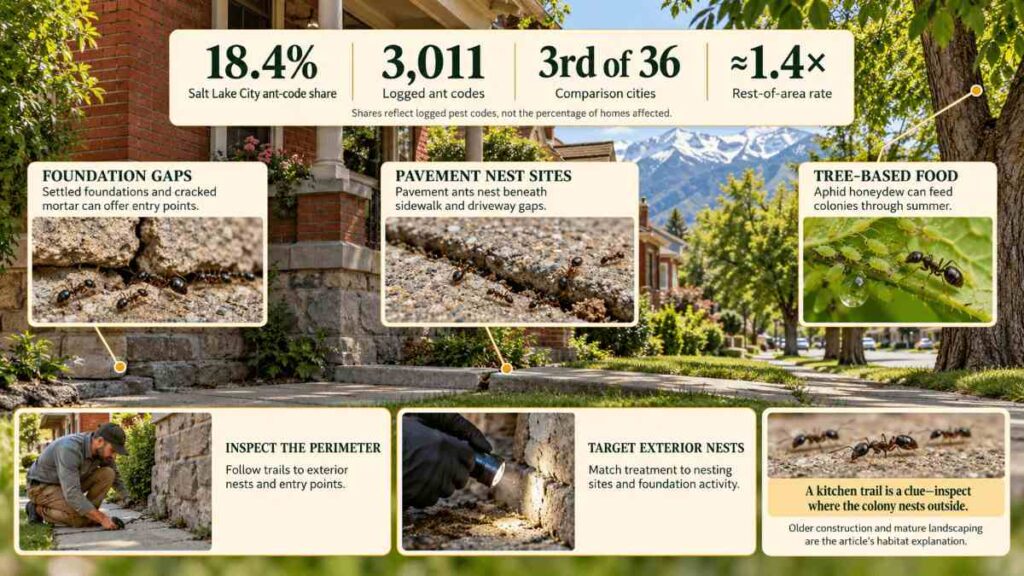
Ants are 18.4% of everything we log in Salt Lake City, the third-highest share among the 36 cities and about 1.4 times the rest of our service area. Out of 16,341 pest codes that is just over 3,000 ant calls.
Old construction probably has a lot to do with it. Century-old foundations settle, mortar cracks, sidewalks and driveways heave, and pavement ants nest under exactly that. Mature park strips and street trees supply aphid honeydew that keeps colonies fed all summer, and an older house has more openings at grade than one built in 2015 with a sealed sill plate. So the work here is perimeter and exterior nest treatment rather than chasing a trail across your counter.
Box elder bugs, and what the tree canopy explains
Box elder bugs are 13.7% of our Salt Lake City work and sixth-highest of the 36 cities, about 1.4 times our service-area rate. That is the mirror image of the newer suburbs, where they barely register, and the explanation is almost certainly trees. Box elder bugs need female, seed-bearing boxelder trees to reproduce, and Salt Lake City Urban Forestry manages roughly 85,000 public trees, 63,000 of them street trees, calling the urban forest a legacy from the city’s first residents. Elm seed bugs are the non-story: they breed on elm and the city has plenty, yet our call share sits at our service-area average, fourteenth of the 36.
Centipedes and the old-basement crowd
Centipede calls run about 1.6 times our service-area rate, seventh of the 36, on a small base. The house centipede is the one people find, and USU Extension notes it is the only centipede species able to complete its entire life cycle indoors, in damp basements, cellars and bathrooms.
Old basements are the common thread: block foundations, floor drains, a sump, no vapor barrier under a 1928 slab. Centipedes are predators, so they are eating something, which is the better clue.
The other side of the list
What Salt Lake City mostly does not get
Earwigs and snails. Both run about a third of our service-area rate, earwigs near the bottom of the 36. They want mulch, constant irrigation and damp groundcover, which describes a new Davis County subdivision better than a city lot with mature dry shade.
Voles. A little over half our rate. Voles arrive when farm ground becomes lawn and greenbelt, and Salt Lake City stopped being farm ground long ago.
Wasps. Still our fourth-biggest complaint here by volume, but as a share of the mix they sit in the bottom ten of the 36. Wasps reward big lots, wide eaves, sheds and vinyl fence rails: a suburban shopping list.
Spiders. The number misleads, so state it plainly. Spiders are the biggest thing we treat here, about 27% of all calls, and also third from the bottom of the 36 as a share of the mix. That does not mean fewer spiders. It means everything else is busier.
Why a Salt Lake City homeowner should call us
Why Salt Lake City homeowners call Beeline
Our office is at 275 W 1700 S in Clearfield, roughly 28 miles and about half an hour up I-15, so you get a local crew and same-week service rather than a national call center. Locally owned, 29 years in Utah, 2,300+ five-star reviews. No hidden charges, and if something comes back between visits, so do we.
Get a free quote: (801) 544-9200, or text us at (385) 425-1766.
We also service nearby:


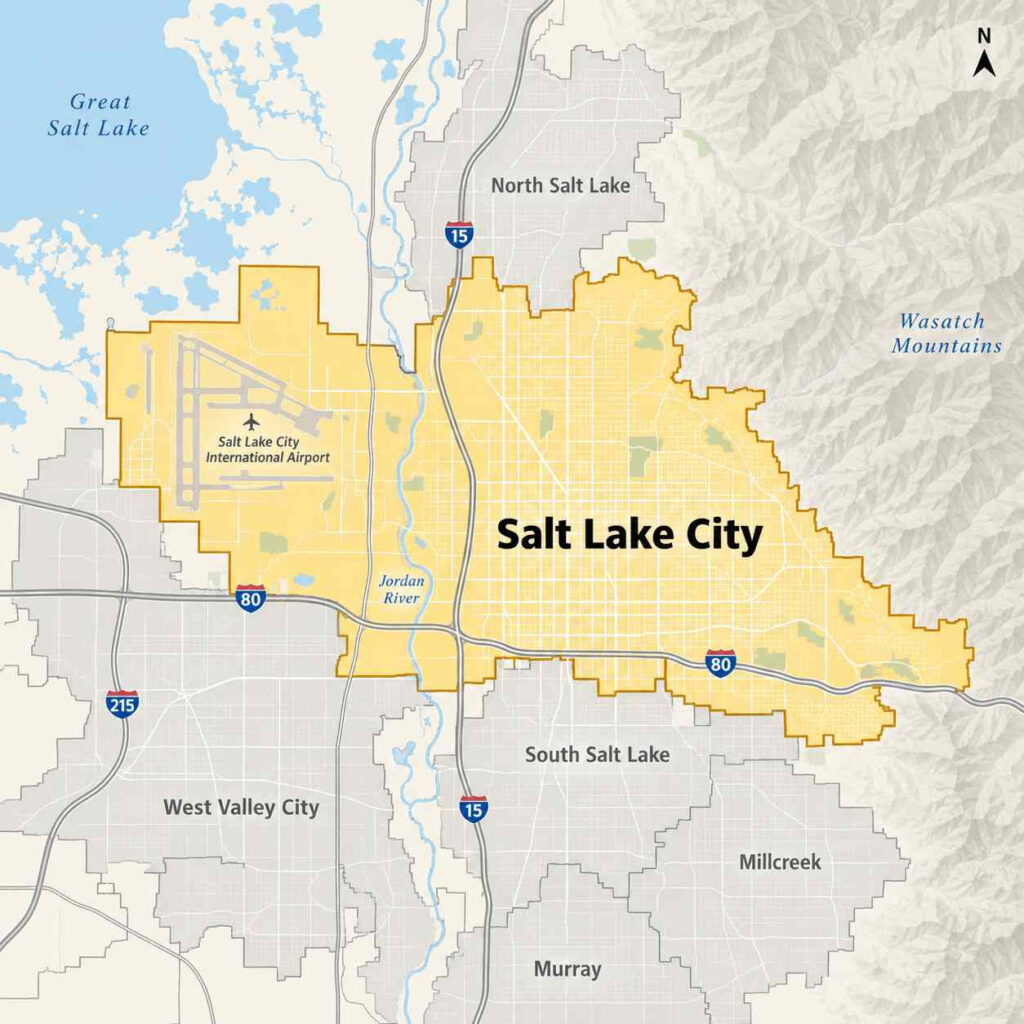
A Salt Lake City pest calendar
What we are treating, and when. The highlighted row is where we are today.
| When | What matters in Salt Lake City |
|---|---|
| March, April | Box elder bugs come off the south walls, ant colonies wake, and rat burrows show before vegetation hides them. |
| May, June | Ant pressure peaks with the first real heat, and spider and wasp season opens. |
| July, August | Spiders, ants and wasps at full strength, and centipedes appear in basements once the upstairs goes hot and dry. |
| September, October | Box elder bugs mass on sunny walls, rats and mice look for a warm winter address, spider webbing peaks. |
| November to February | Rodent season proper, plus pantry and clothes moths, noticed now because this is when the flour and the wool get used. |
Before you book
Salt Lake City pest control questions we actually get asked
Why do I hear about rats in Salt Lake City and never in the suburbs?
Because the difference is real. Rats are about 3.8% of what we log here against 2.0% across the rest of our service area, top five of the 36 cities we service at volume. Norway rats do best with continuous old sewer, dense blocks, alleys and century-old buildings, and no Utah city has more of all four.
Whose job is a rat problem, mine or the city's?
Yours, mostly, and there is an ordinance saying so. Salt Lake City Municipal Code chapter 9.32 requires property owners to ratproof their buildings and keep them that way, prohibits rat harborage, and lets the city inspect, order abatement, do the work and bill the owner.
There are little moths in my kitchen, and something ate my wool coat. Same bug?
No, two different ones, and Salt Lake City gets more of both. Moth calls here run about two and a half times the rest of our service area, second-highest of the 36 cities we service at volume. Kitchen moths are pantry moths that arrived sealed in a bag of flour, rice, birdseed or pet food, so check every box before treating. The coat is clothes moths: USU Extension notes the larvae feed on wool, fur, feathers and hair, and that the damage hides in cuffs and folds.
My parents in Syracuse never get box elder bugs and I get thousands. Why?
Trees. Box elder bugs need female, seed-bearing boxelder trees to reproduce, and Salt Lake City's canopy is old enough to have plenty. The city's urban forestry division manages about 85,000 public trees and calls the urban forest a legacy of the first residents. Newer Davis County subdivisions were farm ground thirty years ago.
Why do I get so few earwigs here when my sister in Layton is overrun?
Earwig calls here run about a third of our service-area rate, near the bottom of the 36 cities we service at volume. Earwigs want mulch, constant irrigation and damp groundcover, which describes newer suburban landscaping better than a city lot.
Do downtown apartments and condos need their own pest control, or is that the building's job?
Usually the building handles common areas and the exterior, and you are on your own inside the unit. That matters here because the pests Salt Lake City runs high on, rats, mice, moths and ants, all travel between units through shared walls, utility chases and trash rooms. Treating one unit while the neighbors do nothing is temporary.
Three ways to get a Salt Lake City quote
All of them free, all of them with a real person at our Clearfield office.
- 1Send us a photo(385) 425-1766. Fastest answer.
- 2Call us(801) 544-9200. Mon to Fri 7:30am to 7:00pm, Sat 7:30am to 4:00pm.
- 3Fill in the formSend a picture of the bug or the damage and we will tell you what it is and what it costs.