
Park City, UT · on our regular Wasatch Back route
Pest Control in Park City, Utah
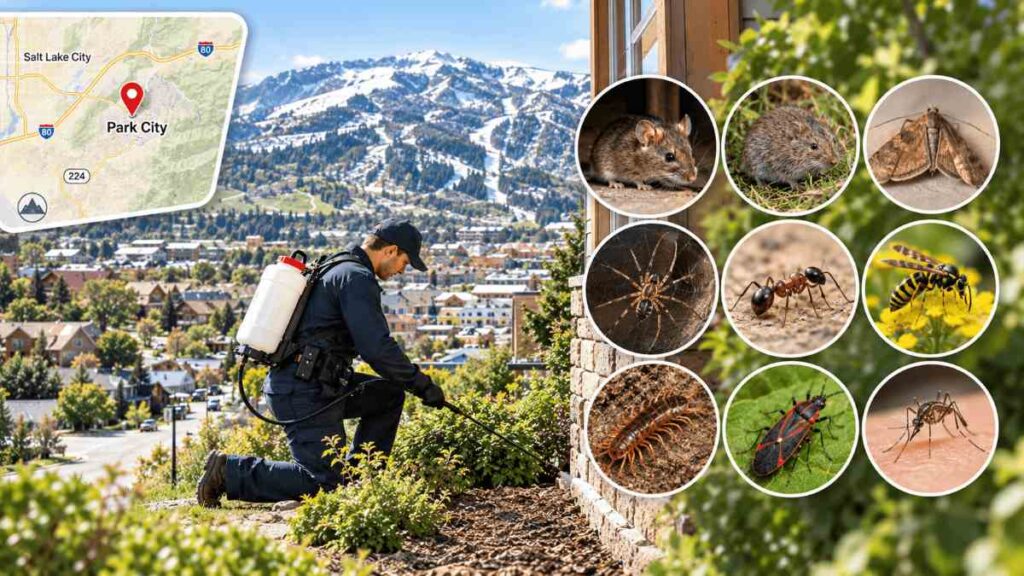
Park City is a rodent town. Mice are the single most common thing homeowners here call us about, at better than twice our rate elsewhere, and voles and moths run higher still. We treat for the town you actually live in.
Text (385) 425-1766 with a question or a photo of the bug, and we will get back to you, free, usually same day.
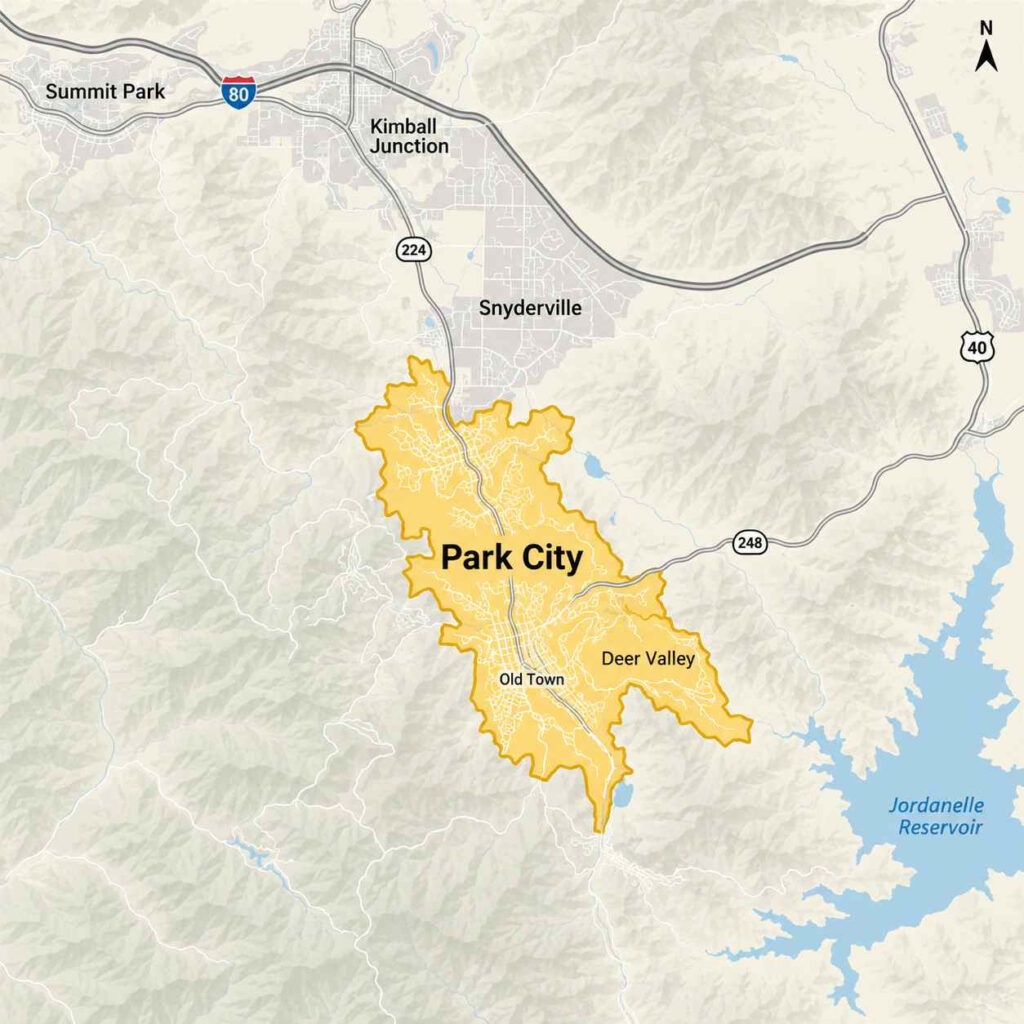
Park City sits at roughly 6,900 feet, about 32 miles southeast of downtown Salt Lake City and a full climate zone away from it. The growing season runs a little over 100 days and snow sits on the ground for months. That does something to the pest list that surprises almost everyone who moves up from the valley.
Most of the classic Utah yard bugs go quiet. The things that get indoors and stay indoors get much louder.
We have run 2,356 appointments in Park City, and the pattern holds well enough to say in one sentence: this is a rodent town. Mice are the single most common thing Park City homeowners call us about. In nearly every other city we service, spiders hold that spot by a wide margin.
The local picture
What Park City’s pest mix actually looks like
First, what these numbers are. They come from our own service records: 2,356 Park City appointments measured against the rest of our Utah work, with every ranking drawn from the 36 cities where we log enough volume for a fair comparison. It is a record of what people call us about, not a census of every insect in Summit County.
Scroll the chart sideways to see the full scale →
Four pests put Park City at the top of that 36-city list. Mice are a bigger share of our work here than anywhere else we service, at better than twice our service-area rate. Vole calls run about five times higher. Moth calls run roughly four times higher. Centipede calls run about two and a half times higher.
Wasps land almost exactly on our average: Park City gets its share, no more and no less.
Then there is the other half. Spiders, ants, box elder bugs, earwigs, elm seed bugs, rats and mosquitoes all run well below our rate, several near the bottom of the 36.
Not sure what you are looking at?
Text us a question or a photo of the bug. We will identify it and tell you whether it needs treating or not, free, usually the same day.
The big one
Mice: the biggest share of our work in any city we service
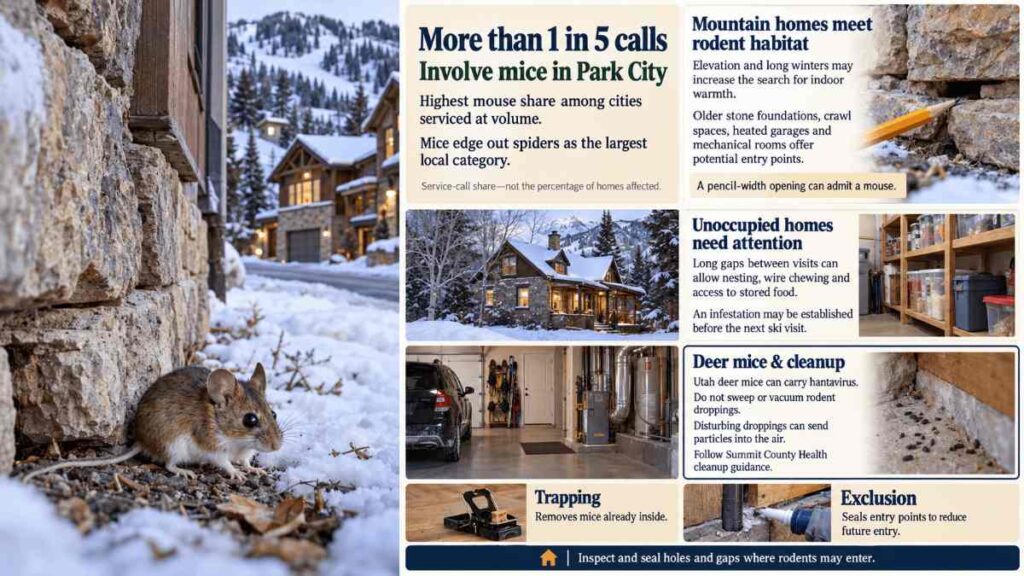
Better than one in five Park City pest calls involves mice. That is the highest share of any city we service at volume, and it edges out spiders for the top spot here, which almost never happens anywhere else.
Elevation and winter probably have a lot to do with it. Mountain homes sit in rodent habitat rather than a few subdivisions away from it, and winter gives mice a long reason to find somewhere warm. A mouse needs a gap the width of a pencil, and the building stock offers plenty: mining-era houses in Old Town on stone foundations, newer homes with deep crawl spaces, heated garages and mechanical rooms.
Second homes make it worse, and that is the part owners do not expect. A house nobody has walked through since March gives mice eight uninterrupted weeks to nest, chew wiring and get into stored food. By the time somebody arrives for a ski weekend, the problem is established.
Summit County Health publishes guidance worth reading here, because deer mice in Utah can carry hantavirus. Two points from it: do not sweep or vacuum rodent droppings, because that stirs particles into the air, and seal up holes or gaps where rodents may enter. That second one is the whole game. Trapping clears the current mice. Exclusion keeps the next batch out.
Voles: the damage you find when the snow goes
Voles are nine percent of our Park City work and about five times our service-area rate, the highest share of any of those 36 cities.
Utah State University Extension counts five vole species in the state, with the meadow vole the most common. They stay active all winter, and what matters at this elevation is what they do under snow: they feed on the lower bark of woody plants, girdling them beneath the snow line. Deep snow that sits for months is cover from hawks and owls, insulation, and a roof over a feeding tunnel.
Add irrigated landscaping that butts against native meadow and you have the conditions USU describes for a spike. In epidemic years they can number over 400 per acre.
You rarely see the animal. You see the aftermath in May: two-inch winding runways across the turf, dime-sized holes, clipped vegetation, and chewed bark at the base of young trees. That last one is the expensive part, because a girdled aspen usually cannot be saved.
In our experience the worst of it lands on lots backing onto open meadow. We do not track results street by street, so we will not pretend one neighborhood is worse than another. What we can say is that the more native groundcover meets your lawn, the more vole pressure to expect.
Moths: what happens in a house that sits empty
Moth calls run roughly four times our service-area rate, number one of the 36. It is a small category in raw numbers and a very loud signal.
The likeliest reason is sitting in the census. Of Park City’s 8,127 housing units, 57.3 percent were counted as vacant in 2020, which here mostly means second homes and nightly rentals. That is a lot of houses full of belongings and short on people.
Clothes moths want exactly that. USU Extension notes the larvae feed on wool, feathers, fur and hair, that they prefer items stained with sweat, oil or beverages, and that damage shows up in hidden spots like cuffs and folds. The adults prefer darkness and are weak fliers, so they stay close to where they hatched. That describes a Park City ski closet: wool base layers worn hard in February, a down jacket, a stack of blankets, shut in the dark until next season.
Our records log moths as a single category, so we cannot split clothes moths from pantry moths. We find both, and the pantry side has the same cause.

Centipedes, flies and beetles: the indoor crowd
Centipedes are a small share of our work here, but Park City is number one of the 36 for them at about two and a half times our rate. They want cool and damp: crawl spaces, mechanical rooms, walk-out basements cut into a hillside. They are also predators, so finding one usually means something else is living down there too.
Flies and beetles both run about two and a half times our rate, second of the 36 on each. Cluster flies are the usual story. They pile into attics on warm October days, then head for the windows in February and March when sun hits the roof. Owners who arrive midwinter to a sill full of flies are often sure something died in the wall. Usually nothing did.
The other side of the list
The pests Park City mostly does not get
This is where the elevation really shows.
Spiders. The number one pest nearly everywhere else we work. Here they are second lowest of the 36, still common but a much smaller slice of a mix dominated by rodents.
Ants. Near the bottom of the 36 as well. A growing season of a little over 100 days, sometimes 120, gives colonies far less time to build than a Davis County summer does.
Box elder bugs. Under half our rate. They need female, seed-bearing boxelder trees to reproduce, and Park City’s canopy is aspen, conifer and mountain maple rather than valley shade trees.
Elm seed bugs. Near the bottom of the 36. Same logic, different tree. They breed on elm, which lines old valley streets and is scarce up here.
Rats. About a third of our rate. Norway rats do best in older, denser, plumbing-heavy urban cores, which in our data means Holladay and Salt Lake City, not a mountain town.
Mosquitoes. We logged four mosquito calls across 2,356 Park City appointments. Summit Mosquito Abatement District puts the county season at roughly April to September, and at this elevation the practical window is shorter still.
A Park City pest calendar
What we are treating, and when. The highlighted row is where we are today.
| When | What matters in Park City |
|---|---|
| April, May | Snowmelt reveals vole runways and girdled bark. Check young trees first, then plan reseeding. |
| June, July | Wasp nests establish under eaves and decks, and ants and spiders pick up with the short warm season. |
| August, September | Peak wasp activity, and rodent pressure starts as nights cool. |
| October, November | The big one. Mice move indoors, cluster flies pack into attics, and exclusion work pays for itself. |
| December to March | Voles work under the snow and moths work in closed closets. The quiet months are only quiet above the snow line. |
Why a Park City homeowner should call us
Why Park City homeowners and property managers call Beeline
We run Park City on a regular route, so you are not waiting on a truck dispatched from the other end of the state. We are up here most weeks, our technicians know what these yards and crawl spaces produce, and 2,356 completed appointments is the proof.
That matters here, because a lot of Park City property is managed remotely. We can service a house between bookings, work with your property manager, and tell you what we found.
Beeline is locally owned, more than 29 years in Utah, 2,300+ five-star reviews, no hidden charges. Our quarterly service covers everything on this page, and if something comes back between visits, so do we.
Get a free quote: (801) 544-9200, or text us at (385) 425-1766.
We also service nearby:


Before you book
Park City pest control questions we actually get asked
Why do we get so many more mice up here than at our place in the valley?
Park City is the heaviest mouse city we service, by share of calls, out of the 36 we compare at volume. Mice even edge out spiders for the top spot here, which almost never happens elsewhere. Elevation, a long winter and homes built into rodent habitat all point the same direction, and a house that sits empty for weeks gives them room to settle in.
We only use the house a few weekends a season. Do we really need pest service?
That is the case for it, not against it. Most of what runs hot in our Park City data takes advantage of an empty house: mice nesting undisturbed, moths working through a closed closet, cluster flies filling an attic nobody checks. A problem found in month three is cheaper than the same problem in month eight.
Something carved winding trails across my lawn over the winter and stripped bark off my aspens. What was it?
Voles. They tunnel under the snowpack all winter and feed on bark below the snow line, so the damage only appears at melt. Check the base of every young tree right away, because a girdled trunk rarely recovers. Park City is our number one vole city of the 36.
There are moths in a closet nobody has opened since March. Where did they come from?
Most likely from what is in the closet. Clothes moth larvae feed on wool, fur and hair, and USU Extension notes they prefer items stained with sweat or oils, which is most of a used ski wardrobe. Park City runs about four times our rate on moth calls, the highest of the 36, and houses that sit closed for a season are our best read on why.
Summit County has a mosquito abatement district. So why do we barely see mosquitoes?
Because the season up here is short and standing water is limited. Across 2,356 Park City appointments we have logged four mosquito calls. Summit Mosquito Abatement District runs county-wide from about April to September, and between their work and the elevation, mosquitoes are close to the last thing on a Park City list.
My parents in Bountiful get box elder bugs all over the house every October. Why don't we?
You probably do not have their trees. Box elder bugs need female, seed-bearing boxelder trees to reproduce, and those are a valley street tree. Park City's canopy is aspen, conifer and mountain maple, so our box elder calls here run under half our rate while Bountiful sits near the top of the list.
Three ways to get a Park City quote
All of them free, all of them with a real person at our Clearfield office.
- 1Send us a photo(385) 425-1766. Fastest answer.
- 2Call us(801) 544-9200. Mon to Fri 7:30am to 7:00pm, Sat 7:30am to 4:00pm.
- 3Fill in the formSend a picture of the bug or the damage and we will tell you what it is and what it costs.