
Heber City, UT 84032 · on our regular Wasatch Back route
Pest Control in Heber City, Utah
Fly calls across the Heber valley and Wasatch Back run 7.55 times our rate elsewhere, the widest gap we have found anywhere we work, and box elder bugs are better than one call in five. We run the valley on a regular route and treat for the town you actually live in.
Text (385) 425-1766 with a question or a photo of the bug, and we will get back to you, free, usually same day.
Area data
Because Heber City sits further out, we look at the whole area
Heber City by itself gives us 585 appointments carrying 599 logged pest codes. Plenty to tell you what we treat here, not enough to build stable rates on. We would rather say that than dress up a thin number.
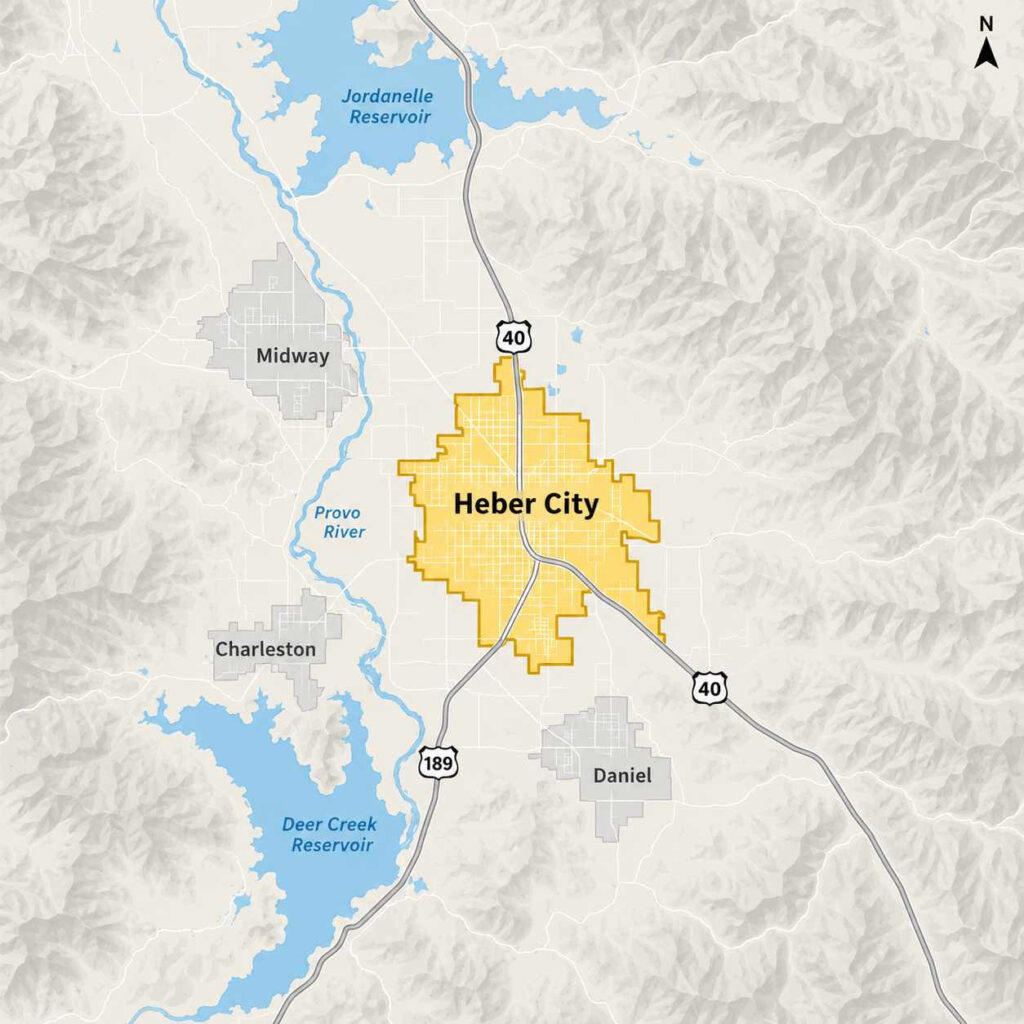
So the data below covers the whole area we work on this side of the mountains. Sixteen towns across three counties: Heber, Midway, Charleston and Wallsburg in Wasatch County; Kamas, Francis, Oakley, Peoa, Wanship, Hoytsville, Coalville, Snyderville and Echo in Summit County; and Morgan, Croydon and Henefer in Morgan County. That pool is 2,460 service appointments carrying 2,645 pest codes. Everything below is area data, labelled that way every time it appears.
Heber City is 43 miles from Salt Lake and feels further, which is why people here assume pest control means waiting for somebody to drive over the pass.
We are already coming. Our records carry 585 Heber City appointments, and the Heber route keeps going: Midway, Charleston, Wallsburg, over to Kamas, Francis and Oakley, then out through Coalville, Henefer and Morgan. Our office is in Clearfield and we will not pretend there is a branch on Main Street. What there is, is a technician on a regular route who has worked these houses for years.
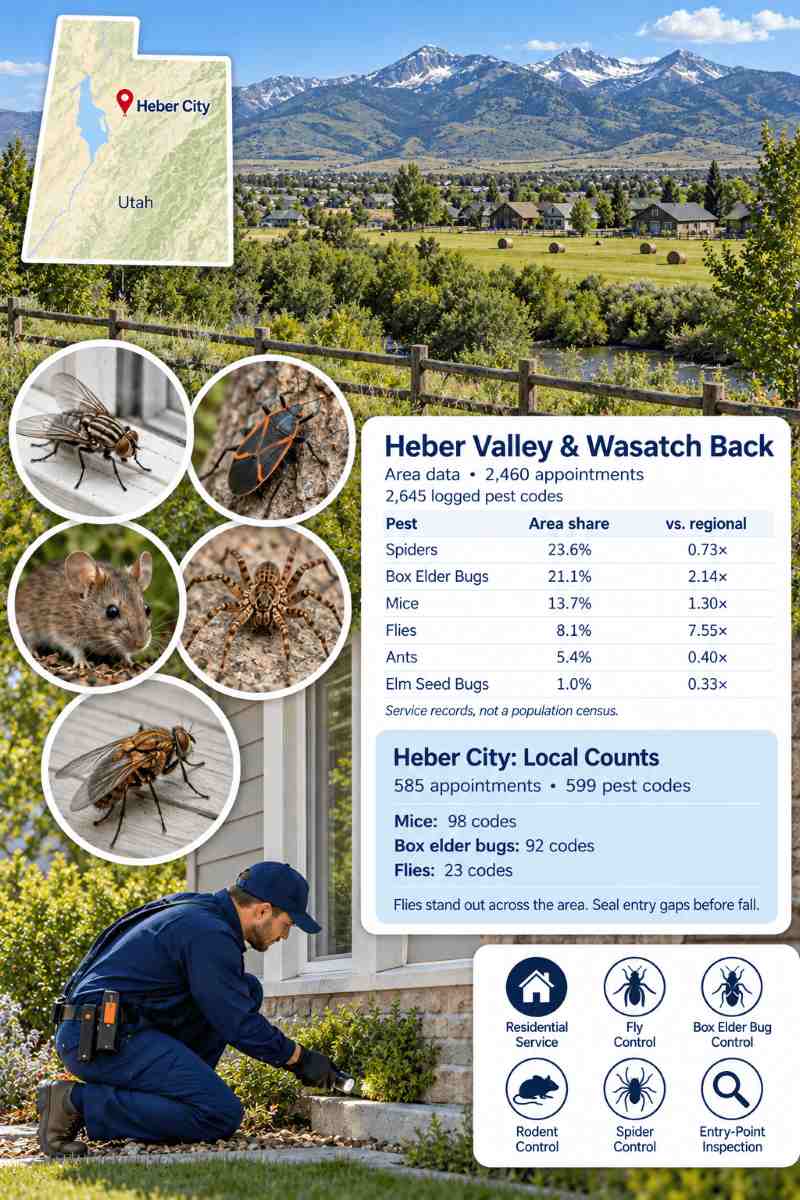
Scroll the chart sideways to see the full scale →
Not sure what you are looking at?
Text us a question or a photo of the bug. We will identify it and tell you whether it needs treating or not, free, usually the same day.
The big one
Flies are the loudest signal anywhere in our records
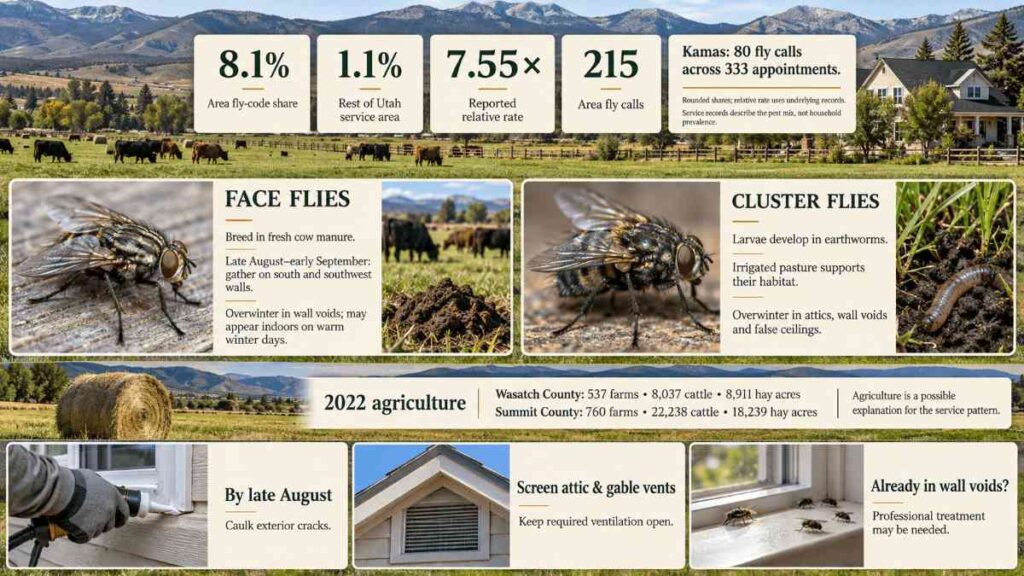
Across the area, flies are 8.1% of every pest code we log, on 215 fly calls, against 1.1% across the rest of our Utah service area. That is 7.55 times the rate, the widest gap of its kind we have found anywhere we work. Not spread evenly, either: Kamas alone logged 80 fly calls across 333 appointments.
Our read is agriculture. This is working valley floor, not scenery. The 2022 Census of Agriculture counts 537 farms, 8,037 head of cattle and 8,911 acres of hay in Wasatch County, and 760 farms, 22,238 head of cattle and 18,239 acres of hay in Summit County, which holds Kamas. Irrigated pasture and livestock in quantity, houses mixed in among it. That combination produces two specific flies, the classic ranch valley problem.
Face flies look almost exactly like house flies. USU Extension notes that they lay eggs in fresh undisturbed cow manure, then seek indoor overwintering sites in late August and early September, gathering on south and southwest facing walls before they get in. Once inside they congregate in wall voids, and turn up on windowsills and light fixtures on warm days in January.
Cluster flies are not a manure fly at all. Their larvae develop as parasites of earthworms, which irrigated pasture suits perfectly, and USU Extension reports as many as four generations per growing season. They overwinter in attics, wall voids and false ceilings, and wake up in warm spells.
Both are exclusion problems first. Caulk exterior cracks and seal attic and gable vents by late August. If the flies are already in the voids, that is a treatment job, and one we do out here more than almost anywhere else.
Box elder bugs: better than one call in five
Box elder bugs are 21.1% of the area’s pest codes on 559 logs, against 9.9% across the rest of our service area. 2.14 times the rate, and the second biggest thing we treat here after spiders.
USU Extension is clear on the cause: these bugs feed on seeds found only on female boxelder trees, and overwinter in cracks and crevices of buildings, especially on unshaded sunny walls. Our read is the river bottoms. The Provo River runs the length of this valley, and boxelder and cottonwood grow along it. Seal before October, treat the south and west walls in fall.
Park City is twenty minutes away and the bugs are not the same
Park City sits on the same side of the same mountains and runs a completely different profile. Flies there run about 2.51 times our rest-of-area rate, high, but a third of what the Heber valley runs. Box elder bugs there run about 0.47 times, which is low, while this area runs 2.14 times.
Park City is a ski town at 6,936 feet with no hay ground and little riverbottom boxelder. The Heber valley sits at 5,601 feet and is still, in large part, ranch land. Twenty minutes of road, two different pest profiles. Our Park City page has those numbers.
The other side of the list
What this area mostly does not get
The cold rows save you money. Ants run 0.40 times our rest-of-area rate, on 144 logs. The default complaint on most of the Wasatch Front barely registers up here. Rats run 0.28 times, on 16 logs across 2,460 appointments. Norway rats want dense, old, plumbing heavy blocks, and this valley does not offer much of that. Elm seed bugs run 0.33 times, on 25 logs, almost certainly because the elm canopy is thinner than in the older Front cities.
Heber City’s own numbers
Of the 599 pest codes logged inside Heber City, 98 are mice and 92 are box elder bugs. Flies inside the city limits are 23 logs, well under what Kamas and the surrounding farm ground produce. Which is what you would expect if agriculture drives the fly signal.
Why a Heber City homeowner should call us
Why Heber valley homeowners call Beeline
Locally owned, 29 years in Utah, more than 2,300 five star reviews, no hidden charges. We quote the price before we start, and there is no surcharge for living past Jordanelle. If something comes back between services, we retreat it free.
Call (801) 544-9200 or text (385) 425-1766 for a free quote.
Also on our Wasatch Back route:


]
A Heber valley pest control calendar
What we are treating, and when. The highlighted row is where we are today.
| When | What matters in Heber City |
|---|---|
| March to June | Cluster flies build through the growing season on irrigated pasture, up to four generations a year. |
| July, August | Caulk exterior cracks and seal attic and gable vents by late August, before face flies look for a way in. |
| September, October | Face flies and box elder bugs gather on sunny south and west walls. Seal before October, and mice press in from pasture. |
| November to February | Overwintering flies wake in warm spells and turn up on windowsills and light fixtures. |
Before you book
Heber City pest control questions we actually get asked
Do you really come out this far, or do I wait until somebody is in the area?
We run a regular route through the Heber valley and the Wasatch Back. Across the area we have logged 2,460 appointments, 585 inside Heber City. You are not an exception to the schedule, you are on it.
Is it more expensive out here than on the Wasatch Front?
No. Same pricing. There is no travel or fuel charge for Heber, Midway, Kamas, Coalville or Morgan, because these towns sit on an established route rather than a special trip.
Why do we get so many more flies than my sister in Lehi?
Because you live next to hay ground and cattle. Area wide, flies run 7.55 times our rest-of-area rate on 215 fly calls, and Kamas alone accounts for 80 of them on 333 appointments. Face flies breed in fresh cow manure, cluster flies in pasture soil, and both move into wall voids for winter. That is our best read on the gap.
My neighbor in Park City says box elder bugs are not a problem. Why are mine everywhere?
Different ground. Park City runs box elder bugs at about 0.47 times our service area rate. This area runs 2.14 times, on 559 logs. These bugs feed on seeds from female boxelder trees, and the Provo River bottoms grow plenty of them. Park City, at 6,936 feet, does not.
We only use the cabin a few weekends a year. What happens between visits?
Common here, and we schedule around it. Exterior treatments do not need you home, so we time the two that matter most: a late summer visit before flies and box elder bugs look for a way in, and a fall rodent check. Find something when you arrive, call and we come back out.
Should I be worried about rats?
Probably not. Across 2,460 appointments in this area we have logged 16 rat calls, 0.28 times our rest-of-area rate. Mice are the real rodent story up here, pressing in from pasture and hay ground every October through the same pencil width gaps at garage corners and utility penetrations that everything else uses.
Three ways to get a Heber City quote
All of them free, all of them with a real person at our Clearfield office.
- 1Send us a photo(385) 425-1766. Fastest answer.
- 2Call us(801) 544-9200. Mon to Fri 7:30am to 7:00pm, Sat 7:30am to 4:00pm.
- 3Fill in the formSend a picture of the bug or the damage and we will tell you what it is and what it costs.