

Key Takeaways
- Most Utah homeowners pay between $100 and $600 for a one-time pest control treatment, or roughly $100 to $300 per visit on a quarterly plan, though the exact number depends on your property and the pest involved.
- General pests like ants and spiders sit at the low end, while termites and bed bugs follow a completely different pricing model built around an inspection.
- The honest answer to how much this will cost you is a real quote based on your home, not a number pulled from a national average.
Introduction
Go ahead and search pest control cost right now. National directory sites and comparison pages dominate the first page, and the pest control companies themselves are nowhere to be found. Almost nobody in this business publishes real prices, so homeowners end up collecting a couple of phone quotes and hoping the final bill matches what they pieced together.
That gap is unusual for a service this common. Ahead is what pest control actually costs nationally and in Utah, why one-time and quarterly pricing differ, what pushes your price up or down, and how to walk away from that first call with a number you trust. Beeline Pest Control Utah put this together on the theory that a homeowner who understands their quote trusts it.
How Much Does Pest Control Cost Nationally and in Utah
Most homeowners pay 100 to 600 dollars for a one-time treatment, or 100 to 300 dollars per visit on a quarterly plan, according to Angi and HomeGuide. Full-year quarterly plans typically total 300 to 900 dollars. These are general industry figures, not a quote from any single company, but they give a real sense of scale, whether you are in Salt Lake City, Ogden, Provo, or elsewhere along the Wasatch Front.
One-Time Versus Quarterly: What the Price Difference Buys You
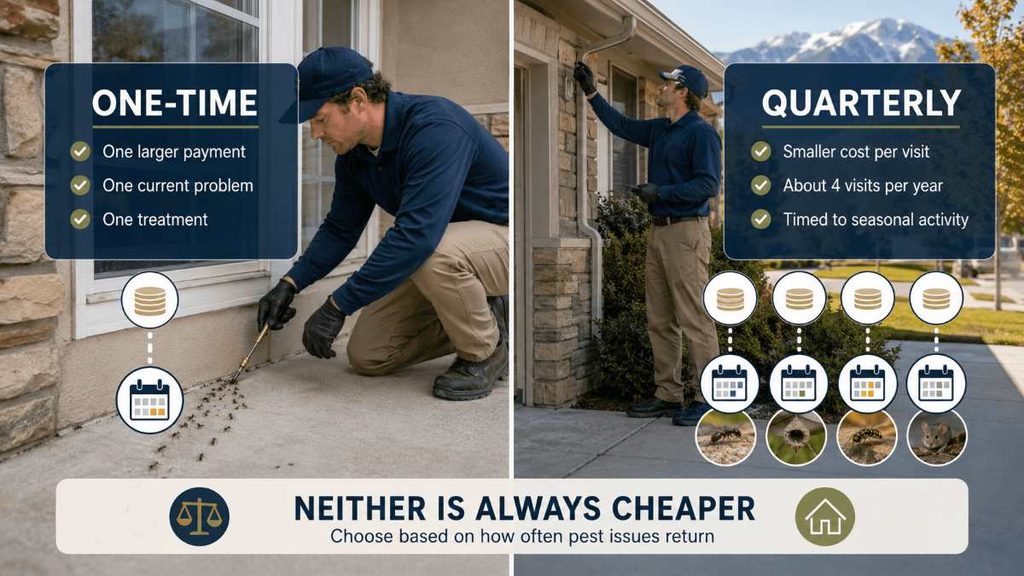
These two options are priced differently on purpose. A one-time treatment is a single, larger cost that handles what is happening now and stops there. A quarterly plan spreads a smaller per-visit cost across roughly four visits a year, timed to Utah’s pest seasons instead of reacting after the fact. Neither is automatically cheaper. A single ant trail in June might only need one visit, but a property with something new every season usually comes out ahead on quarterly service.
What Factors Affect Your Pest Control Price
No two quotes look identical, because no two homes are identical. Square footage tops the list; a larger structure and yard need more product and time. Severity matters just as much; a light ant presence costs far less than an infestation with weeks to spread. Access adds time too; crawl spaces, basements, and larger or fenced yards all take longer to treat. Utah adds its own wrinkle, since many Wasatch Front homes have unfinished basements or crawl spaces built to meet local frost line requirements, a factor a national average was never built to account for. None of this is arbitrary; it is why one flat number could never fit every property.
Does the Type of Pest Affect the Cost
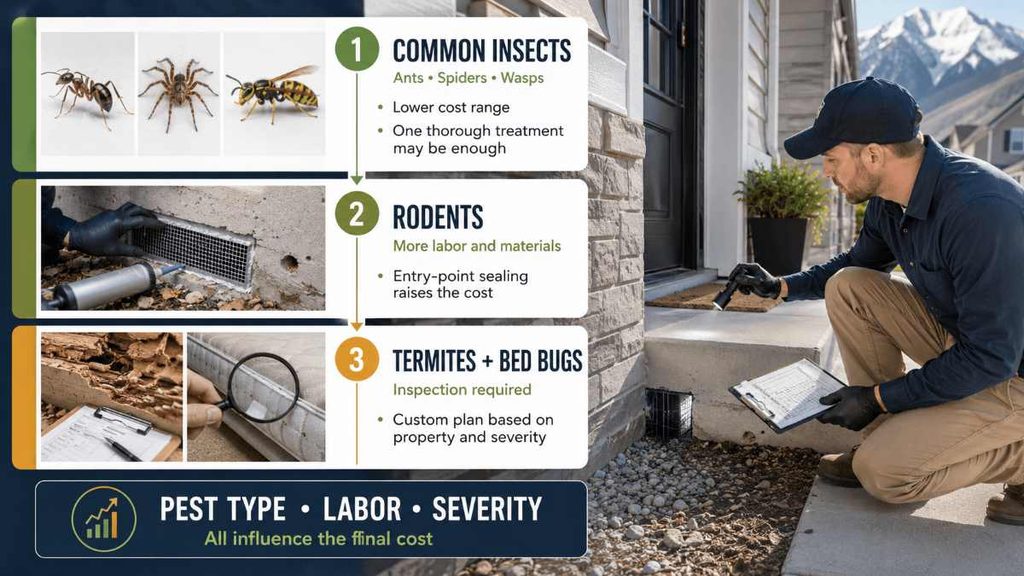
It does, and quite a bit. Ants, spiders, and wasps land at the lower end, since one thorough treatment usually finishes the job. Rodents run a little higher, since exclusion work, sealing off entry points, takes more time than a spray. Termites and bed bugs sit in a different category entirely, requiring a property-specific inspection before any plan gets built. The National Pest Management Association notes termite pricing is typically set individually rather than published flat, and either can run from a few hundred dollars into the thousands depending on severity.
Is There a Separate Pest Control Inspection Fee
Some companies charge a standalone inspection fee, typically 125 to 450 dollars nationally, which may or may not get credited toward treatment if you proceed. A real inspection is more than a walkthrough; for general pests, it means checking entry points and known problem areas, and for termites it means examining foundation lines and any visible damage before a plan gets built. Ask directly whether a fee applies and whether it credits toward service; that one question tells you more about a company’s pricing than almost anything else.
Why Most Pest Control Companies Do Not Publish Their Prices
Fair question, and the answer is less cynical than it sounds. Pricing depends on so many property-specific variables that one published number would mislead most people who read it. A few companies in Utah do advertise a flat starting rate, which works for a single standard package but gets harder to hold once a plan is built around your property, and that tradeoff is why most quotes start with a conversation instead of a number on a page.
How Beeline Determines Your Price
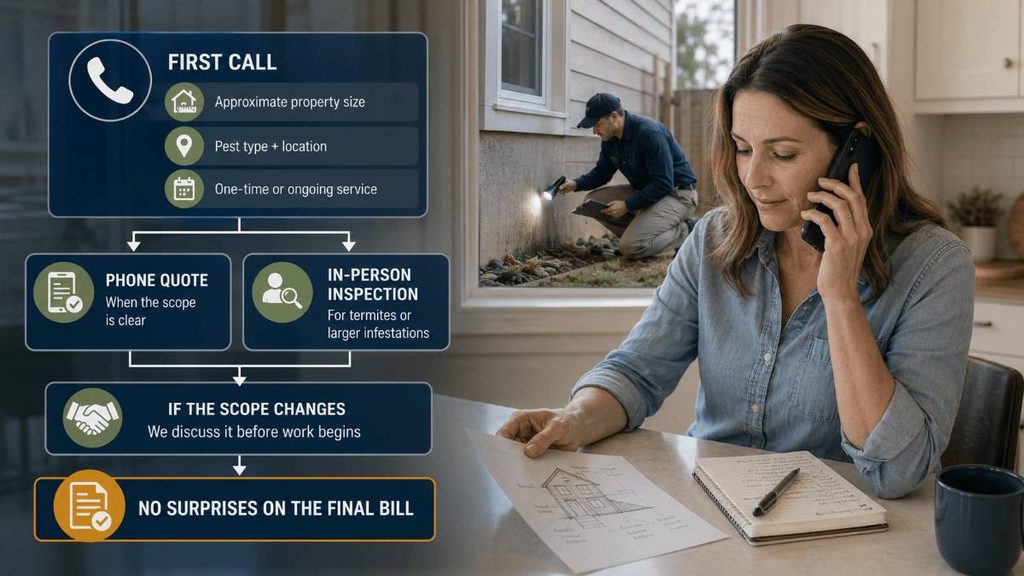
The first call gathers the basics: your property’s approximate size, what pest you are seeing and where, and whether you want a one-time visit or ongoing service. Some situations can be quoted right on the phone, while larger infestations or termite concerns call for a closer look first. If that in-person look turns up something different than what came across by phone, that gets discussed with you before work begins, not folded into the final bill. This is our no hidden fees approach in practice, not just a marketing line.
What to Watch for When Comparing Quotes
Ask any company about three categories: cancellation fees, travel fees outside a core service area, and charges for add-on pests not covered in your base plan. A good answer should not require hedging. The Better Business Bureau’s standard advice, get terms in writing before work begins, applies here too.
Does Going Contract Free Cost More
It is easy to assume flexibility comes with a price tag, but that is worth confirming rather than assuming, since practices vary by company. Cancelling or switching plans is covered fully in our article on how quarterly pest control scheduling works.
How to Get an Accurate Quote for Your Home
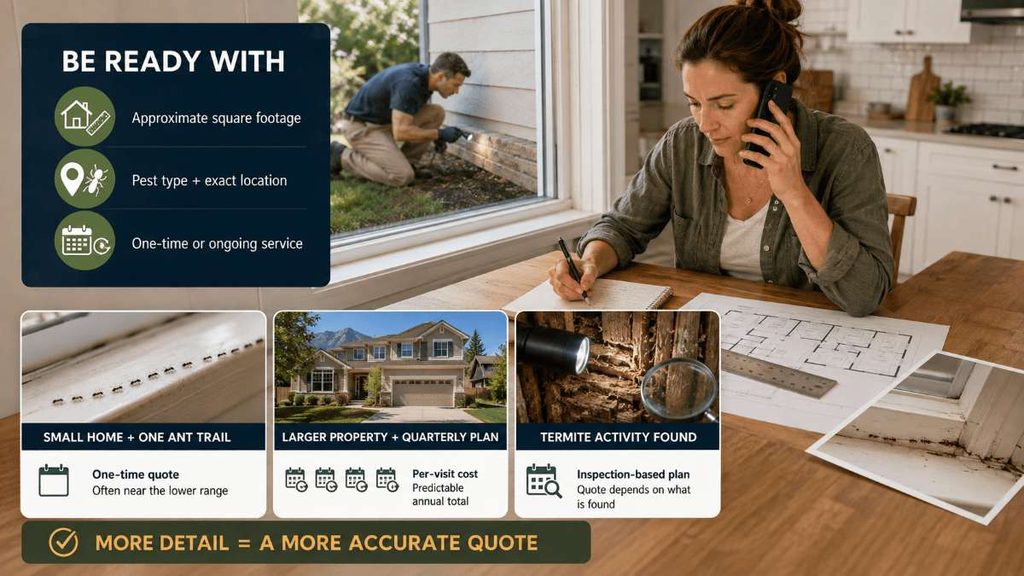
Walking into that first call prepared helps. Know your approximate square footage, name the specific pest and where you have seen it, and decide whether you want a one-time fix or ongoing coverage. The more specific you are, the less back and forth it takes to land on a trustworthy number.
Picture a smaller home with one ant trail along a windowsill, landing near the lower end of the one-time range. A larger property starting a quarterly plan gets quoted as a per-visit cost that adds up to a predictable annual total. A routine inspection that turns up termite activity looks different, since that plan gets built around what is found.
Expert Tips
Measure or estimate your square footage before you call; it is the first thing any company will ask. Name the specific pest and where you are seeing it rather than saying bugs; that changes a quote more than almost anything. When comparing quotes, look past the headline number and factor in the guarantee behind it and whether the plan locks you into a contract.
Conclusion
Pricing that depends on your property’s specifics is not a dodge. It is the honest answer for a service that genuinely varies from home to home, and the goal here has been to explain why. Ask the right questions, know what should be included, and a fair number stops feeling like a mystery.
Ready to find out what pest control actually costs at your address? Request a free quote from Beeline Pest Control, and we will walk you through exactly how we got to that number.
Frequently Asked Questions
Do pest control prices increase at renewal?
Worth confirming at sign-up, since practices vary by company. Ask whether your rate stays locked for the plan’s life or can change at renewal.
Are there discounts for multiple properties or referrals?
Many companies offer some form of multi-property or referral discount, worth asking about directly.
Does commercial pricing work differently than residential?
Generally yes, since square footage, foot traffic, and pest pressure look different than in a typical home, so a restaurant or rental property usually gets its own quote.
Is financing or a payment plan available?
Worth asking about larger treatments, particularly termite work, during your initial call.
How is pricing different for an apartment or condo?
Smaller, attached units typically cost less than a full house, though shared walls can mean coordinating with neighbors. Ask how this is handled for your building.
Why did my neighbor get a different quote for what seems like the same problem?
Similar-looking homes can differ in access, yard size, or how established a problem is, and any of those can shift a quote. It reflects the property, not inconsistent pricing.
Is a cheap quote ever a red flag?
It can be, if it arrives with no explanation of what is included. A trustworthy quote accounts for your property and includes a clear guarantee, so compare what each price covers, not just the number.
Does the price include the guarantee, or is that extra?
The guarantee is part of the service, not an add-on. Our article on how our guarantee works covers what is included at no additional cost.
Can I get a quote without committing to anything?
Yes. A quote is information about what your property needs and what that would cost, with no obligation to move forward.
What is the fastest way to get an accurate number?
Call or request a quote with your square footage and the specific pest ready to go. The more specific that conversation is, the more accurate the number you walk away with.
Next: Pest Control for Property Managers: A Utah Multifamily and Rental Guide