
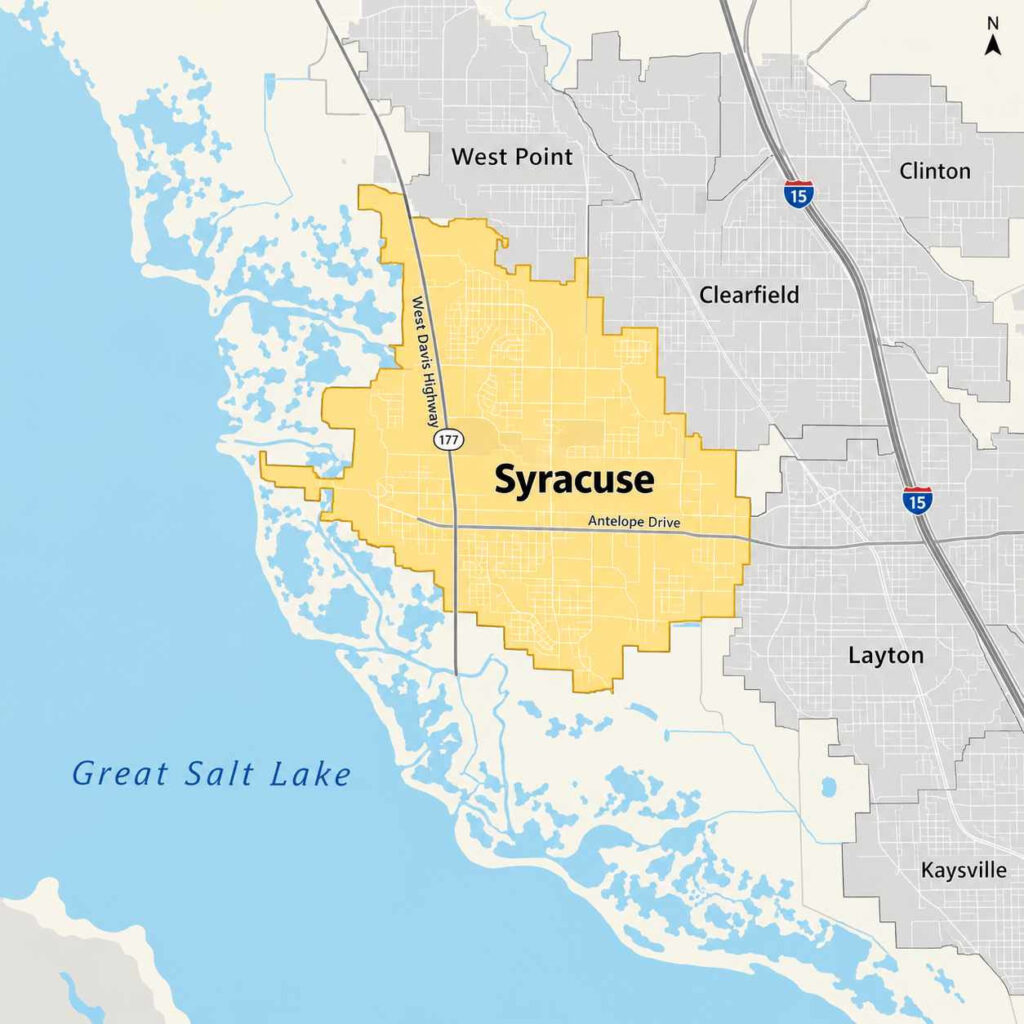
Syracuse, UT 84075 · 10 minutes from our Clearfield office
Pest control built for Syracuse
Syracuse sits next to the wetland. We log three to four times the mosquito calls here that we do anywhere else we service, and almost no box elder bugs. We treat for the city you actually live in.
Text (385) 425-1766 with a question or a photo of the bug, and we will get back to you, free, usually same day.
The local picture
What makes Syracuse different from the rest of Davis County
First, what these numbers are. They come from our own service records: 3,765 Syracuse appointments measured against the rest of our Utah work, with rankings drawn from the 36 cities where we log enough volume for a fair comparison. It is a record of what people call us about, not a census of every insect in the city. Across that many visits, the pattern holds up.
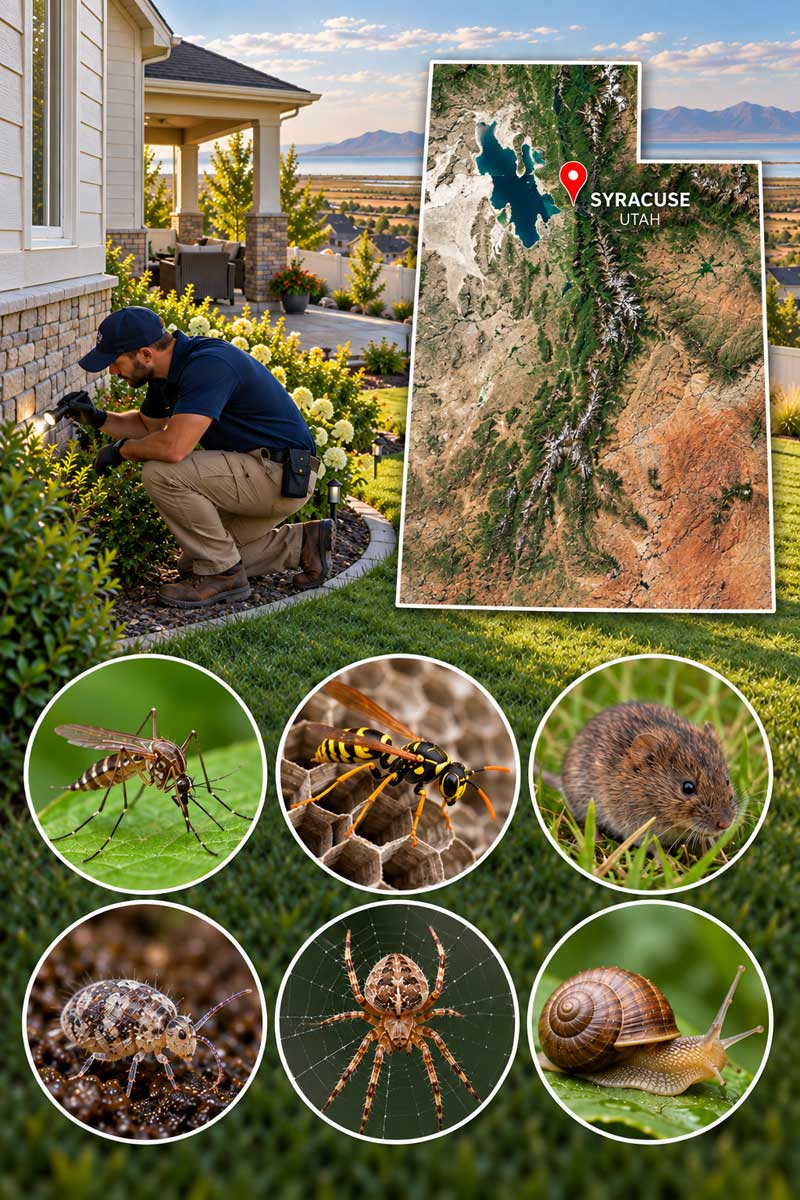
Spiders, wasps, ants and mice make up the bulk of what we treat in every Utah city, Syracuse included. The interesting part is where Syracuse pulls away:
- Mosquito calls run three to four times higher here than across the rest of our service area. Syracuse and neighboring West Point are the two heaviest mosquito cities on that list.
- Wasps make up roughly a quarter of Syracuse service calls, putting the city in the top five.
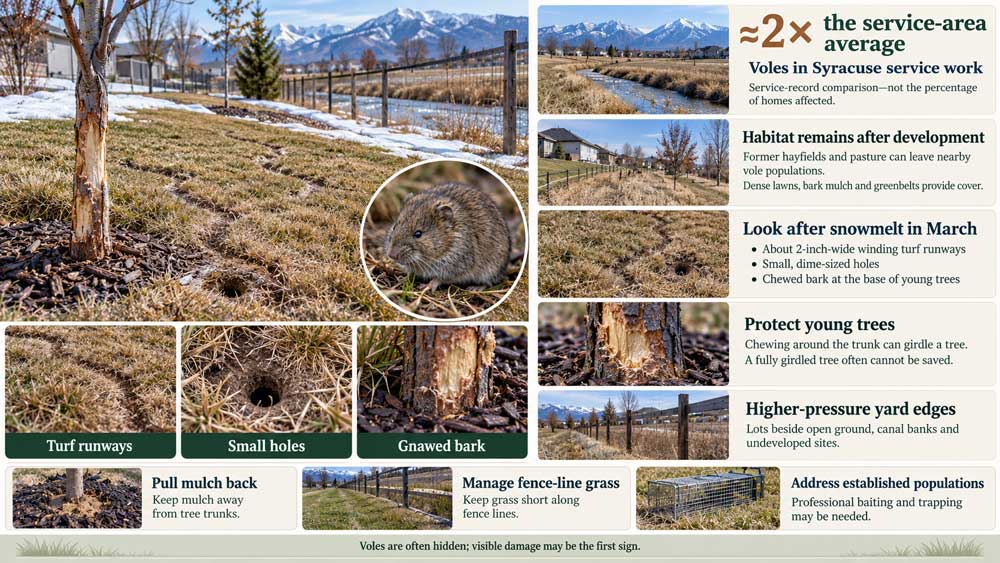
- Vole calls run about twice our service-area average.
- Springtails, the damp-ground insect most people cannot name, are a bigger share of our work here than in any other city on the list.
Then there is what Syracuse does not get, and box elder bugs are the surprise. They are our second-biggest complaint in Bountiful and Ogden, and they are all over Layton next door. Here they are a rounding error: roughly a tenth the rate of the rest of our service area, and the lowest share of any city on that list.
Scroll the chart sideways to see the full scale →
Two things look like they account for most of this: water on the west side of the city, and how young the landscaping is everywhere else. Service records cannot prove either one, but both fit what our technicians see in Syracuse yards.
Not sure what you are looking at?
Text us a question or a photo of the bug. We will identify it and tell you whether it needs treating or not, free, usually the same day.
The big one
Mosquitoes: Syracuse’s signature pest problem
The Davis Mosquito Abatement District says it plainly on its own Syracuse page: the city “is located just east of very productive mosquito breeding sites.” The district has also found West Nile Virus in mosquitoes trapped in and around Syracuse every summer for over a decade.
That goes a long way toward explaining what we see. The seasonal wetland west of Bluff Road and out toward the causeway is the shallow, warm, slow-moving water mosquitoes need, and it sits upwind of 32,000 people. Our technicians find the heaviest pressure closest to that water, and a west breeze on a July evening carries mosquitoes east across the city.
What the abatement district covers, and what it does not
This is our most-asked Syracuse question. The district handles the source: treating standing water, larviciding the marsh, running traps, fogging when counts justify it. Your property taxes already pay for that, and if your only complaint is a few bites near Jensen Nature Park, you probably do not need us.
What the district does not do is treat your yard. Mosquitoes drifting in from the west spend daylight hours resting in the cool, shaded spots on your property: under the deck, in the arborvitae, along a fence line, beneath the trampoline. A residential treatment is a barrier application to those spots, refreshed through the season. If you cannot use your own backyard in July, that is a harborage problem, and that is ours.

Wasps and hornets: plan on it every year
Roughly one in four Syracuse service calls involves wasps, hornets or yellow jackets. That is top five among the cities we service at volume, alongside Farmington and Clinton.
Timing matters here. A nest treated in May is a dozen cells and one queen; the same nest in August is several hundred workers that turn aggressive around anything sweet at a barbecue. Homeowners on a spring eave treatment rarely call us panicking in August.
Voles: the damage you find when the snow melts
Voles separate Syracuse from most of Davis County, running about twice as common in our work here as our service-area average. You rarely see the animal. You see the aftermath in March: two-inch winding runways carved into the turf, dime-sized holes, and chewed bark at the base of young landscape trees. That last one is the expensive part, because a girdled tree usually cannot be saved.
What you are actually buying
What a Beeline visit in Syracuse includes
Every quarterly service covers the pests on this page. Nothing on this list is an upsell.
Full exterior barrier
Foundation, eaves, window wells, weep holes and the shaded harborage where mosquitoes and spiders sit out the day.
Eave and nest sweep
Wasp and hornet nests knocked down and treated, including the vinyl fence rails and shed rooflines Syracuse yards are full of.
Rodent and vole check
Runway and burrow inspection along fence lines and anywhere you back onto open ground or a canal bank.
Moisture walk
Where springtails and pill bugs are coming from: irrigation run times, grading, mulch against the foundation, downspouts.
Free quote, no hidden charges, no long contracts. Locally owned, 29 years in Utah, 2,300+ five-star reviews.
Why a Syracuse homeowner should call us
We are ten minutes up the road
Our office is at 275 W 1700 S in Clearfield, about ten minutes from most Syracuse addresses. That means same-week service and short callback windows, not a technician driving up from Utah County at the end of a long route.
Call (801) 544-9200 or text (385) 425-1766 for a free quote.
We also service nearby:


A Syracuse pest control calendar
What we are treating, and when. The highlighted row is where we are today.
| When | What matters in Syracuse |
|---|---|
| March, April | Assess vole damage after snowmelt; treat eaves before wasp nests establish. |
| May, June | Spider and ant pressure builds, wasp nests go up, mosquito season opens as the marsh warms. |
| July, August | Peak mosquitoes and peak yellow jacket aggression; springtails spike with irrigation. |
| September, October | Wasp nests at maximum size, mice moving indoors, spider webbing heaviest. |
| November to February | Rodent and interior work, and the months when voles do their worst under the snow. |
Before you book
Syracuse pest control questions we actually get asked
Why do I have so many more mosquitoes than my friends in Layton or Kaysville?
Proximity to the breeding source is the likeliest reason. The Davis Mosquito Abatement District describes Syracuse as sitting just east of very productive mosquito breeding sites, the wetland between the city and the Great Salt Lake. Layton and Kaysville sit further from that water, and as a share of our work, Syracuse mosquito calls run roughly double theirs.
The abatement district already sprays. Do I still need mosquito service?
Often yes, because they are different jobs. The district treats the water where mosquitoes breed; a residential treatment targets where adults rest during the day on your property: under decks, in dense shrubs, along shaded fence lines. If source work alone were enough, you would not be bitten in your own backyard at dusk.
Is it worse to live on the west side of Syracuse, near the causeway?
We do not track results street by street, so we will not pretend to a precise answer. What we can say is that the breeding ground is west of the city, so the closer you are to that water the more mosquito pressure you are likely to see. For voles, what matters is less which side of town you are on than whether you back onto open ground or an un-built lot.
My parents in Bountiful get box elder bugs all over their house every fall. Why do not I?
Most likely, you do not have their trees. Box elder bugs need female seed-bearing boxelder trees to reproduce, and Syracuse’s housing stock is newer than the boxelder canopy older towns have. Of every city we service at volume, Syracuse has the lowest share of box elder bug calls and Bountiful is near the highest.
What are the tiny grey bugs jumping around my window wells and patio?
Almost certainly springtails. Syracuse is the heaviest city for them among the ones we service at volume. They are harmless and cannot live indoors long, but they signal excess moisture. Check irrigation run times, grading and downspouts first.
I found winding trails and dead patches in my lawn right after the snow melted. What is that?
Vole runways. They tunnel under snow all winter and the damage only shows at melt. Check young landscape trees for chewed bark at the base right away, because girdled trees rarely recover and Syracuse yards are full of trees young enough to lose.
Do brand-new Syracuse homes need pest control?
New builds are more vulnerable, not less, for the first couple of years. Construction displaces whatever lived in the ground, fresh sod and irrigation create the damp conditions springtails want, and gaps at utility penetrations and garage corners have not been sealed. A builder’s treatment at closing will not carry you through the first summer.
Three ways to get a Syracuse quote
All of them free, all of them with a real person at our Clearfield office.
- 1Send us a photo(385) 425-1766. Fastest answer.
- 2Call us(801) 544-9200. Mon to Fri 7:30am to 7:00pm, Sat 7:30am to 4:00pm.
- 3Fill in the formSend a picture of the bug or the damage and we will tell you what it is and what it costs.