
Clearfield, UT · home of our office on 1700 South
Pest Control in Clearfield, Utah
Clearfield is our home city, and its bugs are its own. Earwig calls here run nearly three times our rate elsewhere, the highest of any city we service at volume, and mice run high too. We treat for the city you actually live in.
Text (385) 425-1766. Send a photo of the bug and we will tell you what it is, free, usually same day.
Our office is at 275 W 1700 S. Not “serving Clearfield” from a dispatch center two counties away. Our trucks load here every morning, and plenty of our technicians live inside the city limits.
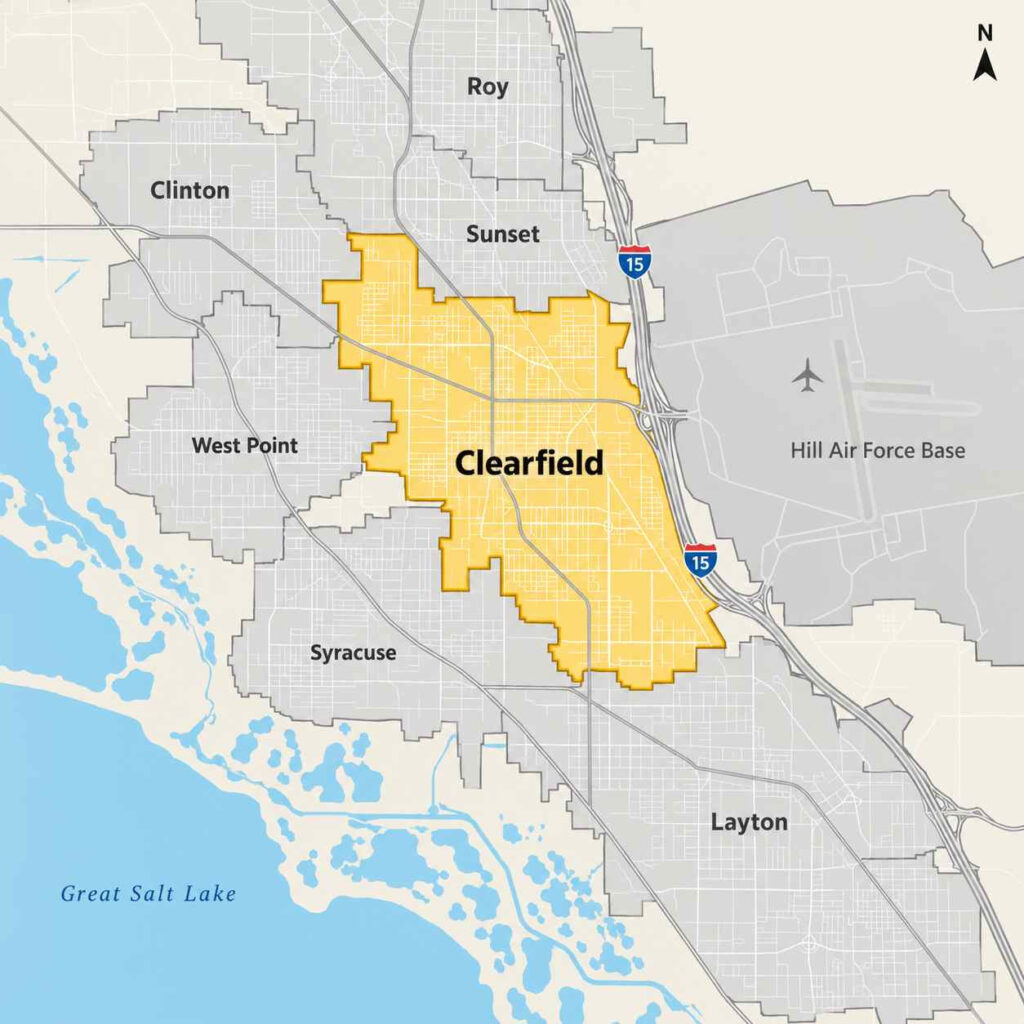
So we have more service history here than almost anywhere, and it says something specific. Clearfield’s pest mix does not look like Syracuse’s or Layton’s, ten minutes up the road.
The local picture
What Clearfield gets more of than the rest of Davis County
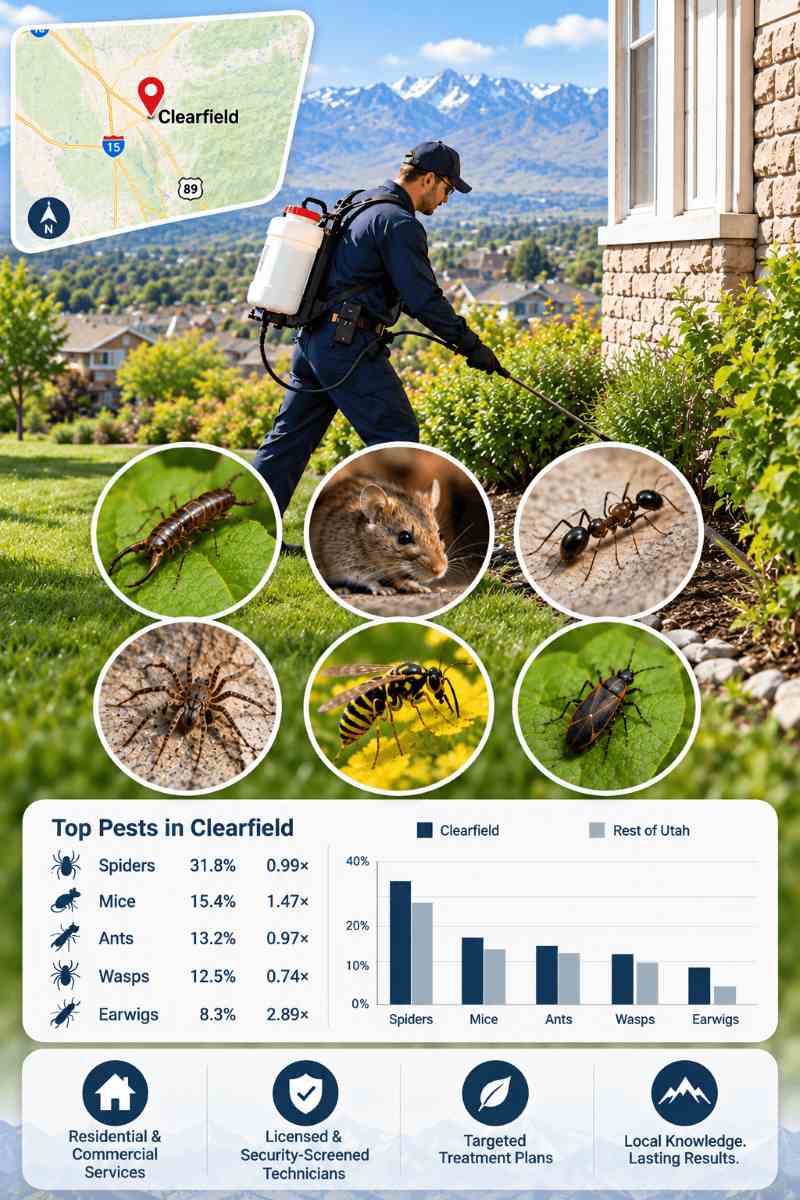
First, where these numbers come from. They are our own service records: 3,157 Clearfield appointments measured against the rest of our Utah work, with every ranking drawn from the 36 cities where we log enough volume to compare fairly. It is a record of what people call us about, not a census of every insect in the city. Across that many visits the pattern holds steady.
Spiders, mice, ants and wasps are the bulk of the work in every city we service. The gap opens up underneath them.
- Earwig calls run nearly three times higher here than across the rest of our area. Clearfield is our number one earwig city of the 36 we compare at volume.
- Mice are more than fifteen percent of the pest codes we log here, about half again the rest-of-area rate, and top five on that list.
- Elm seed bug calls run about a third above average, and beetles a little more than that.
Then the reverse. Wasps, box elder bugs, moths, springtails and aphids all come in below our service-area rate. For a town this old, box elder bugs are the surprise in that list.
Scroll the chart sideways to see the full scale →
Not sure what you are looking at?
Send us a photo. We will identify it and tell you whether it needs treating or not, free, usually the same day.
The big one
Earwigs: Clearfield is our number one city for them
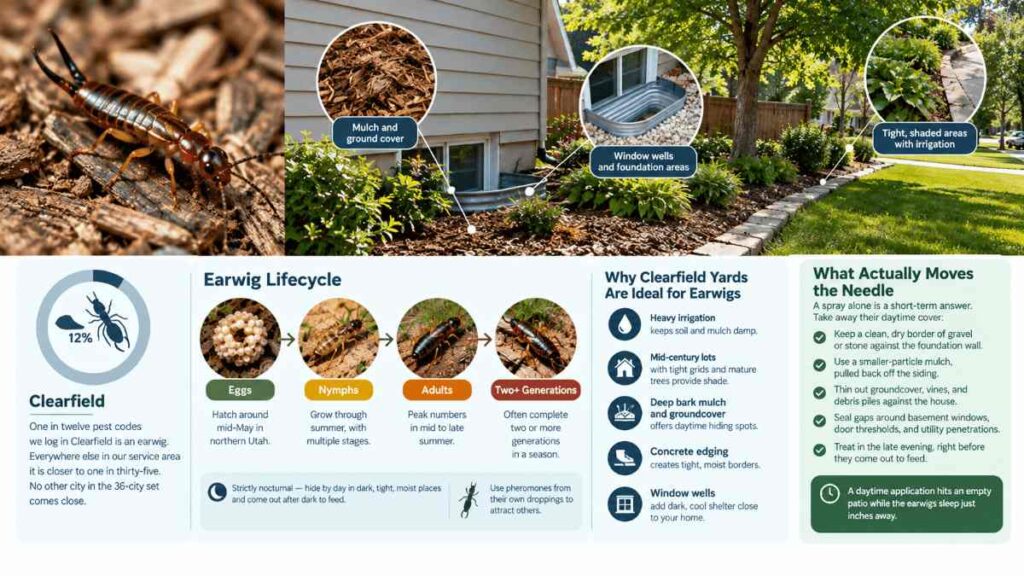
One in twelve pest codes we log in Clearfield is an earwig. Everywhere else in our service area it is closer to one in thirty-five. No other city in the 36-city set comes close, and it is the sharpest difference in the whole Clearfield file.
Earwigs are the flat brown insect with pincers on the back end that bolts for cover when you move a flowerpot. They do not sting and they are not venomous. They just show up in numbers that make people give up on their own patio.
Why a Clearfield yard suits them so well
Utah State University Extension describes the European earwig as strictly nocturnal, hiding by day in dark, tight, moist places and coming out after dark to feed. It also notes that earwigs pull each other in with pheromones from their own droppings, so a good hiding spot does not stay a one-earwig hiding spot for long.
Now walk a Clearfield block. The city sits on the old Lake Bonneville lakebed and stayed dry enough to be called Sand Ridge until the Davis and Weber Counties Canal arrived in 1884. Everything green here is green because somebody waters it. Add mid-century lots on a tight grid, mature shade trees, deep bark mulch, thick groundcover, concrete edging and window wells, and you have the cover that fact sheet describes.
Our best read is that combination: heavy irrigation, a lot of hard edges, and lots small enough that the damp shady half sits against the house. Service records cannot prove it, but it matches what our crews find under the mulch.
USU Extension puts egg hatch in northern Utah around mid-May, with numbers peaking in mid to late summer and two or more generations finished in a season. Our call volume tracks that closely, which is why the panicked July calls are so predictable.
What actually moves the needle on earwigs
A spray alone is a short-term answer, because the yard keeps producing more. USU Extension’s control guidance is mostly about taking away the daytime cover:
- Keep a clean, dry border of gravel or stone against the foundation wall.
- Use a smaller-particle mulch, pulled back off the siding.
- Thin out groundcover, vines and debris piles sitting against the house.
- Seal gaps around basement windows, door thresholds and utility penetrations.
- Treat in the late evening, right before they come out to feed.
That last point matters more than people expect. A daytime application hits an empty patio while the earwigs sleep six inches away under the bark.
Mice: about one in six of everything we treat here
Mouse calls are 15 percent of our Clearfield pest codes against roughly 10 percent across the rest of our area, which puts the city top five of the 36 we compare. By volume, mice are the second most common thing we get called about here, behind spiders.
Clearfield is denser than its neighbors: about 32,000 people on 7.7 square miles, roughly 4,100 per square mile at the 2020 Census. The housing stock is older than the cities west of it, and about four in ten homes are rentals. Older construction means settled foundations, retrofit plumbing, crawl spaces and pencil-width gaps at the sill plate.
Then there is the Freeport Center: 78 buildings and seven million square feet, built in 1943 as the Clearfield Naval Supply Depot and now home to about 70 companies. Loading docks, rail spurs and food distribution on 680 acres in the middle of town is a lot of rodent habitat. We do not track results block by block, so we will not guess how far that reaches. What we can say is that mouse calls run high here and rat calls do not, the pattern you expect from older small structures rather than a dense core.
October and November are when this becomes phone calls. The first cold snap moves mice out of landscaping and into garages, then pantries.
Elm seed bugs and the trees the boom brought
Elm seed bugs are about 3.9 percent of what we treat here against 2.8 percent elsewhere, 12th of the 36 cities. They reached Utah in 2014 and breed on elm, so where they turn up is mostly a question of which trees a neighborhood planted.
Clearfield grew 381 percent in the 1940s, from under a thousand residents to more than 4,700, on the back of Hill Air Force Base and the Depot. Streets laid out in that window got the shade trees that era planted, and those canopies are still standing. Elm seed bugs pile onto sunny walls in midsummer and again in fall, looking for a way in around window frames.
The damp crowd, and one result we cannot explain
Pill bugs run more than twice our service-area rate and rank fifth of 36. Snails and centipedes come in a little above average too. All three want the moist ground earwigs want, so the group reads as one story rather than three. Fair warning on the pill bug figure: it rests on ten logged calls, thin enough that we would not build a plan on it alone.
Here is the part we cannot tidy up. Springtails are a damp-ground insect too, and here they run at less than half our service-area rate, 33rd of 36. That cuts against everything above, and we do not have an explanation we would stand behind, so we will not invent one.
The other side of the list
What Clearfield mostly gets a pass on
Wasps. About 12.5 percent of our Clearfield calls against nearly 17 percent elsewhere, 30th of 36. Nests still go up every year and still need handling in spring. They are just a smaller slice of the work here than in the big-lot cities west of us.
Box elder bugs. Six percent here, ten percent across the rest of the area, 24th of 36. That surprises people, because Clearfield is old enough to have the canopy. Box elder bugs need female, seed-bearing boxelder trees to reproduce, and our best read is that mid-century planting here leaned elm rather than boxelder. Bountiful and Ogden went the other way and pay for it every October.
Mosquitoes. Below average, 17th of 36. The Davis Mosquito Abatement District’s own Clearfield page puts the city 3.5 miles east of the productive breeding sites out toward the lake.
Voles and rats. Both below our service-area rate. Voles want the open ground and new sod of a converted farm field, and Clearfield stopped being farm ground two generations ago.
Why a Clearfield homeowner should call us
Why Clearfield homeowners call Beeline
Nobody is driving up from Utah County. Our office is at 275 W 1700 S, so most Clearfield addresses are under ten minutes away and same-week service is normal rather than a favor. Locally owned, 29 years in Utah, 2,300+ five-star reviews, no hidden charges. Our quarterly service covers every pest on this page, and if something comes back between visits, so do we.
Get a free quote: (801) 544-9200, or text us at (385) 425-1766.
We also service nearby:


A Calendar for Pest Control in Clearfield
What we are treating, and when. The highlighted row is where we are today.
| When | What matters in Clearfield |
|---|---|
| March, April | Clear mulch and debris off foundations before earwig eggs hatch. Knock down wasp queens scouting eaves. |
| May | Earwig hatch begins, usually mid-month. First ant pressure with real heat. |
| June, July, August | Peak earwigs, treated in the evening. Elm seed bugs on sunny walls. Spider webbing builds. |
| September, October | Earwigs taper off, mice start testing the house, elm seed bugs look for a way inside. |
| November to February | Rodent work, interior spiders, and sealing the gaps you found in fall. |
Before you book
Clearfield pest control questions we actually get asked
Why does Clearfield have so many more earwigs than Syracuse or Layton?
Of the 36 cities we service at volume, Clearfield has the highest share of earwig calls, close to three times the rest of our service area. Our best read is the combination: heavy irrigation on old lakebed sand, small lots, and decades of mulch, groundcover and concrete edging. That is the damp daytime cover earwigs need, and newer cities west of us have less.
I keep finding earwigs in my bathroom and kitchen. Is my house infested?
Almost never. Earwigs cannot sustain a population indoors, so the ones inside wandered in from the yard and die within days. Steady sightings mean the outdoor population is high and something is letting them through, usually a door sweep, a window well or a utility gap. Fix the yard and the doorway and the indoor problem stops.
My sister in Bountiful gets box elder bugs all over her house every fall and my house is older than hers. Why don't I?
Most likely you do not have her trees. Box elder bugs need female, seed-bearing boxelder trees to reproduce, and our best read is that Clearfield's mid-century street planting went a different way. They are about 6 percent of our Clearfield calls against about 10 percent across the rest of our area.
The mosquito abatement district already treats Clearfield. Do I still need my own mosquito service?
Often no, and we would rather say so than sell you something. Clearfield mosquito calls run below our service-area average, and the district's own Clearfield page puts the city 3.5 miles east of the productive breeding sites. If you can use your backyard at dusk, you are fine. If you cannot, the problem is usually shaded resting cover on your property, and that part is ours.
Does living near the Freeport Center mean more mice?
We do not track results street by street, so we will not pretend to a precise answer. What we can say is that Clearfield runs top five of 36 cities for mouse calls, and seven million square feet of warehousing and food distribution is a lot of rodent habitat. In our experience the properties that struggle most are the older ones with unsealed crawl spaces and garages, wherever they sit.
Do Clearfield rentals and apartments need their own pest control?
About four in ten Clearfield homes are rentals, and shared walls change the math. Earwigs and mice both move between units, so treating one apartment while the neighbors do nothing rarely holds. Ask your landlord about the building's service schedule before you pay out of pocket. We work with plenty of Clearfield property managers on exactly this.
Three ways to get a Clearfield quote
All of them free, all of them with a real person at our Clearfield office.
- 1Send us a photo(385) 425-1766. Fastest answer.
- 2Call us(801) 544-9200. Mon to Fri 7:30am to 7:00pm, Sat 7:30am to 4:00pm.
- 3Fill in the formSend a picture of the bug or the damage and we will tell you what it is and what it costs.