
Holladay, UT · Salt Lake County
Pest Control in Holladay, Utah
Holladay has been lived in since 1847, and its pests show it. Rat calls here run nearly four times our rate elsewhere, the highest of any city we service at volume, while mice run at half. We treat for the city you actually live in.
Text (385) 425-1766. Send a photo of the bug and we will tell you what it is, free, usually same day.
Holladay has been lived in longer than almost anywhere else in Utah. A group led by John Holladay came into the valley in July 1847, and the city’s history page calls what followed “the first village established away from Salt Lake itself.” They picked the spot for its springs and creeks. Nearly 180 years later the creeks still run, the orchards have become yards, and the trees have grown into one of the valley’s deepest canopies.
All of that shows up in the bugs. We have worked Utah homes for 29 years, and a Holladay pest problem looks like what the city is: an old, wooded, creek-fed place that finished filling in decades ago. The loudest single number in our whole data set belongs to Holladay, and it is not an insect.
The local picture
What Holladay’s service records actually say
First, what these numbers are. They come from our own records: 3,134 Holladay appointments measured against the rest of our Utah work, with every ranking drawn from the 36 cities where we log enough volume to compare fairly. It records what people call us about, not a census of everything living here.
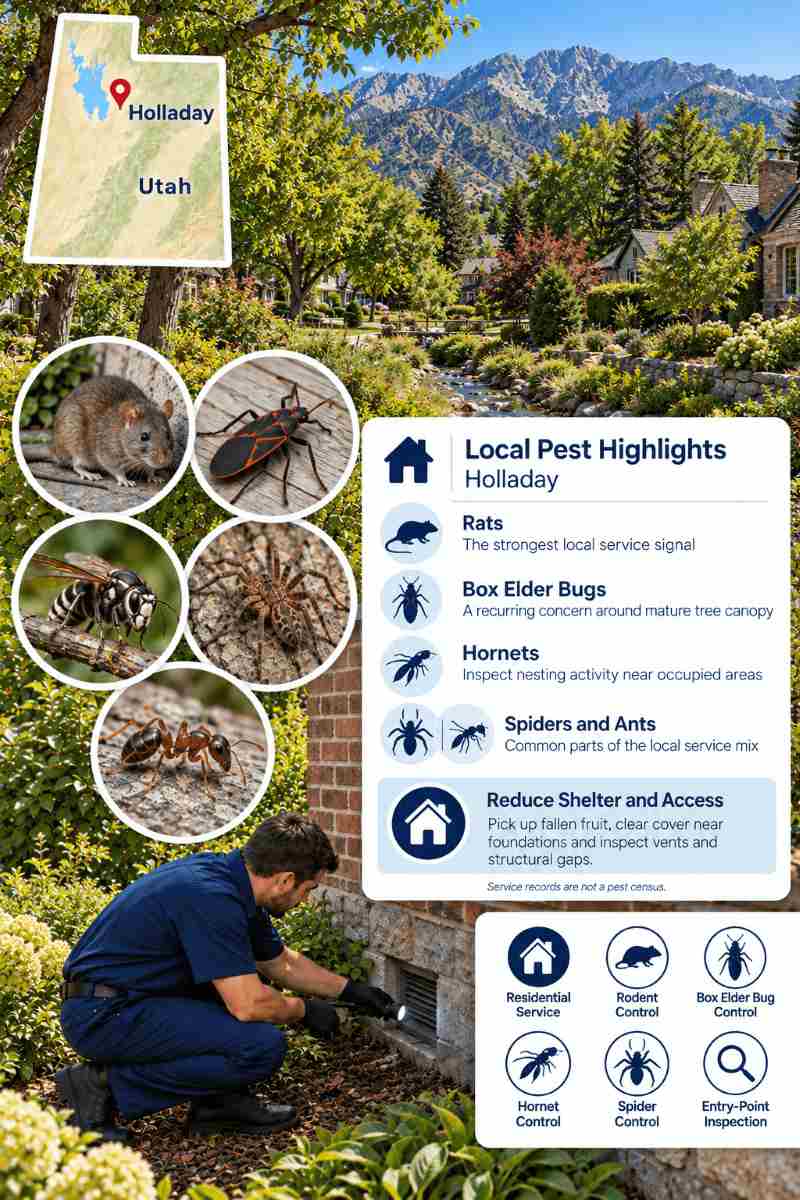
Spiders, ants and wasps are the bulk of the work here, as everywhere in Utah. The interesting part is where Holladay pulls away:
- Rat calls are 7.9% of our Holladay work against 2.0% across the rest of our area. Nearly four times the rate, and the highest share of any of the 36 cities we service at volume.
- Mouse calls run at half the rest-of-area rate, 32nd of those 36. That inversion is the most interesting thing in the file.
- Box elder bug calls run about one and a half times higher, top five of the 36.
- Hornets and bees are both top three, though ordinary wasp calls sit right at average.
- Earwig calls are under a third of the rest-of-area rate, 34th of 36, with voles, beetles and flies all near half.
Scroll the chart sideways to see the full scale →
Read the hot rows and the cold rows together and one story covers most of them. Holladay gets the pests of a settled place: established trees, established burrows, established pipe. It misses the ones that arrive with fresh sod, new sprinklers and open ground at the edge of town.
Not sure what you are looking at?
Text us a photo. We will identify it and tell you whether it needs treating or not, free, usually the same day.
The big one
Rats: the clearest signal anywhere in our service area
Nothing else in our records comes close. At 7.9% of pest codes logged, Holladay ranks first of the 36 cities we service at volume, at nearly four times the rest-of-area rate.
This is a habitat and infrastructure story, not a housekeeping one. Norway rats are not drawn to messy people. They are drawn to three things sitting close together, and Holladay supplies all three.
Water that never shuts off. Big Cottonwood Creek runs through the city on its way from the canyon to the Jordan River, and Holladay was founded on spring-fed streams. The Seven Greenways Vision Plan counts 25.3 stream miles in that corridor, much of it lined with the dense bank vegetation a rat burrows into. Holladay’s own tree ordinance singles out trees near creeks and canals for extra protection, which tells you how much of the corridor is still soft green cover.
Food from the landscape itself. The city grew up on orchards and the fruit and nut trees never left. Fallen apricots, crabapples, walnuts and pears are rat food on a schedule. Add grape arbors, bird feeders and compost, and a Holladay block feeds rats year round.
Cover, and plenty of it. Large lots with detached garages, sheds, decks over crawl space, window wells, firewood stacks, and ivy thickening in the same bed since the Eisenhower administration.
Underneath the yard sits a fourth factor. Holladay’s sewer runs through the Mt. Olympus and Cottonwood Improvement Districts, and much of the lateral pipe from house to main is original clay, which cracks, offsets and root-intrudes. Service records cannot prove that is what produces the number, but a rat signal this far above everywhere else, in the part of the valley with the oldest plumbing, is hard to explain otherwise.
Why rats are a block problem, not a house problem
UC IPM puts the nightly foraging range of a Norway rat at 100 to 500 feet from the nest. On a street of half-acre lots that circle covers your property and four or five neighbors’ at once.
So the rat on your fence is rarely living where you saw it. Treating one property hard while the burrow sits two doors down buys a quiet month. What holds is harborage reduction across the block plus baiting placed on travel routes, not on the sighting.
On your own lot: pick up fallen fruit, lift the woodpile off the ground, cut ivy back off the foundation, screen crawl space vents, and seal gaps wider than half an inch.

Mice run cold here, and that is not a typo
Mouse calls are 5.4% of our Holladay work against 10.7% everywhere else, half the rate, 32nd of 36. In the city that leads the whole list for rats, that surprises people.
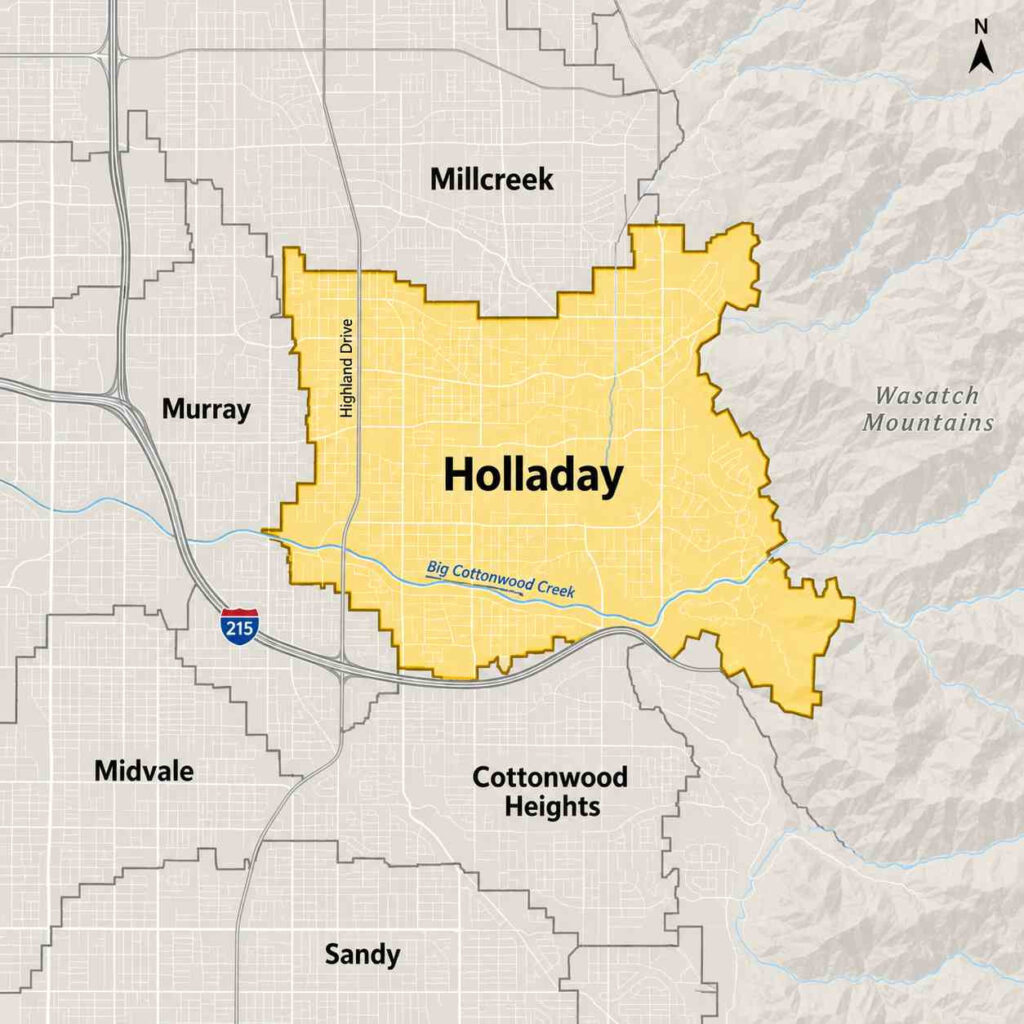
Three things probably contribute, and we would not bet the house on any one. Norway rats and house mice compete for the same harborage, and where rats are established they crowd mice out. House mice in our records also track open ground hardest: fields, canal banks, unbuilt lots. Holladay is 8.5 square miles hemmed in by Murray, Millcreek and Cottonwood Heights, so there is no fringe left for mice to push in from.
The third possibility is about the records themselves. In a neighborhood with a known rat presence, “rat” is the word a homeowner reaches for. Our technicians identify the animal on site, which limits the skew, but it is a real caveat.
Box elder bugs: the bill that comes with a good canopy
Box elder bugs are 14.6% of our Holladay work against 10.0% elsewhere, about one and a half times the rate and fifth of the 36 cities we service at volume. By raw volume they are our fourth-largest category, behind spiders, ants and wasps, but they are what most separates Holladay from the newer half of the valley.
The reason is almost certainly the trees. Box elder bugs need female, seed-bearing boxelder trees to reproduce, plus warm sunny walls to mass on in October. Holladay is a Tree City USA community with a tree committee and an ordinance written to protect what already stands. That canopy is the city’s best feature and, in the second week of October, its most annoying one.
You do not fix this by removing trees. What works is an exterior treatment on sunny south and west walls in early fall, before the bugs mass and work their way in behind siding.
Hornets and bees: near the top for both
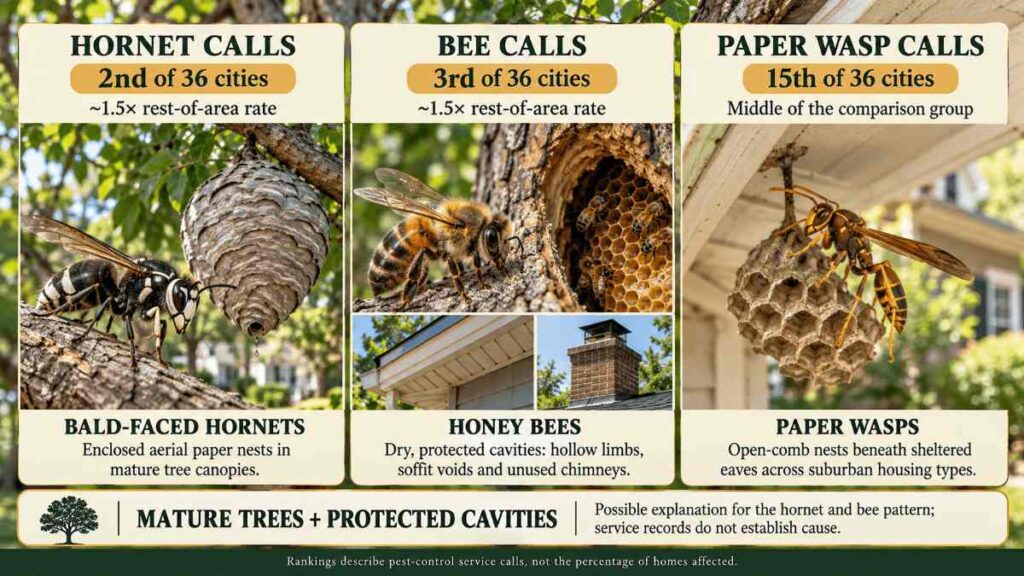
Holladay is second of 36 for hornet calls and third for bee calls, roughly one and a half times the rest-of-area rate on each. Ordinary wasp calls are 16.0% of the work and sit mid-pack, 15th of 36.
That split is telling. Paper wasps nest on anything with an eave, which is why every city gets them at the same rate. Bald-faced hornets want a mature tree to hang an aerial nest in, and honey bee swarms want a dry protected cavity: a hollow limb, a 1950s soffit, an old chimney. Holladay has far more of both than a subdivision built in 2012.
The other side of the list
What Holladay mostly does not get
The cold rows are as useful as the hot ones, because they save you money on services you do not need.
Earwigs. Under a third of the rest-of-area rate, 34th of 36. They thrive in fresh sod, new bark mulch and heavy sprinkler schedules. Our best read is that established, settled ground does not produce them the way a three-year-old west-side yard does.
Voles. Half the rest-of-area rate, 28th of 36. They come out of pasture, canal banks and unbuilt lots, and Holladay has none of that left.
Spiders belong here too. They are the biggest single category of Holladay call at 28.8%, yet that share sits below our service-area average, 32nd of 36. Spiders are the background noise of Utah pest control, not what makes Holladay unusual.
The everyday work
Ants are 16.6% of the mix and run modestly above average, ninth of the 36, which fits a city with this much irrigated old landscaping. Most homes here want a standard quarterly exterior with rodent work layered on.
Why a Holladay homeowner should call us
Why Holladay homeowners call Beeline
Our office is at 275 W 1700 S in Clearfield, about 40 minutes up I-15 from most Holladay addresses. Locally owned, 29 years in Utah, 2,300+ five-star reviews, no hidden charges. Our quarterly service covers everything on this page, and if something comes back between visits, so do we.
Get a free quote: (801) 544-9200, or text us at (385) 425-1766.
We also service nearby:
Review slot 1
Pull a real Holladay or Salt Lake County review from Google. Do not write one.
Review slot 2
Ideally one that mentions rats or box elder bugs.
A Holladay pest control calendar
What we are treating, and when. The highlighted row is where we are today.
| When | What matters in Holladay |
|---|---|
| March, April | Rebait exterior rodent stations before spring breeding, and treat eaves before wasp and hornet queens nest. |
| May, June | Ants push indoors with the first real heat, spider pressure builds, box elder bugs hatch. |
| July, August | Peak stinging insect season and full-size hornet nests. Fruit starts dropping, so rat activity climbs on orchard lots. |
| September, October | Box elder bugs mass on sunny walls, the window where treatment works. Rat pressure moves toward structures as nights cool. |
| November to February | The heaviest rodent months. Rats move into crawl spaces, garages and wall voids, and exclusion does most of the work. |
Before you book
Holladay pest control questions we actually get asked
Does having rats mean my house is dirty?
No, and we want to be plain about it. Holladay leads all 36 cities we service at volume for rat calls, and the reason is habitat, not housekeeping. A creek corridor, old fruit trees and decades-old landscaping supply water, food and cover on their own. Some of the tidiest homes here have rats under the deck.
Why do I have rats when my friends in newer subdivisions have mice?
You live in a different kind of place. Rat calls here run nearly four times the rest-of-area rate while mouse calls run at half of it, 32nd of 36. Rats do best in older, plumbing-heavy neighborhoods with permanent water and continuous cover. Mice track open ground, and Holladay has none left.
Who do I call about rats, the city or a pest control company?
Possibly both. The Mt. Olympus and Cottonwood Improvement Districts maintain the public sewer mains, but the lateral from your house to that main is yours, and a cracked clay lateral is a rat highway. Get it scoped if you have had drainage trouble. The yard, the structure and the baiting are our side.
My daughter's new house on the west side never gets box elder bugs. Why is my yard covered in them?
Trees. Box elder bugs need female seed-bearing boxelder trees to breed, and Holladay's canopy is generations older than a west-side subdivision's. We run fifth of 36 cities for box elder bug calls, a direct consequence of what makes the neighborhood beautiful.
I almost never see earwigs here. Is something different about Holladay?
Yes, and the numbers back you up. Earwig calls here are under a third of our rest-of-area rate, 34th of 36 cities. Earwigs want constantly damp ground, which newer yards with fresh sod and heavy irrigation produce in quantity. Established Holladay landscaping mostly does not, so do not pay for a service you will not use.
There is a ball of bees hanging in my tree. Is that a pest control call?
Tell us what it looks like before anything gets sprayed. Holladay is third of 36 for bee calls and second for hornets, so both are common, but they are very different situations. A honey bee swarm resting in a tree usually moves on and warrants a beekeeper. A bald-faced hornet nest in the same tree in August does not.
Three ways to get a Holladay quote
All of them free, all of them with a real person at our Clearfield office.
- 1Text us a photo(385) 425-1766. Fastest answer. Send a picture of the bug or the damage and we will tell you what it is and what it costs.
- 2Call us(801) 544-9200. Mon to Fri 7:30am to 7:00pm, Sat 7:30am to 4:00pm.
- 3Fill in the formBest if you are reading this at midnight. We will come back to you the next working morning.