
Layton, UT · 10 minutes from our Clearfield office
Pest Control in Layton, Utah
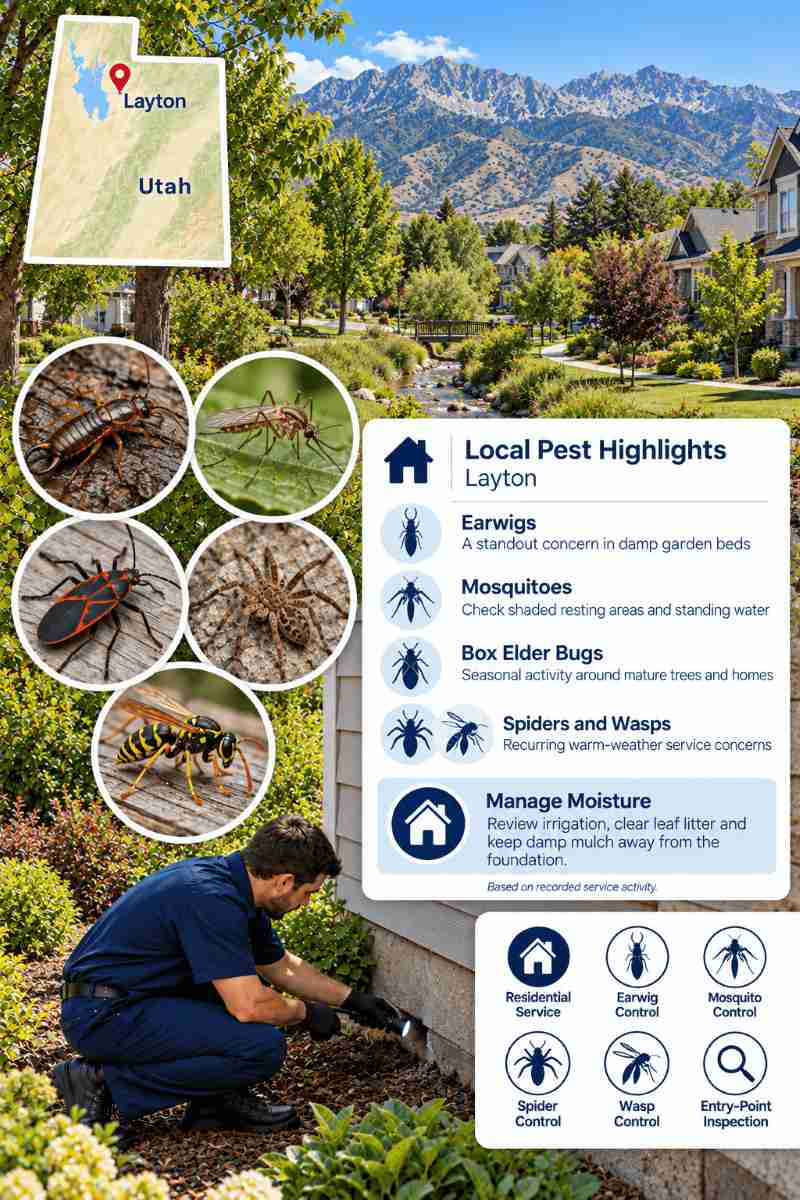
Layton runs on secondary water, and its bugs show it. We log earwig calls at about 1.8 times our rate elsewhere, more mosquitoes and springtails, and almost no flies. We treat for the city you actually live in.
Text (385) 425-1766. Send a photo of the bug and we will tell you what it is, free, usually same day.
Layton is the largest city in Davis County by population and by land area, and it got there in stages. Under 700 people in 1940. Hill Air Force Base arrives, and a decade later there are 3,456. Then subdivisions roll west across the farm ground for fifty years, out toward the Great Salt Lake wetlands, until 2020 counts 81,773.
That layered history is why Layton’s bugs do not look like its neighbors’ bugs. Syracuse to your west is almost all new landscaping. Bountiful to the south is almost all old trees. Layton is both at once, on more outdoor water than nearly anywhere else in the county. We have serviced Utah homes for 29 years, thousands of those visits inside Layton, and the pests that follow water do very well here.
The local picture
What 8,854 Layton service visits actually show
First, what these numbers are. They come from our own service records: 8,854 Layton appointments and 10,070 logged pest codes, measured against the rest of our Utah work. Every ranking below comes from the 36 cities where we log enough volume for a fair comparison. It is a record of what people call us about, not a census of every insect in the city.
Spiders, wasps, ants and mice are the bulk of what we treat in every Utah city. The interesting part is where Layton pulls away:
- Earwig calls run about 1.8 times the rate of the rest of our service area, fourth highest among those 36 cities.
- Mosquito calls run about 1.6 times our service-area rate, sixth of 36, which is high for a city that is not sitting on the lake.
- Springtails, aphids and crickets each run about half again our average, and each lands seventh of 36.
- Box elder bug calls run above average too, tenth of 36 and Layton’s fourth-biggest complaint by volume.
Then there is what Layton does not get, and flies are the headline. Fly calls here are roughly a fifth of our service-area rate, dead last of all 36 cities we compare at volume.
Scroll the chart sideways to see the full scale →
Nearly every pest on that hot list wants the same thing: damp ground and dense planting. Our best read is that Layton’s pest mix is mostly a watering story.
Not sure what you are looking at?
Send us a photo. We will identify it and tell you whether it needs treating or not, free, usually the same day.
The big picture
The water underneath all of it
Layton carries one of the heaviest secondary irrigation loads on this stretch of the Wasatch Front. The city’s water element, filed with the Utah Division of Water Resources, names four secondary suppliers: Weber Basin Water Conservancy District, Kays Creek Irrigation, Holmes Creek Irrigation and the Davis and Weber County Canal Company. Together they delivered roughly 10,873 acre feet in 2021.
Here is the part that matters for bugs. Those connections have largely been unmetered, and the city and Weber Basin are working to meter all of them by 2030. Unmetered water gets used generously. That is not a knock on anybody, it is what people do when the sprinkler is effectively free.
Layout adds to it. Kays Creek and Holmes Creek come down out of the Wasatch and cross the city heading west, and the Kays Creek Parkway follows nearly three miles of that corridor past reedy marsh and heavy tree cover. East Layton backs into Adams Canyon, west Layton runs out into the lake wetlands, and the soil under the mulch rarely dries out.
Earwigs: Layton’s signature call
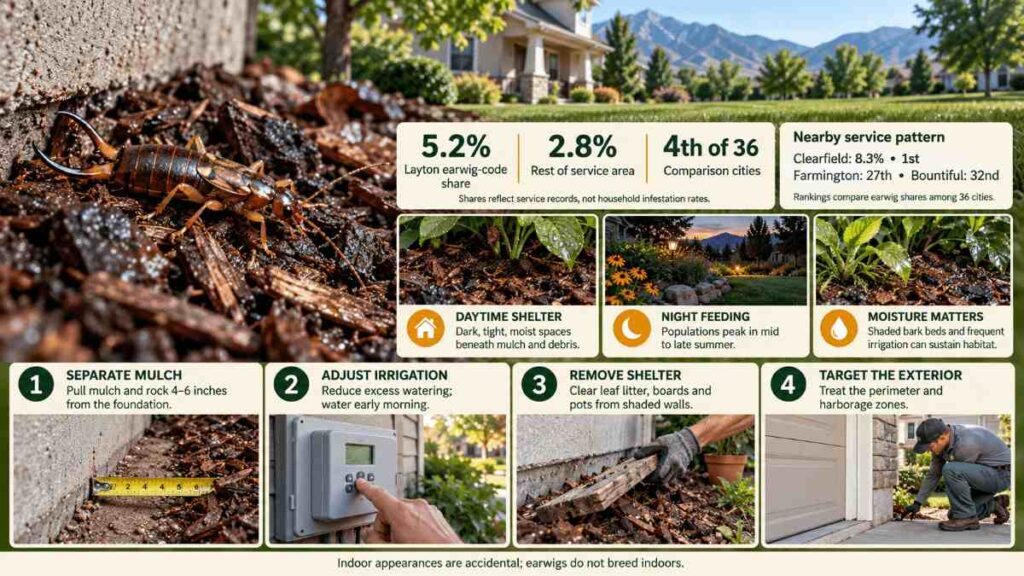
Earwigs are the flat brown insects with the pincers on the back end, and in Layton they are 5.2% of everything we log. Across the rest of our service area they are 2.8%. That is fourth of 36 cities.
The odd part is how local it is. Clearfield, on Layton’s northwest border, is our number one earwig city at 8.3%. Head south and it falls off a cliff: Farmington sits 27th of 36 and Bountiful 32nd. The earwig belt is the northern Davis corridor, and Layton is squarely inside it.
Service records cannot prove why, but the ingredients line up. USU Extension describes earwigs hiding in “dark, tight, and moist places during the daytime,” feeding at night, with populations peaking in mid to late summer. A Layton yard with a thick bark bed against the foundation, a lawn on secondary water and a mature canopy overhead is close to ideal. Flat, heavily irrigated ground holds moisture longer than the bench lots to the south.
What actually helps
Earwigs get inside by accident, through a garage door sweep or a window well, and they do not breed indoors. Interior spraying misses the point. The work is outside:
- Pull mulch and rock back four to six inches from the foundation so the wall can dry.
- Cut sprinkler run times, and water early morning rather than evening.
- Clear leaf litter, boards and pots off the shaded side of the house.
- Treat the exterior perimeter and the harborage itself, then repeat as new generations come up.
One thing you can skip is the worry. Earwigs do not sting, do not carry disease, and the ear business is folklore.
Mosquitoes: elevated, but not for Syracuse’s reason
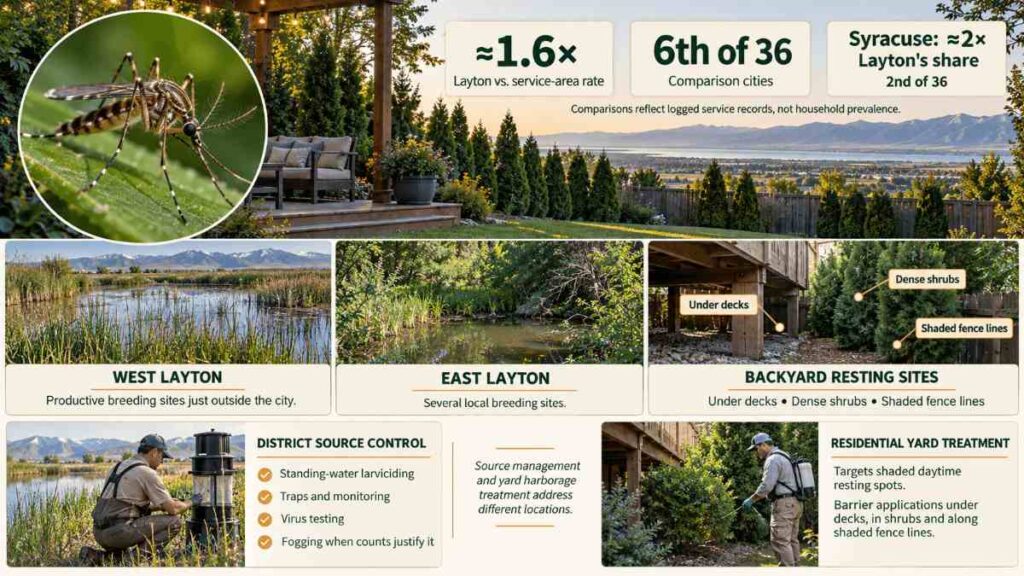
Mosquito calls in Layton run about 1.6 times our service-area rate, sixth of 36. Worth setting next to Syracuse, which runs roughly double Layton’s share and sits second of 36.
The Davis Mosquito Abatement District is blunt about the geography on its own Layton page. It says very productive mosquito breeding sites are located just outside of West Layton, and that East Layton has several productive breeding sites of its own. The district also says it has found West Nile Virus in mosquitoes trapped here every summer for over a decade.
So Layton gets squeezed from both ends: lake wetlands west, canyon and creek water east, 81,000 people in between. Syracuse fights one big marsh upwind; Layton fights a scatter of smaller sources on both sides.
What the abatement district does, and what it does not
The district handles the source: larviciding standing water, running traps, testing for West Nile, fogging when counts justify it. Your property taxes already pay for that. What it does not do is treat your yard. Mosquitoes that drift in rest all day in the shaded spots on your property: under the deck, inside the arborvitae, along a north fence line. A residential treatment is a barrier application to those spots, refreshed through the season.
Box elder bugs: the pest Layton has and Syracuse does not
Box elder bugs are 11.5% of our Layton work, tenth of 36 and above our service-area rate. They are the black and orange bugs that pile onto a sunny south wall in October, then find a way around a window frame.
Cross into Syracuse and they nearly vanish, the lowest share of any city we service at volume. Our best read on that gap is tree age. Box elder bugs need female, seed-bearing boxelder trees to reproduce, and much of Layton has had seventy years to grow a canopy while Syracuse’s streets have not. Bountiful, older still, runs second highest of the 36. Timing is everything on these: a perimeter application in late September, before the first cold snap pushes them to the wall, prevents most November calls.
The other side of the list
What Layton barely gets
Flies. Last of all 36 cities, at roughly a fifth of our service-area rate. Fifteen miles north, Ogden is fourth highest. Fly calls tend to track livestock, dairies and open ground with animals on it, and Layton has essentially none of that left. Our best read is that the fly sources moved out ahead of the subdivisions.
Mice and rats. Both below our service-area rate, mice at about three quarters and rats at about seven tenths. Norway rats do best in older, denser, plumbing-heavy urban cores, which Layton is not. Mice still press indoors every October near open ground.
Spiders, wasps and ants: the everyday work
For everything unusual here, the daily reality matches everywhere else. Spiders are about a third of what we treat and are overwhelmingly harmless: hobo spiders, cellar spiders, orb weavers in window wells. Wasps are 19% of our Layton work, and a nest treated in May is one queen while the same nest in August is hundreds of workers.
Why a Layton homeowner should call us
Why Layton homeowners call Beeline
Our office is at 275 W 1700 S in Clearfield, the next city over and about ten minutes from most Layton addresses. That means same-week service instead of a technician driving up from Utah County. Locally owned, 29 years in Utah, 2,300+ five-star reviews, no hidden charges. Our quarterly service covers every pest on this page, and if something comes back between visits, so do we.
Get a free quote: (801) 544-9200, or text us at (385) 425-1766.
We also service nearby:


Map image slot
Static map, Clearfield office pinned, Layton outlined. Use a static image, not an embedded iframe, so it does not slow the page.
A Layton pest control calendar
What we are treating, and when. The highlighted row is where we are today.
| When | What matters in Layton |
|---|---|
| March, April | Treat eaves and vents before wasp queens commit, and check turf for vole runways after snowmelt. |
| May, June | Ants and spiders build, wasp nests establish, the first earwig generation shows up with the secondary water. |
| July, August | Peak earwigs and mosquitoes, springtails after heavy irrigation, aphids dripping honeydew onto cars. |
| September, October | Box elder bugs mass on south walls, wasp nests hit maximum size, mice move indoors. |
| November to February | Interior rodent work, plus the box elder bugs already in the wall voids. |
Before you book
Layton pest control questions we actually get asked
Why does Layton get so many earwigs?
Moisture is the likeliest answer. Earwigs need damp, tight, dark places to spend the day, and Layton has generous secondary irrigation, decades of established landscaping and two creek corridors running through town. Earwigs are 5.2% of our Layton work against 2.8% across the rest of our service area, fourth among the 36 cities we service at volume.
My sister in Bountiful has never seen an earwig. Why is my patio covered in them?
The earwig belt in Davis County is the north end, not the south. Clearfield is our heaviest earwig city and Layton is fourth of 36, while Bountiful sits 32nd and Farmington 27th. We do not track results street by street, so we will not pretend to a finer answer than that. The flat, heavily irrigated ground up here holds moisture longer than the bench lots to the south.
The mosquito abatement district already treats Layton. Do I still need yard service?
Often yes, because they are two different jobs. The Davis Mosquito Abatement District treats the water where mosquitoes breed and runs trapping and West Nile testing. A residential treatment targets where adult mosquitoes rest during the day on your property: under decks, in dense shrubs, along shaded fence lines. If source work alone were enough, you would not be bitten in your own backyard at dusk.
Why do I get box elder bugs when Syracuse next door barely does?
Most likely, you have the trees and they do not. Box elder bugs need female, seed-bearing boxelder trees to reproduce, and much of Layton has had seventy years to grow a canopy while Syracuse's streets are newer. They are 11.5% of our Layton work, tenth of 36, and Syracuse has the lowest share of any city we service at volume.
Why do we get almost no flies here when Ogden does?
Flies are the strangest thing in our Layton data. Layton is last of all 36 cities we compare, at roughly a fifth of our service-area rate, while Ogden fifteen miles north is fourth highest. Fly calls tend to follow livestock, dairies and open ground with animals on it, and our best read is that Layton built over all of that decades ago.
Does watering with secondary irrigation make my bug problem worse?
It can, and it is easy to fix. Secondary connections in Layton have largely been unmetered, so sprinkler run times drift long without anybody noticing. Constantly wet soil against a foundation is exactly what earwigs, springtails, pill bugs and snails want. Cutting run times and watering early rather than at dusk helps more than people expect.
Three ways to get a Layton quote
All of them free, all of them with a real person at our Clearfield office.
- 1Send us a photo(385) 425-1766. Fastest answer.
- 2Call us(801) 544-9200. Mon to Fri 7:30am to 7:00pm, Sat 7:30am to 4:00pm.
- 3Fill in the formSend a picture of the bug or the damage and we will tell you what it is and what it costs.