
American Fork, UT 84003 · on our regular Utah County route
Pest Control in American Fork, Utah
American Fork logs elm seed bugs at about 2.65 times our rate elsewhere, a pest that did not exist in Utah twelve years ago. We run the city on a regular route and treat for the town you actually live in.
Text (385) 425-1766. Send a photo of the bug and we will tell you what it is, free, usually same day.
American Fork gave us the clearest pest signal on the north Utah County bench, and it comes from a bug that did not exist in this state twelve years ago.
Local service
We are in American Fork most weeks
We have logged 845 service appointments in American Fork. We run the city on a regular route, so a June call does not mean waiting for a special trip from Davis County. Beeline is locally owned, more than 29 years in Utah, over 2,300 five star reviews. Our office at 275 W 1700 S in Clearfield is the only address we have, and we will not pretend otherwise.
Because American Fork sits further out, we look at the whole area
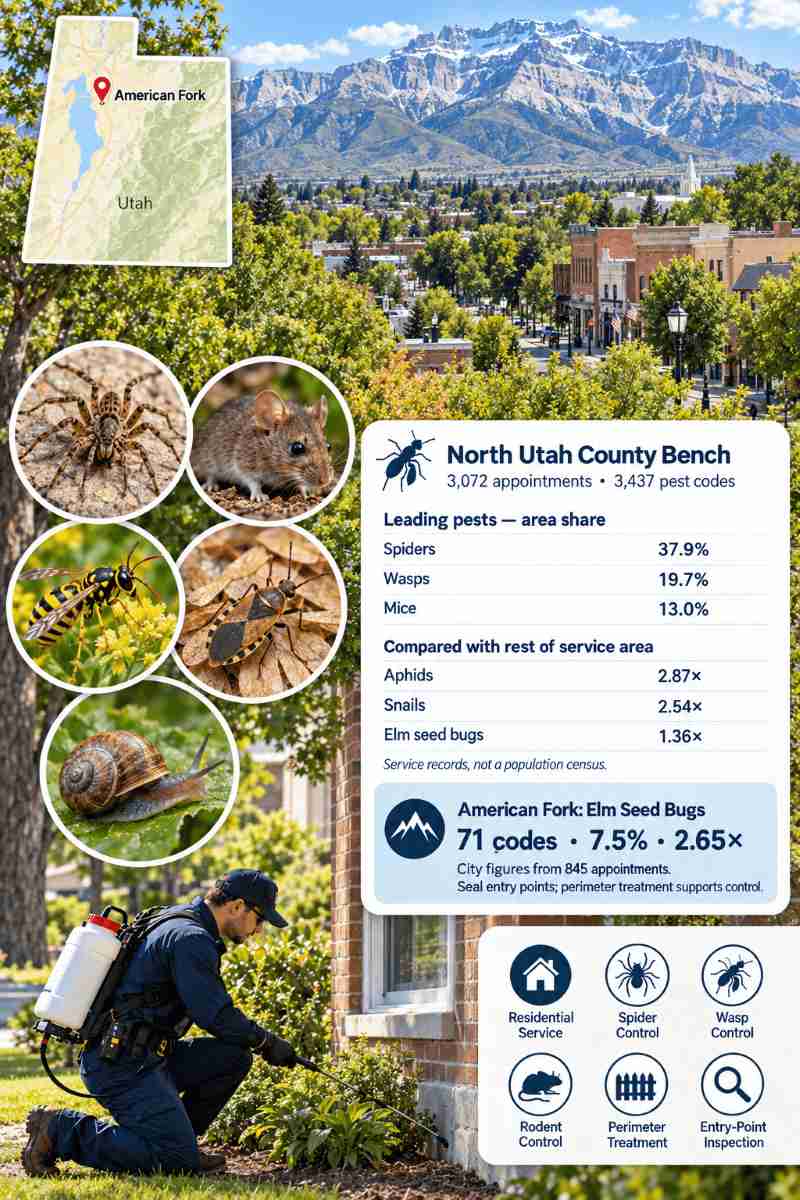
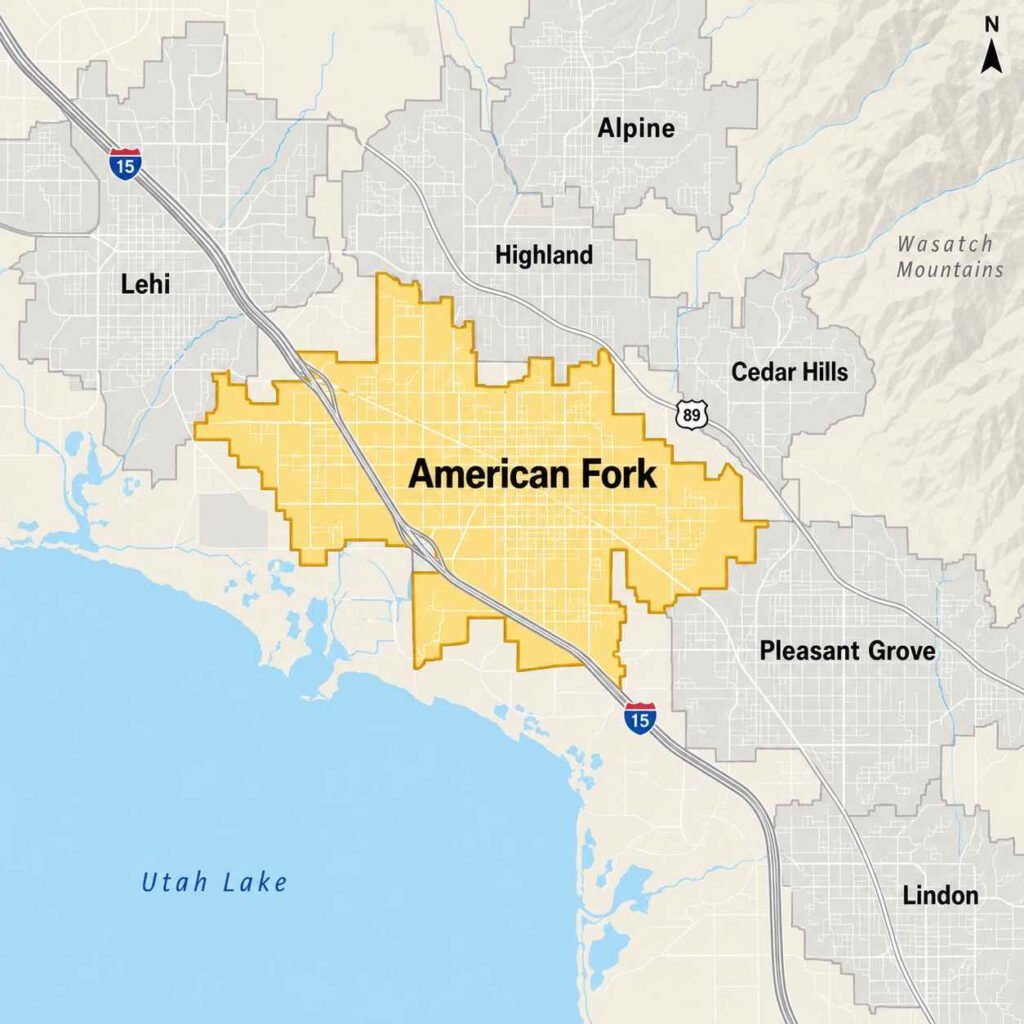
845 appointments is plenty for American Fork’s biggest pest. It is thin for the quieter rows, where a few calls swing a percentage. So for the broad picture we pool American Fork with its bench neighbors: Pleasant Grove, Highland, Lindon, Alpine, Cedar Hills and Vineyard, which is 3,072 appointments carrying 3,437 pest codes. The next two sections are area data, labeled as such.
Scroll the chart sideways to see the full scale →
What the bench calls us about
Across those 3,072 bench appointments the top of the list looks like most of Utah: spiders 37.9 percent of pest codes, wasps 19.7 percent, mice 13.0 percent.
The interesting part sits underneath. Aphids run 2.87 times the rest of our service area on 24 bench logs, snails 2.54 times on 38, elm seed bugs 1.36 times on 132. Three pests that drive our phones everywhere else go quiet here: rats at 0.20 times, box elder bugs at 0.59 times, ants at 0.68 times.
One caveat: this records what people call us about, not a census of the local insect population.
Not sure what you are looking at?
Send us a photo. We will identify it and tell you whether it needs treating or not, free, usually the same day.
Area data
What makes this bench different from the Wasatch Front
Next to Davis County or the Salt Lake valley, whole categories of call vanish. Rats are the big one: 0.44 percent of bench pest codes against 2.20 percent everywhere else, on 15 logs. Norway rats track old dense infrastructure: aging sewer lines, alleys, tight lots, long established commercial strips. Highland, Alpine, Cedar Hills and Vineyard went up in the last forty years on farm ground, and do not have it.
Aphids and snails are the other side of that coin. Both are landscape pests that like young, heavily irrigated yards with new plantings and fresh mulch, the dominant type out here. Our best read is one story: new watered landscaping on old farm ground, with very little old core to feed the rodents.
American Fork is the exception inside its own area.
The big one
American Fork’s elm seed bugs
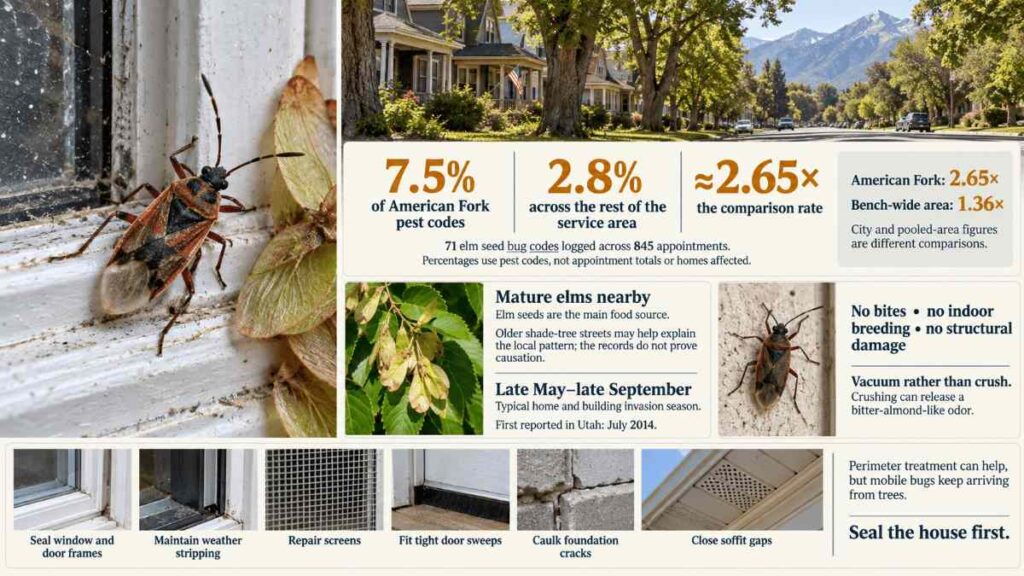
On 845 American Fork appointments we logged 71 elm seed bug codes: 7.5 percent of the city’s pest codes against 2.8 percent across the rest of our service area, about 2.65 times the rate. It is the strongest city level signal on this bench.
The bench as a whole runs elm seed bugs at 1.36 times. American Fork alone runs 2.65 times. The newer towns pull that area figure down and American Fork pulls it up.
Elm seed bugs are new to Utah. Utah State University Extension’s diagnostic lab and USDA APHIS confirmed the first reported occurrence in the state in July 2014. Extension says the insect “feed mostly on elm seeds,” and that “home and building invasions generally occur from late May through late September.” The pest needs mature elm nearby, and nothing substitutes.
American Fork was settled in 1850, generations before most of its neighbors. Its historic district, a dozen downtown blocks, is described in its National Register nomination this way: “Large, mature trees line the streets and shade residential lots throughout the district.” American elm is still on the city’s approved street tree list through its Urban Forestry Office. Highland and Cedar Hills have no such inventory, because they did not exist long enough to grow it.
We cannot prove the trees cause the calls. We can say the one town on this bench with a century and a half of street trees is the one logging elm seed bugs at two and a half times the rate.
The bug is a nuisance, not damage: no bites, no indoor breeding, no structural harm. It does smell, and Extension describes a pungent odor “similar to bitter almonds,” so vacuum rather than crush them. Extension is also blunt that “control with insecticides can be difficult because elm seed bugs are so mobile.” A perimeter spray helps, but cannot finish alone, because new bugs keep arriving off the tree all summer.
Exclusion is what holds: sealing window and door frames, weather stripping, tight screens, door sweeps, caulking foundation cracks and soffit gaps. Extension does list removing nearby elms as an option, though we would not ask a family to lose a ninety year old shade tree over a nuisance bug. Seal the house first. We do the perimeter work and walk your entry points with you, because that is the win.
American Fork’s other numbers
Snails came up on 15 American Fork logs, 1.6 percent of city pest codes against 0.4 percent elsewhere. Fifteen calls is thin and we are flagging it as thin, so believe the direction and not the decimal. Aphids sit at 9 logs, below the line where we make a claim at all. Rats came up 7 times in 845 appointments, which is why we lead with insects here rather than rodents.
Spiders remain your most common call at 355 logs. Elm seed bugs are not the biggest number here, just the most distinctive.
Why an American Fork homeowner should call us
Why Utah County homeowners call Beeline
Locally owned, 29 years in Utah, more than 2,300 five star reviews, no hidden charges. We quote the price before we start, and there is no surcharge for living south of Point of the Mountain. If something comes back between services, we come back and retreat it at no charge.
Call (801) 544-9200 or text (385) 425-1766 for a free quote.
Also on our American Fork County route:


How we handle an American Fork property
A full exterior perimeter: eaves, window and door frames, foundation line and entry points, plus wasp and hornet nests knocked down where found. Late May brings the first elm seed bugs toward structures, June through August is the peak along with wasps and snails, and October is when mice look for a way in. September sealing covers both.
If something comes back between visits, we come back out, with no hidden charges. Call (801) 544-9200, text (385) 425-1766, or email service@BeelinePestControl.com for a free consultation. Tell us if there is an elm on or near the property. It changes what we do first.
An American Fork pest control calendar
What we are treating, and when. The highlighted row is where we are today.
| When | What matters in American Fork |
|---|---|
| November to April | Interior and rodent work, and the window to plan sealing before the elm seed bugs move. |
| May | Late May brings the first elm seed bugs toward structures. Get the sealing done before they move. |
| June, July, August | Peak elm seed bugs on window frames, along with wasps and snails. |
| September | New elm seed bugs keep arriving off the tree. September sealing covers them and the October mice. |
| October | Mice look for a way in. |
Before you book
American Fork questions we actually get
Do you really service American Fork, or is this just a web page?
We really do: 845 appointments in our own records, run on a regular route. Our only office is in Clearfield and we will not pretend there is one here.
What are the flat brown and black bugs on my window frames in July?
Almost certainly elm seed bugs. About a third of an inch, dark with rusty red markings, crowding frames on the sunny side of the house. They are 71 of our American Fork pest codes. Squash one and it smells, so vacuum.
We sprayed and they were back in two days. Did it fail?
No. USU Extension says control with insecticides is difficult because elm seed bugs are so mobile. You killed the ones present and more flew in off the elm the next morning. Spraying supports the job, sealing the house holds it.
How often will you actually be out here?
Quarterly on a standard plan, on the route that already runs through American Fork. If elm seed bugs are your issue we weight a visit toward late May, so sealing is done before they move.
Does it cost more because you are up in Clearfield?
No. We price by property and service, not by how far the truck drove.
What if they come back between my scheduled services?
Call us and we come back out. With elm seed bugs, mid summer re service is normal rather than a sign something went wrong: the tree keeps sending new arrivals into September.
Three ways to get an American Fork quote
All of them free, all of them with a real person at our Clearfield office.
- 1Send us a photo(385) 425-1766. Fastest answer.
- 2Call us(801) 544-9200. Mon to Fri 7:30am to 7:00pm, Sat 7:30am to 4:00pm.
- 3Fill in the formSend a picture of the bug or the damage and we will tell you what it is and what it costs.