
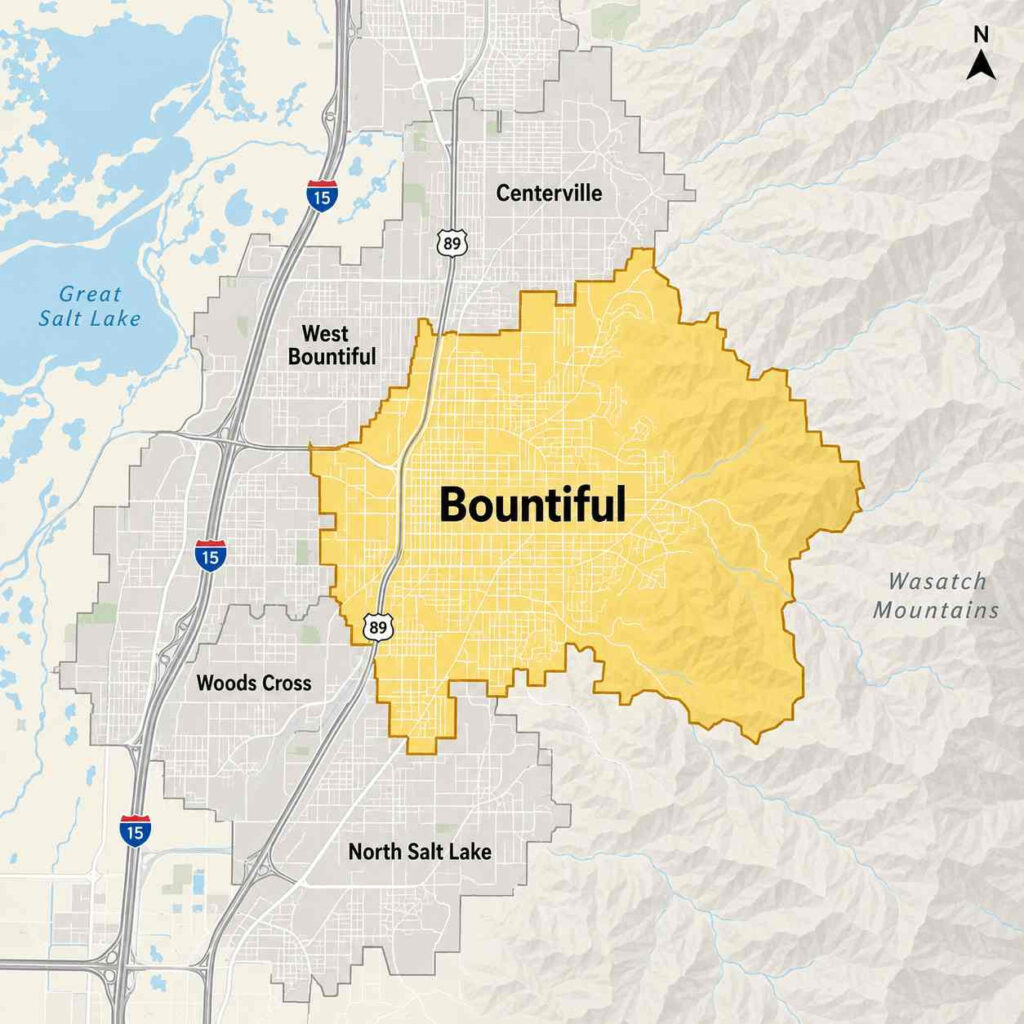
Bountiful, UT 84010 · 25 minutes from our Clearfield office
Pest Control in Bountiful, Utah
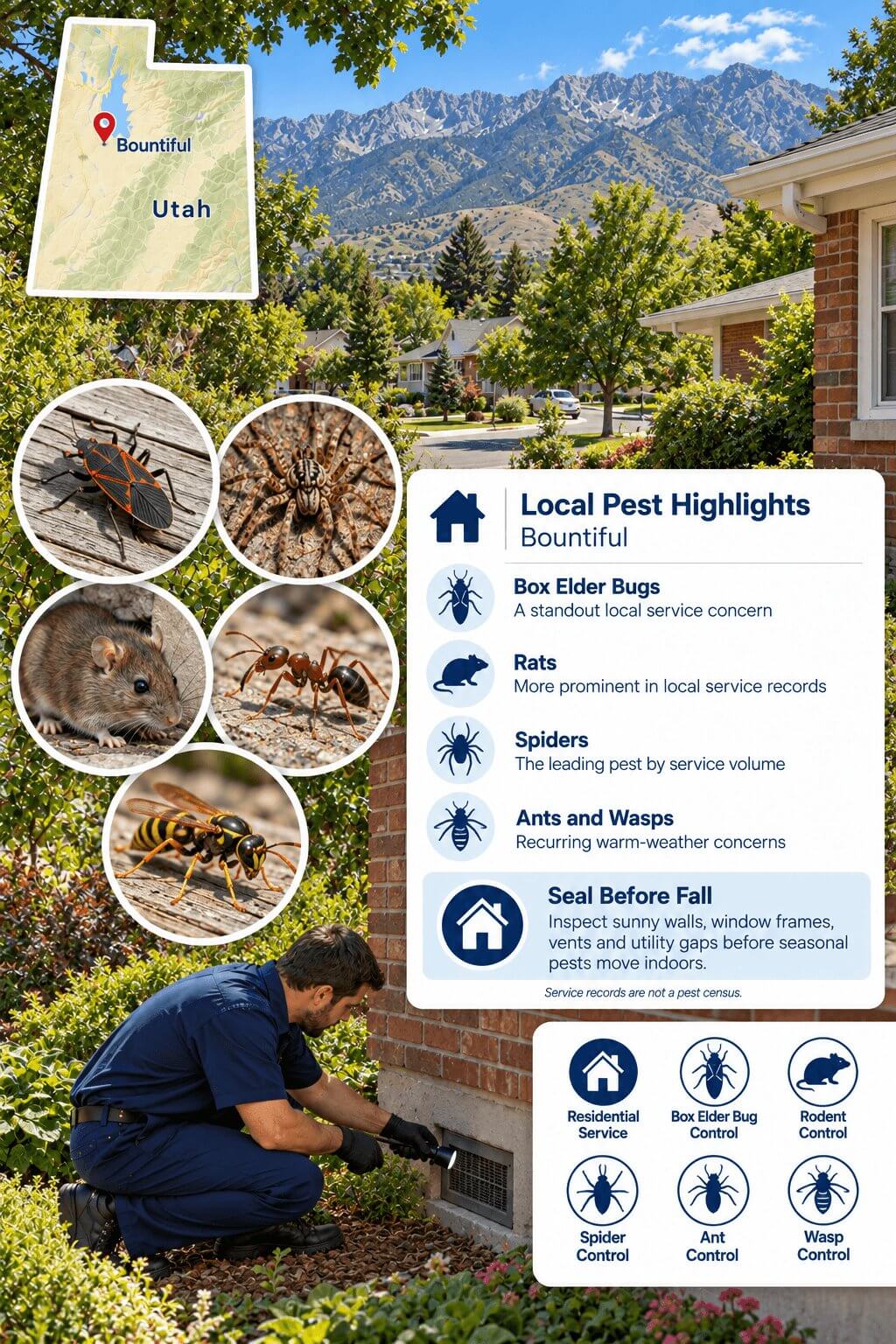
Bountiful is Utah’s second-oldest town, and its bugs show it. We log about 1.6 times the box elder bug calls here that we do across the rest of our service area, more rats, and fewer mice. We treat for the city you actually live in.
Text (385) 425-1766 with a question or a photo of the bug, and we will get back to you, free, usually same day.
Bountiful was settled on September 27, 1847, by Perrigrine Sessions, which makes it Utah’s second town after Salt Lake City. It has had a very long time to grow trees, lay pipe and fill in a bench. Most Wasatch Front cities we serve went from hayfield to subdivision in one generation. Bountiful did not.
That shows up in the bugs. We have serviced Utah homes for 29 years, thousands of those visits inside Bountiful, and the call list here looks nothing like a new city’s. If you moved up the hill and felt like the pests changed, you were not imagining it.
The local picture
What a very old town does to a bug list
First, what these numbers are. They come from our own service records: 4,227 Bountiful appointments measured against the rest of our Utah work, with every ranking drawn from the 36 cities where we log enough volume for a fair comparison. It records what people call us about, not a census of every insect in the city.
Spiders, ants and wasps are the bulk of the work in every Utah city, Bountiful included. Where Bountiful pulls away:
- Box elder bug calls run about 1.6 times higher here than across the rest of our area. They are Bountiful’s second biggest complaint after spiders, and the second highest share of the 36 cities we service at volume.
- Rat calls run about 1.75 times higher, top ten of that same list.
- Mouse calls run about a third lower than our service-area average. For a city with a rat signal that strong, that is backwards, and it is the most interesting number here.
- Earwigs, elm seed bugs and springtails each run at roughly four tenths of our service-area rate, all near the bottom of the 36.
Scroll the chart sideways to see the full scale →
Two things look like they account for most of this: how old the trees are, and how old the pipes are. Service records cannot prove either, but both fit what our technicians keep finding in Bountiful yards and basements.
Not sure what you are looking at?
Text us a question or a photo of the bug. We will identify it and tell you whether it needs treating or not, free, usually the same day.
The big one
Box elder bugs: a clear number two, and not by a little
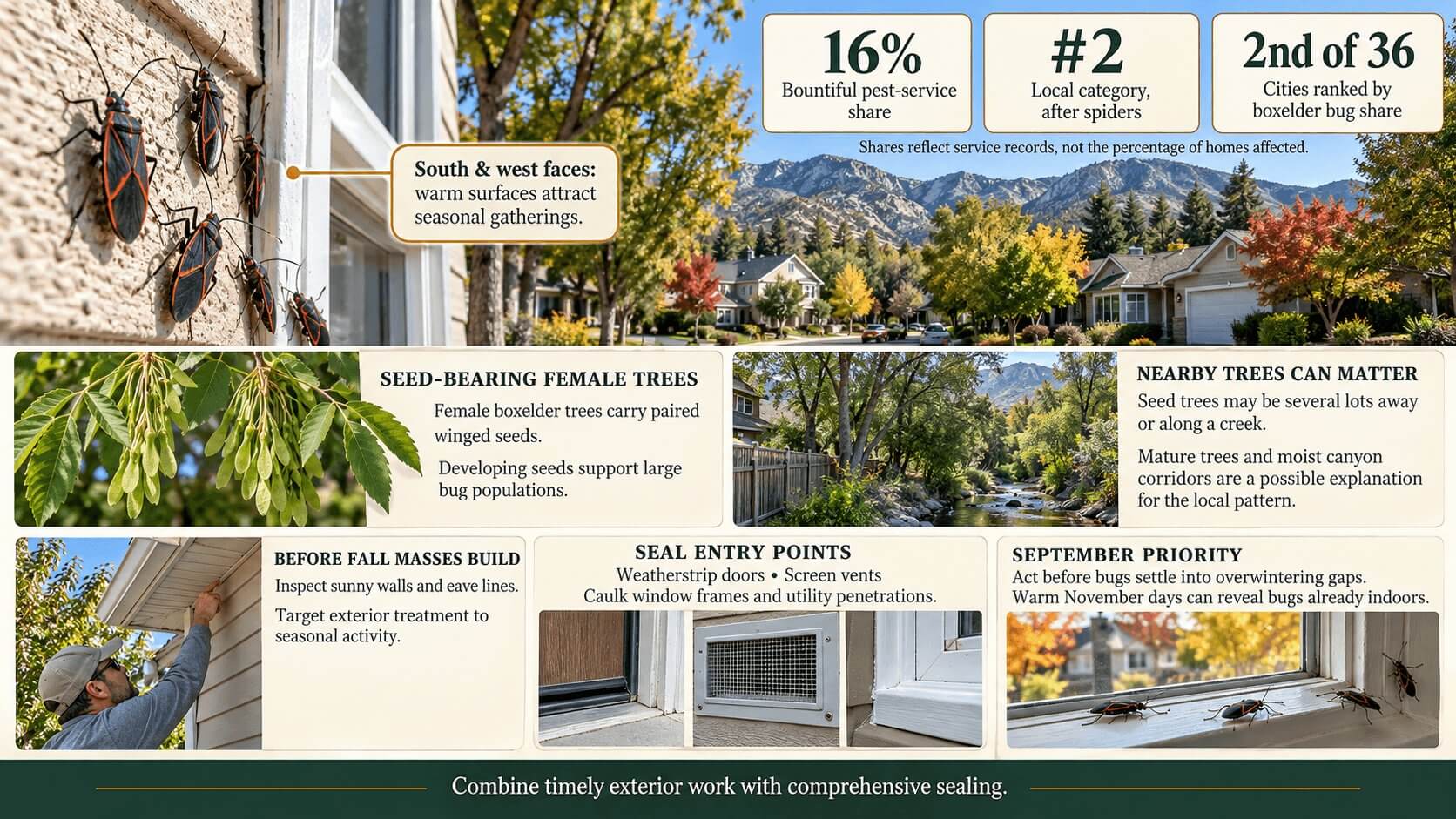
Box elder bugs are 16% of everything we treat in Bountiful. Spiders are the only pest ahead of them, and nothing else is close. Of the 36 cities we service at volume, only one logs a higher share.
The tree explains most of it. Boxelder, sometimes called ashleaf maple, is native to Utah and grows on moist ground along streams and floodplains between roughly 4,000 and 8,000 feet, which describes the canyon drainages out of Mueller Park and Holbrook Canyon almost exactly. It also got planted as a fast shade tree all over town while Bountiful was filling in. The city went from about 6,000 people in 1950 to nearly 33,000 by 1980, so many Bountiful shade trees have had fifty to seventy years to get big.
Boxelder has separate male and female trees, and only the females carry the paired seeds that hang in long chains into winter. USU Extension notes that large box elder bug populations build on those female, seed-bearing trees, feeding on the developing seeds. No seed crop, no population. That is our best read on the gap: Bountiful has the seed trees, and the newer cities do not.
Why your wall gets covered and your neighbor’s does not
We do not track results street by street, so we will not tell you which block is worst. Here is what our technicians see over and over. The heavy masses land on warm, sunny walls, usually the south and west faces, on houses within easy flying distance of a seed-bearing tree. That tree does not have to be yours. It can be three lots over, or in the creek bottom behind the fence.
Timing matters more than product. The bugs move to buildings in late summer and fall, looking for a warm surface and a gap to overwinter in. USU is blunt that spraying alone is difficult and not very successful, because these bugs tolerate a lot. What pays off is treating the sunny walls and eave line before the masses build, paired with sealing: weatherstrip the doors, screen the vents, caulk the window frames and utility penetrations. Handled in September, this is manageable. Handled in November, when they are waking up in your bedroom on a warm day, it is a longer conversation.
Rats, and a rodent mix that surprises people
Rat calls are 3.7% of our Bountiful work against 2.1% across the rest of our area, a top-ten share among the 36 cities we compare. On its own that is a normal old-city number. What makes Bountiful unusual is what sits next to it.
Mice run the other way: 7.2% of our work here against 10.7% everywhere else, near the bottom of the same 36. Put those together and Bountiful’s rodent calls come in at roughly two mice for every rat, where the rest of our area is closer to five to one. Bountiful is not a rodent hot spot. It is a city whose rodent problem is unusually rat-shaped.
Our best read is that this is an infrastructure story, not a wildlife story. Norway rats do well in older, denser, plumbing-heavy neighborhoods with mature landscaping and a long history of buried utilities. Bountiful has had that since before most Utah cities had a paved street. House mice push indoors hardest from open ground, and Bountiful has very little of that left inside city limits. The Utah Department of Agriculture and Food puts the exclusion numbers plainly: a rat gets through an opening over half an inch, a mouse through anything over a quarter inch, and a female rat can produce eight litters a year. That is why a small gap at a crawl space vent or an old sewer cleanout becomes a real problem faster than people expect.
If you are hearing something heavier than a mouse in the wall, or finding droppings around three quarters of an inch, do not talk yourself out of it.
Spiders, ants and wasps: the everyday work
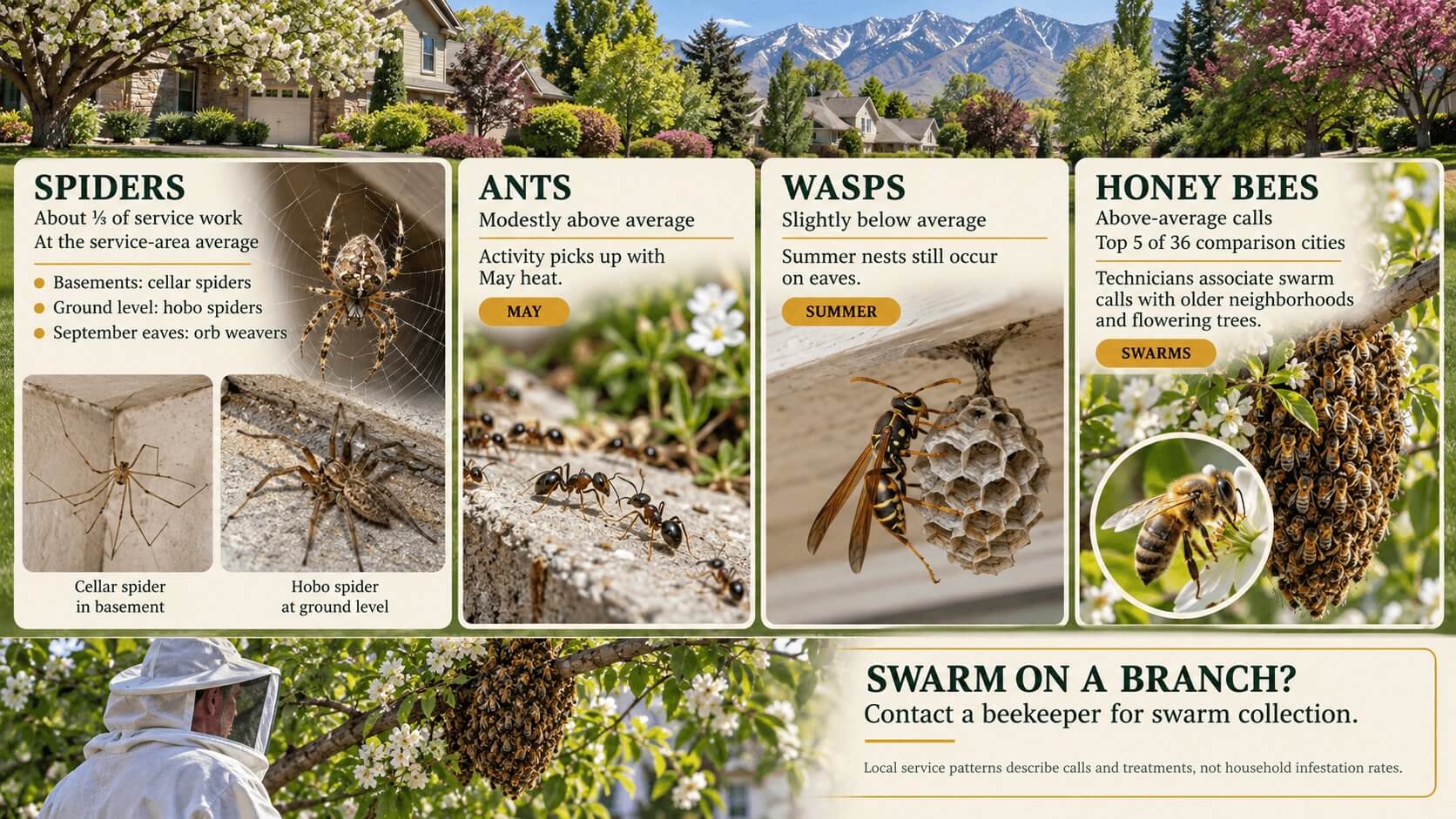
For all that is unusual here, most of the calendar is ordinary. Spiders are about a third of everything we treat, dead level with our service-area average, and nearly all of them harmless: cellar spiders in basements, hobo spiders at ground level, orb weavers across the eaves by September.
Ants run modestly above average and pick up with the first real heat in May. Wasps run a little below our service-area rate, though we still pull nests off Bountiful houses every summer. One quirk: honey bee calls run above average here, a top-five share among the 36 cities we compare. Older neighborhoods with big flowering trees produce more swarm calls, and a swarm on a branch is a beekeeper’s job, not an exterminator’s.
The other side of the list
What Bountiful mostly does not get
The absences matter as much as the peaks, because they save you money on services you do not need.
Earwigs. About four tenths of our service-area rate, near the bottom of the 36. Earwigs want dark, tight, damp daytime hiding places. Bountiful sits on a steep bench that sheds water toward the lake instead of holding it, and that goes a long way toward explaining why the flatter cities west of I-15 call us about earwigs and Bountiful mostly does not.
Springtails. Same story, smaller numbers. They need constantly damp ground, and Bountiful yards drain.
Elm seed bugs. This one surprises people, because Bountiful has plenty of mature trees. The catch is that elm seed bugs need elm, not maple or boxelder. They were first reported in Utah in July 2014 and have spread widely along the Wasatch Front, but Bountiful’s call volume is still about four tenths of our rate elsewhere. Our read is that it comes down to what got planted here, and this is boxelder and maple country.
Mice. Worth repeating, because people budget for the wrong rodent here. Mice are less of a Bountiful problem than average, and rats are more of one.
Why a Bountiful homeowner should call us
Why Bountiful homeowners call Beeline
Our office is at 275 W 1700 S in Clearfield, about 25 minutes up I-15, so you get same-week service from a crew that works Davis County every day. Locally owned, 29 years in Utah, 2,300+ five-star reviews, no hidden charges. Our quarterly service covers every pest on this page, and if something comes back between visits, so do we.
Free quote: (801) 544-9200, or text (385) 425-1766.
We also service nearby:


A Bountiful pest control calendar
What we are treating, and when. The highlighted row is where we are today.
| When | What matters in Bountiful |
|---|---|
| March, April | Overwintered box elder bugs come out of walls and attics on the first warm days. Seal now, before the spring generation lays eggs on the seed trees. |
| May, June | Ants pick up with the heat, wasp queens start nests under eaves, spider activity builds. |
| July, August | Peak spider and wasp season, and the second box elder bug generation developing on the trees. |
| September, October | The big one. Box elder bugs mass on sunny walls, spider webbing peaks, and rodents start working toward warm basements and crawl spaces. |
| November to February | Rat and interior work, plus the box elder bugs that already got in and keep turning up in one warm room. |
Before you book
Bountiful pest control questions we actually get asked
My daughter's house in Syracuse never gets box elder bugs and mine is covered every fall. Why?
Trees. Box elder bugs build their big populations on female, seed-bearing boxelder trees, and Bountiful has had seventy years to grow them while Syracuse was farm ground. Of the 36 cities we service at volume, Bountiful has the second highest share of box elder bug calls and Syracuse the lowest.
Do I have to cut down my boxelder tree?
Usually not, and we would rather you did not lose a mature shade tree over a nuisance bug. Removal only helps if the tree is female and seed bearing, and even then the bugs fly in from other yards. If you are replacing a failing tree anyway, pick something other than boxelder. Otherwise, treat the sunny walls and seal the house.
Is it actually rats in Bountiful, or is everyone just calling mice rats?
It is genuinely rats more often here than in most cities we work. Rat calls run about 1.75 times our service-area rate and mouse calls about a third below it, so Bountiful's rodent mix is roughly two mice per rat where the rest of our area is closer to five to one. Size is the easy check: a Norway rat runs 12 to 18 inches nose to tail, a house mouse under 8.
Are rats worse on the west side of Bountiful, down by the highway?
We do not track results street by street, so we will not pretend to a precise answer. From field experience, the pattern follows age and density more than direction: older housing, older buried utilities, mature landscaping and any property with food sitting out. A 1950s block on the bench can have the same issue as one down near 500 West.
Why do I almost never see earwigs when everyone says Utah is crawling with them?
Because you live on a bench that drains. Earwigs need dark, tight, damp daytime shelter, and Bountiful's coarse, steep ground does not hold water the way the flats west of I-15 do. Earwig calls here are about four tenths of our service-area rate, 32nd of the 36 cities we service at volume. Same goes for springtails.
My house was built in the 1950s. Does that change what I should be worried about?
It does, in both directions. Older Bountiful homes tend to have more gaps at sills, vents, crawl space hatches and utility penetrations, which is the rat and box elder bug entry story. They also sit on better-drained, established lots, so you are less likely to fight the moisture pests. The highest-value thing you can do on a mid-century Bountiful house is exclusion work before fall, not more spray.
Three ways to get a Bountiful quote
All of them free, all of them with a real person at our Clearfield office.
- 1Send us a photo(385) 425-1766. Fastest answer.
- 2Call us(801) 544-9200. Mon to Fri 7:30am to 7:00pm, Sat 7:30am to 4:00pm.
- 3Fill in the formSend a picture of the bug or the damage and we will tell you what it is and what it costs.