
Lehi, UT 84043 · on our regular Utah County route
Pest Control in Lehi, Utah
Snail and slug calls in Lehi run more than five times our rate elsewhere, the highest multiple of any pest in any city we service at volume. We run Lehi on a regular route most weeks and treat for the town you actually live in.
Text (385) 425-1766 with a question or a photo of the bug, and we will get back to you, free, usually same day.
The local picture
What our Lehi service records show
These come from our own appointment records: 1,396 Lehi visits carrying 1,568 logged pest codes, measured against the rest of our Utah service area and ranked only against the 35 cities where we log enough volume to compare fairly. Lehi clears that bar on its own. Most towns out this way do not.
- Snails are 2.3% of every pest code we log in Lehi, about 5.3 times the rest-of-area rate, and first of those 35 cities. Honest caveat: that sits on 36 logs. The direction is solid and the gap is wide, but treat the exact multiple as a ballpark.
- Box elder bug calls run about a third of our service-area rate, 53 logs out of 1,568, the largest absence in Lehi’s table.
- Mosquito calls run close to twice our rate, on 23 logs. Real, but a small number, and we say so.
- Spiders, wasps, mice and ants fill the rest, in that order, as they do nearly everywhere in Utah.
The ground does not stop at the city line, so neither does our data
Lehi shares its soil, water and construction timeline with the towns west of it, and some pests read more clearly in that wider pool. So we also pooled Lehi, Saratoga Springs, Eagle Mountain, Cedar Fort and Fairfield: 2,456 appointments and 2,691 pest codes across Cedar Valley and west Utah County. Everything below is area data, labelled as such.
Lehi holds the strangest number in our entire service record. Snail and slug calls here run more than five times the rate we see across the rest of our Utah coverage, the single highest multiple of any pest in any city we service at volume. That is what happens when a dry farm valley gets 90,000 people, sod lawns and a pressurized irrigation line on nearly every lot.
Lehi was settled at Dry Creek in 1850 and spent a century as grain and dairy ground. It had 19,028 residents in 2000 and 75,907 in 2020. Silicon Slopes arrived with the rooftops, and so did bark mulch, drip line and secondary water. We have treated Utah homes for 29 years, 1,396 of those appointments in Lehi, on a regular route most weeks.
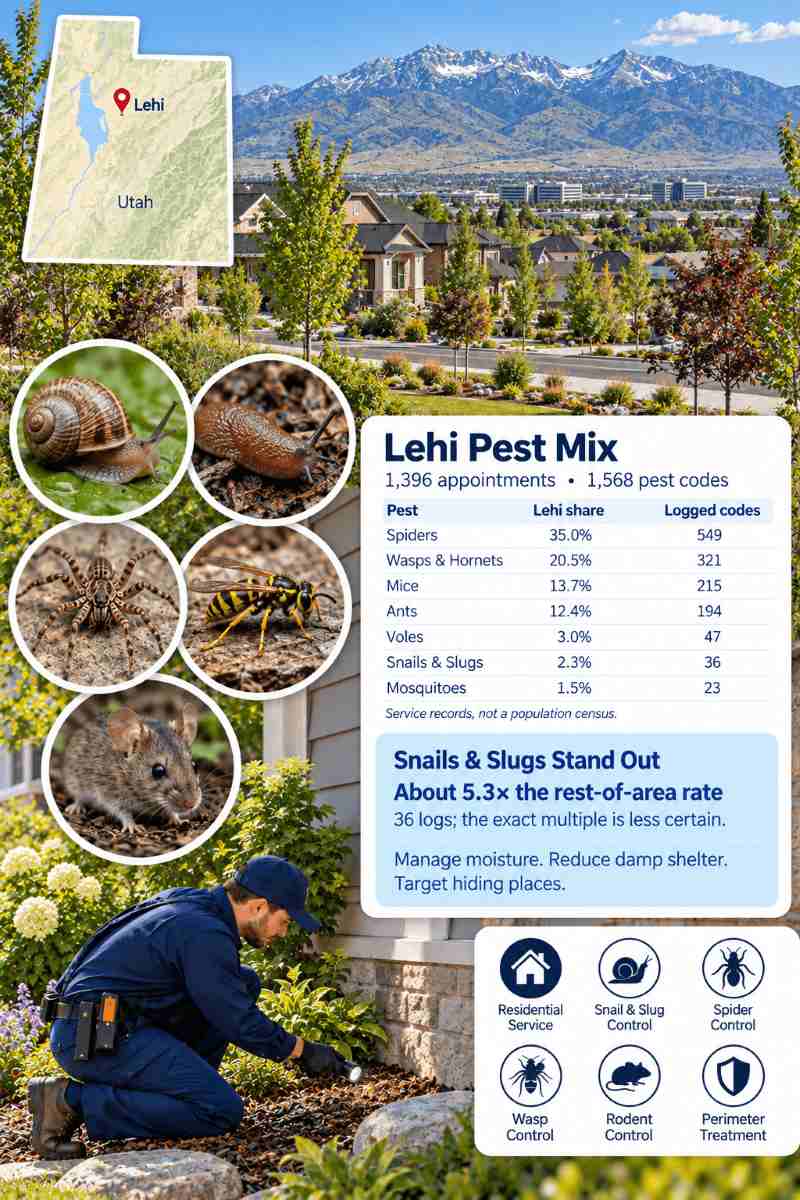
Scroll the chart sideways to see the full scale →
Across that area, mouse calls run about 1.65 times our rate on 465 logs, voles about 2.4 times on 124 logs, flies about 1.7 times on 54 logs, and snails about 3.9 times on 45 logs. Rats are nearly absent: 8 codes out of 2,691.
Not sure what you are looking at?
Text us a question or a photo of the bug. We will identify it and tell you whether it needs treating or not, free, usually the same day.
The big one
Snails and slugs: the highest single multiple anywhere we work
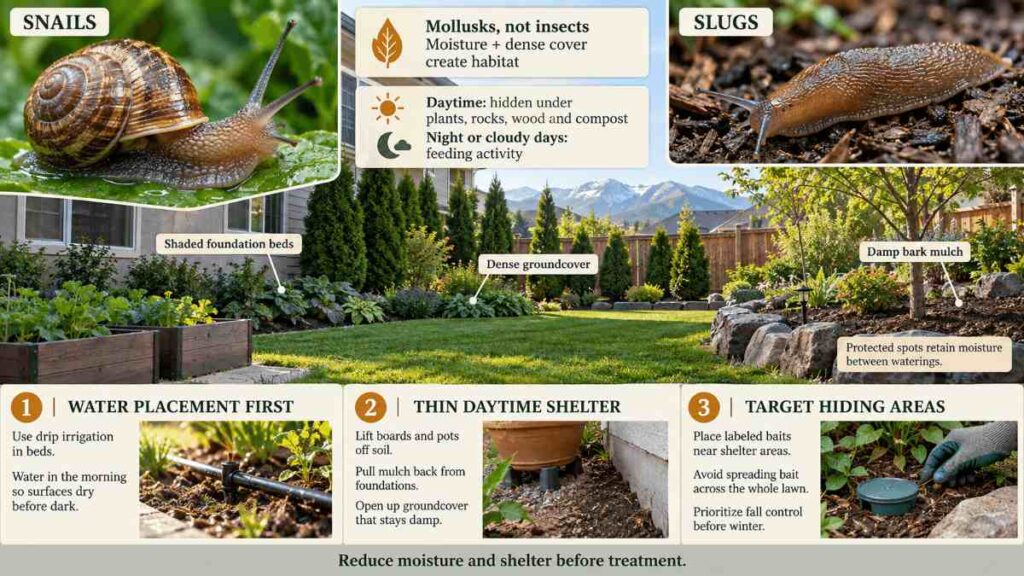
USU Extension explains the Lehi number better than we can. Slugs and snails are mollusks, closer to clams than insects, and they need moisture to thrive, surviving drier conditions only by hiding in protected spots. By day they shelter under plants, rocks, wood and compost, and they feed at night or on dark, cloudy days. Dense groundcover, turf and moisture-holding organic matter build their habitat.
Read that again as a description of a five-year-old Lehi backyard. New sod on a secondary irrigation schedule. Fresh bark over weed fabric, damp underneath for days. Boulder edging, arborvitae, raised beds against a north foundation. The dry farm ground that used to sit here supported none of it.
What actually works on them
Water placement first. Extension notes that drip irrigation reduces the free moisture snails depend on, so moving beds off spray heads is the biggest lever most Lehi homeowners have, and morning watering lets surfaces dry before dark. Then thin the daytime shelter: lift boards and pots off the soil, pull mulch back from foundations, open up groundcover that never dries. Then treat, with baits where they hide rather than across lawn. Fall control pays for itself: Extension puts one adult removed before winter at roughly 300 fewer offspring next spring.
The other side of the list
What this area does not get
The cold numbers out here are as useful as the hot ones, and they all point at the age of the ground.
Rats are close to nonexistent: 8 codes out of 2,691 across the area. Norway rats want old, dense, plumbing-heavy blocks with a century of buried infrastructure under them, and Cedar Valley has almost none of that. If you moved here from Salt Lake City, that is a real difference, not marketing.
Box elder bugs need mature female boxelder trees to breed on, and Lehi’s canopy is too young, which is why they run at a third of our rate. Earwigs and elm seed bugs sit near 40% of our rate area-wide for the same reason.
The everyday work, and a Lehi calendar
Most visits here are ordinary. Spiders are 549 of our 1,568 Lehi pest codes, right at our norm. Wasps are 321, helped along by deep eaves, detached shops and vinyl fence rails. Mice are 215 and ants 194. Voles, on 47 Lehi logs and higher still area-wide, chew bark and run surface trails under snow in these newer irrigated subdivisions. Mosquitoes fit the geography too: the Jordan River leaves Utah Lake at Lehi’s southeast edge, the Utah County Mosquito Abatement District treats that source water, and a yard barrier treatment covers the shaded spots it does not.
| When | What matters in Lehi |
|---|---|
| March and April | Snail baiting as beds green up, vole damage at snowmelt, first wasp queens on the eaves. |
| May and June | Secondary water comes on, mosquitoes start, ants move indoors. |
| July and August | Peak wasps, mosquitoes and spiders, while snails keep going under irrigated mulch. |
| September and October | The important months for snails, because fall control removes next year’s eggs. Mice press indoors, and secondary water shuts off by October 15. |
| November through February | Rodent exclusion, voles under snow, overwintering spiders in garages. |
Why a Lehi homeowner should call us
Why Lehi homeowners call Beeline
Locally owned, 29 years in Utah, 2,300+ five-star reviews, no hidden charges. Lehi is on a regular route, so if something shows up between quarterly visits we come back at no extra cost.
Call (801) 544-9200, text (385) 425-1766, or request a free quote online.
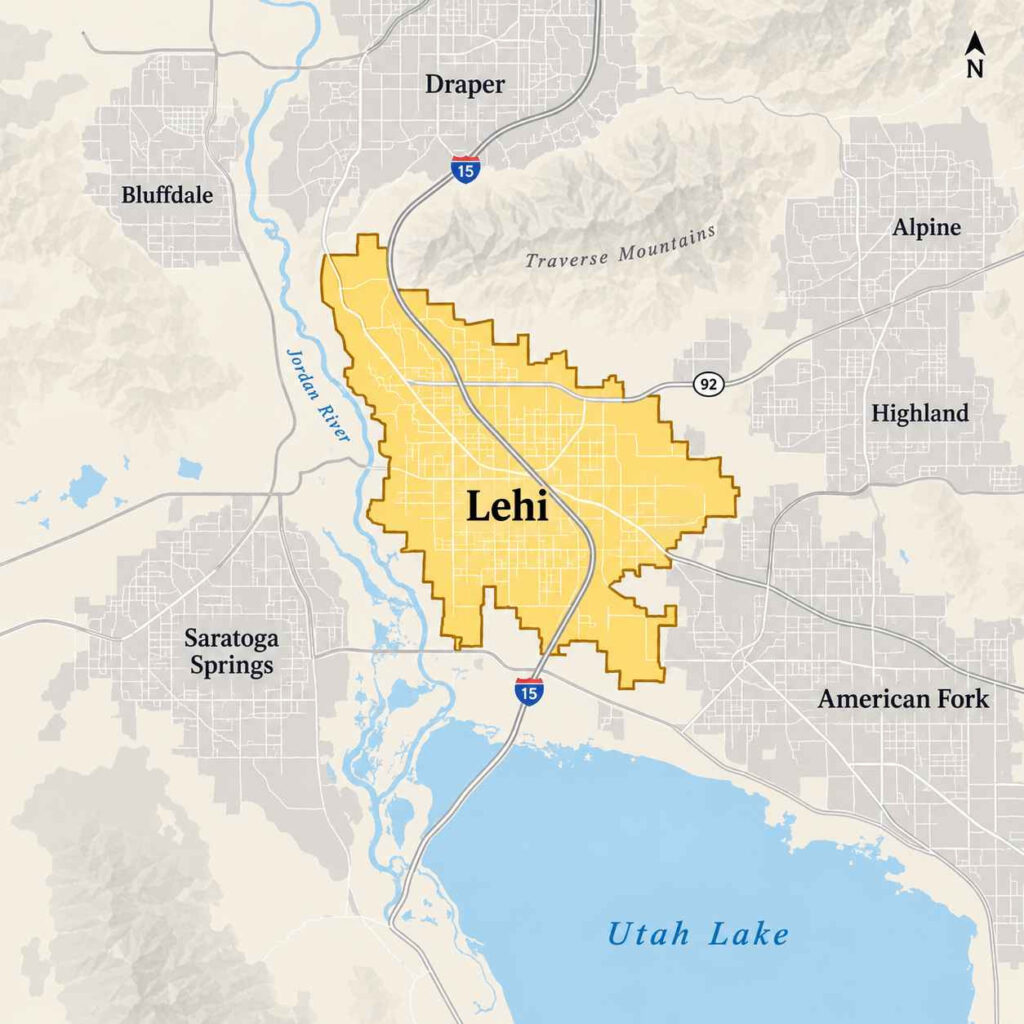
Also on our Cedar Valley route:


Before you book
Lehi pest control questions we actually get asked
Do you really come out to Lehi?
We really come out. Lehi accounts for 1,396 of our service appointments, more than most cities we work. It is a scheduled route, not a special trip, and we are here most weeks.
Does it cost more because you are not based in Lehi?
No. Lehi is a routed service area, priced the same as anywhere else we run. You are not paying for anybody's drive time.
What if I get a problem between scheduled visits?
Call us and we come back out. Return visits between regular services are included.
Why do I have snails in Utah? I thought this was a desert.
Because your yard is not. Snail calls here run about 5.3 times our rate across the rest of Utah, the highest multiple of any pest in any of the 35 cities we compare, on 36 logged calls. USU Extension notes that slugs and snails need moisture and hide by day under plants, rocks, wood and mulch. New sod, bark beds and secondary water gave them all of that on former dry farm ground.
My neighbor's yard is crawling with them and mine is not. Why?
Usually irrigation and mulch. Beds on spray heads that run in the evening stay wet all night, and bark over weed fabric holds damp for days. A yard on drip, watered in the morning, is a far worse place to be a snail.
Do you cover Saratoga Springs and Eagle Mountain too?
Yes. Both are on the same routes, and with Lehi, Cedar Fort and Fairfield they make up the 2,456 appointments in our Cedar Valley and west Utah County data.
Why do I never see box elder bugs when my parents in Bountiful get swarmed every fall?
Trees. Box elder bugs breed on female boxelder, and Lehi's canopy is too young. Calls here run about a third of our service-area rate on 53 logged calls, the biggest gap in Lehi's profile. Older Davis County neighborhoods have the trees and get the swarms.
Are rats something I should worry about in Lehi?
Far less than almost anywhere else we work. Across Cedar Valley and west Utah County we logged 8 rat codes out of 2,691, among the lowest of any area in our records. Mice are a different story and worth sealing for.
Three ways to get a Lehi quote
All of them free, all of them with a real person at our Clearfield office.
- 1Send us a photo(385) 425-1766. Fastest answer.
- 2Call us(801) 544-9200. Mon to Fri 7:30am to 7:00pm, Sat 7:30am to 4:00pm.
- 3Fill in the formSend a picture of the bug or the damage and we will tell you what it is and what it costs.