
Tooele, UT 84074 · on our regular Tooele valley route
Pest Control in Tooele, Utah
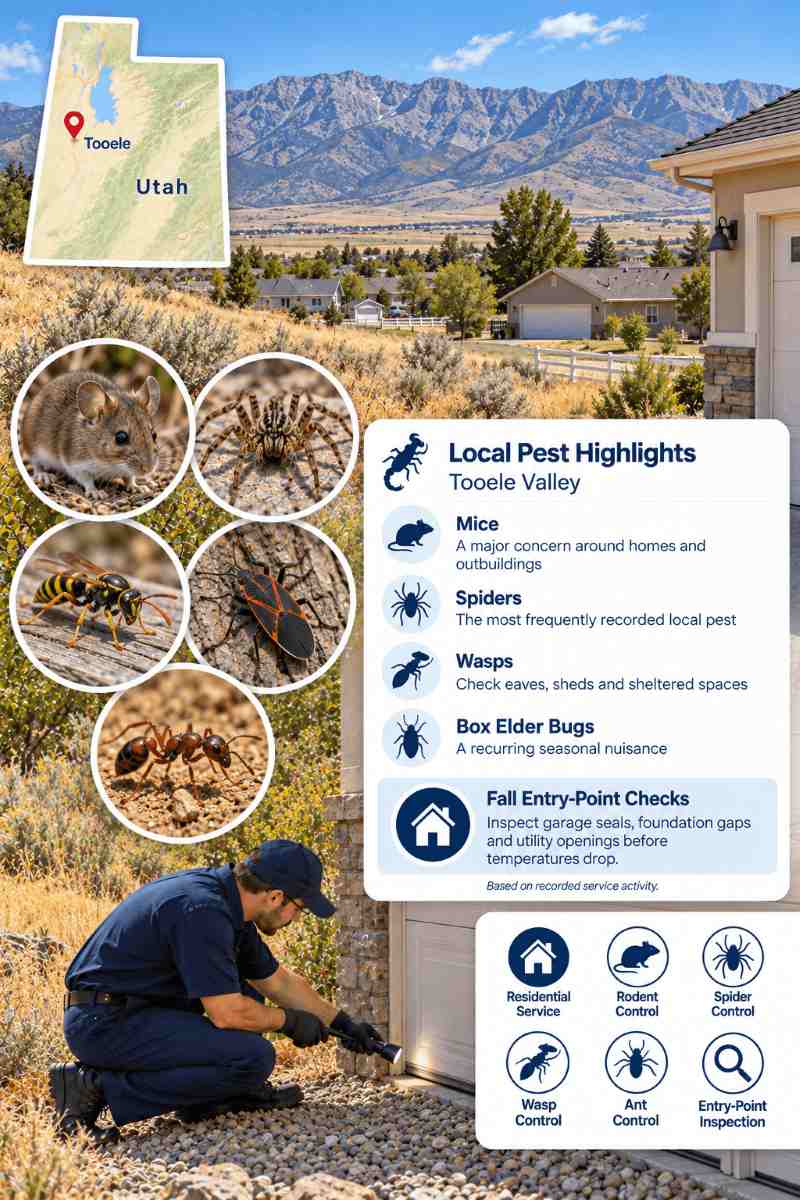
Mouse calls across the Tooele valley run 1.82 times our rate elsewhere, and inside Tooele they are more than one call in five. We run the valley on a regular route and treat for the town you actually live in.
Text (385) 425-1766 with a question or a photo of the bug, and we will get back to you, free, usually same day.
Area data
Because Tooele sits further out, we look at the whole valley
Tooele sits on the far side of the Oquirrhs, and people here tend to assume that puts them at the back of everybody’s schedule.
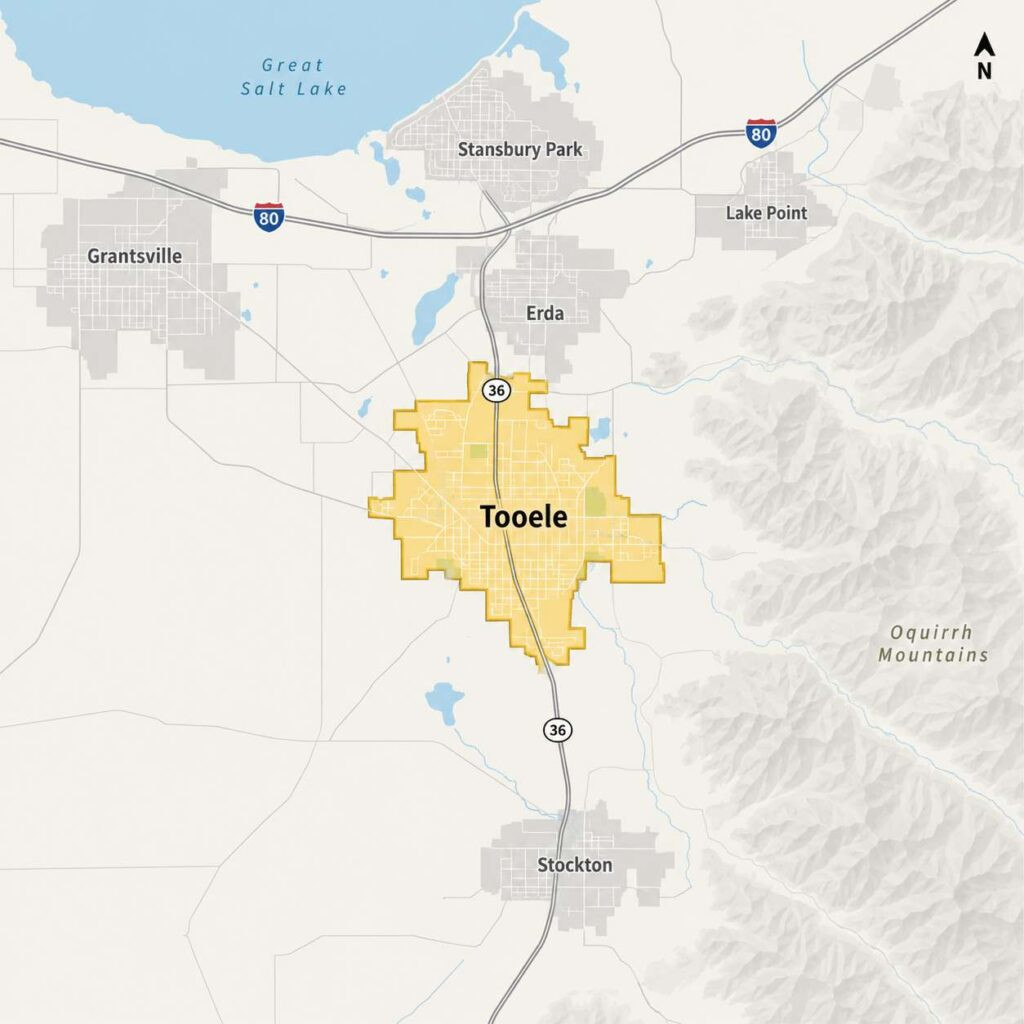
We are already out here. Our records carry 634 Tooele appointments, and the route does not stop at the city line: Stansbury Park, Erda, Lake Point, Grantsville and Stockton are all on it. Our office is in Clearfield and we will not pretend there is a storefront on Main Street. What there is, is a regular route and a valley we have worked for years.
Tooele by itself gives us 634 appointments carrying 672 logged pest codes. Plenty to tell you what we treat here, not quite enough to build stable rates on. We would rather say that than dress up a thin number.
So the data below covers the whole valley: Tooele, Stansbury Park, Grantsville, Erda, Lake Point and Stockton, plus single visits out to Rush Valley and Wendover. That pool is 1,147 service appointments carrying 1,249 pest codes. Everything that follows is area data, and it is labelled that way every time it appears.
Scroll the chart sideways to see the full scale →
Not sure what you are looking at?
Text us a question or a photo of the bug. We will identify it and tell you whether it needs treating or not, free, usually the same day.
The big one
Mice are the story out here
In the Tooele valley area data, mice are 19.1% of every pest code we log, on 239 mouse calls, against 10.5% across the rest of our Utah service area. That is 1.82 times the rate, and it reorders the whole list. Mice are the second most common thing this valley calls us about, behind spiders and ahead of wasps. Across the rest of our service area wasps run 16.8% and mice 10.5%. Tooele valley flips that order.
The city is heavier still. Of the 672 pest codes logged inside Tooele, 152 are mice, 22.6% of everything we write down in town against 10.5% across the rest of the service area.
Our read is the ground the valley is built on. Tooele County covers 6,941 square miles of land at about ten people per square mile, nearly all of them in this one valley with dry rangeland on every side. Subdivisions here do not fade into other subdivisions. They stop, and sagebrush starts. Lots are big, outbuildings are normal, and a lot of newer housing sits straight against undeveloped ground.
That is the arrangement mice like. USU Extension describes deer mice as preferring rural areas including fields, pastures and the vegetated ground around buildings, and as only occasional invaders indoors that move in when it gets cold. House mice are the committed indoor species, and Utah’s commensal rodent guidance is blunt about how little room they need: seal every opening larger than a quarter inch, because one female can produce as many as 13 litters a year of three to ten young.
Deer mice, outbuildings and the one risk worth taking seriously
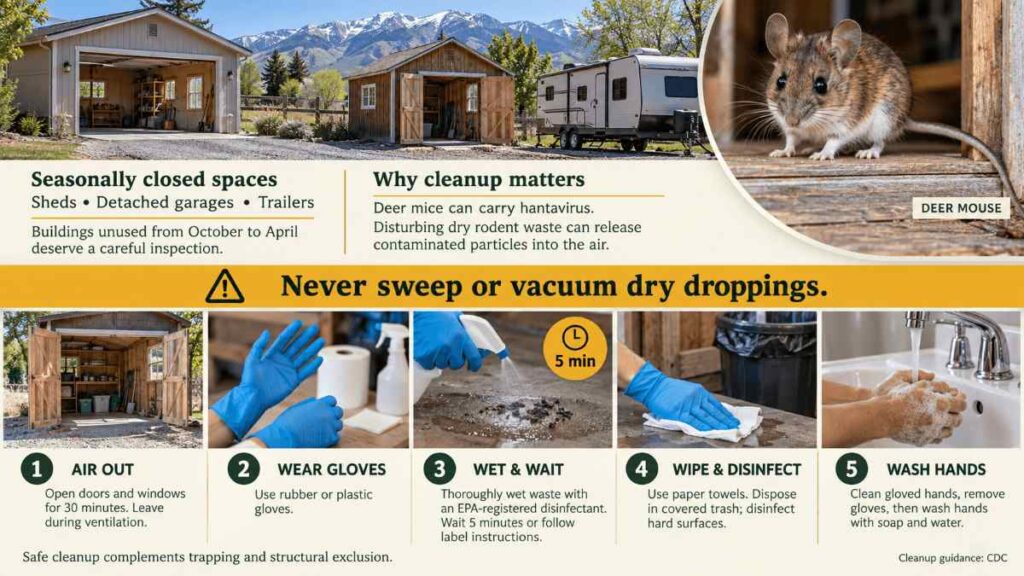
A shed, a detached garage or a trailer that sits closed from October to April is a deer mouse building, and out here almost everybody has one.
Utah’s health department names the deer mouse as the most common source of hantavirus in North America. People are infected by inhaling dust containing dried rodent urine or droppings, and the activity the state lists first is opening and cleaning a building that has been sitting unused. The guidance is worth following: air the space out before you go in, never sweep or vacuum dry droppings, wet everything down with disinfectant and let it soak five minutes, wipe it up with paper towels, then wash your hands. This is rare, and we are not trying to frighten anybody. It is just the one problem out here where how you clean up matters as much as how you trap.
Three smaller signals, and all three are thin
Three more pests run above our service area rate in the valley data, and we will be straight about the counts behind them. Springtails sit at 2.46 times our rest-of-area rate, on 10 logs. Beetles at 1.99 times, on 16. Mosquitoes at 1.82 times, on 17. Those are small numbers. None of the three is a finding on its own.
For what it is worth, springtails and mosquitoes point the same direction, which is water in a dry place. USU Extension notes that springtails dry out easily and need constantly moist soil, then move into damp spots indoors when conditions outside turn hot and arid. New lawn, new mulch and a sprinkler running hard in a dry valley is exactly that.
The other side of the list
What this valley mostly does not get
The cold rows are a real break from the Wasatch Front, and they save you money. Box elder bugs run 0.70 times our rest-of-area rate, on 88 logs, 7.1% of the area mix against 10.1% everywhere else. Elm seed bugs run 0.50 times, on 18 logs. Ants run 0.79 times, on 134.
Both of those bugs are tree pests before they are house pests. USU Extension says box elder bugs prefer boxelder seeds, which are only found on female boxelder trees, and that elm seed bugs gather around buildings where elm seeds have piled up. A dry valley with much of its housing built inside the last twenty five years has less of that mature seed bearing canopy than an older Salt Lake City or West Valley City street. That is our best read on the gap rather than a finding.
Tooele’s own numbers
Of the 672 pest codes logged inside the city, 183 are spiders, 152 are mice, 107 are wasps and 70 are box elder bugs. Rats are 4. Four rat calls across 634 appointments is about as close to a non problem as our records get, and it is the reverse of the older, denser parts of the Salt Lake valley.
Why a Tooele homeowner should call us
Why Tooele valley homeowners call Beeline
Locally owned, 29 years in Utah, more than 2,300 five star reviews, no hidden charges. We quote the price before we start, and there is no surcharge for living west of the Oquirrhs. If something comes back between services, we come back and retreat it free.
Call (801) 544-9200 or text (385) 425-1766 for a free quote.
Also on our Tooele valley route:


A Tooele valley pest control calendar
What we are treating, and when. The highlighted row is where we are today.
| When | What matters in Tooele |
|---|---|
| March, April, May | Second best time for mouse work: find out what overwintered inside, and air out sheds before you clean them. |
| June, July | Hot, dry stretches push springtails toward damp spots indoors. Spider and wasp work builds. |
| August, September, October | Seal the house and outbuildings before the first hard cold. This is when mouse work is worth the most. |
| November to February | Mice are in sheds, garages and closed-up trailers. Clean droppings wet, never dry sweep. |
Before you book
Tooele pest control questions we actually get asked
Do you actually come out to Tooele, or do I wait until somebody is in the area?
We run Tooele valley on a regular route. Across the valley we have logged 1,147 appointments, 634 of them inside Tooele city. You are on the schedule, not an exception to it.
Is it more expensive out here than in the Salt Lake valley?
No. Same pricing, and no travel or fuel charge for Tooele, Stansbury Park, Erda, Grantsville, Lake Point or Stockton. These towns sit on an established route rather than a special trip.
Why do we get so many more mice than my sister on the other side of the Oquirrhs?
Open ground. In our Tooele valley area data mice are 19.1% of every pest code on 239 calls, against 10.5% across the rest of our service area, and inside Tooele city it is 152 of 672 codes. Big lots, outbuildings and subdivisions that end at rangeland give mice somewhere to live all summer and somewhere to go in October. That is our best read, not a laboratory result.
I found droppings in the shed. Should I be worried?
Be careful rather than worried. Utah's health department names the deer mouse as the most common source of hantavirus in North America, and the risky move is sweeping or vacuuming dry droppings in a closed building. Air it out, wet everything with disinfectant, let it soak five minutes, wipe it up with paper towels, and never dry sweep. Then deal with how they got in.
When should I get the mouse work done?
Before the first hard cold. Mice start looking for shelter as soon as the nights turn, so late August through October is when sealing the house is worth the most. Spring is second best, because that is when you find out what overwintered inside.
Do you treat the outbuildings too, or just the house?
Sheds, detached garages, shops and barns are where the rodent pressure usually starts out here, so yes. Tell us what is on the property when you book and we will walk it. Treating the house and leaving the shop full of mice just moves the problem forty feet.
Three ways to get a Tooele quote
All of them free, all of them with a real person at our Clearfield office.
- 1Send us a photo(385) 425-1766. Fastest answer.
- 2Call us(801) 544-9200. Mon to Fri 7:30am to 7:00pm, Sat 7:30am to 4:00pm.
- 3Fill in the formSend a picture of the bug or the damage and we will tell you what it is and what it costs.