
West Valley City, UT · on our regular Salt Lake County route
Pest Control in West Valley City, Utah
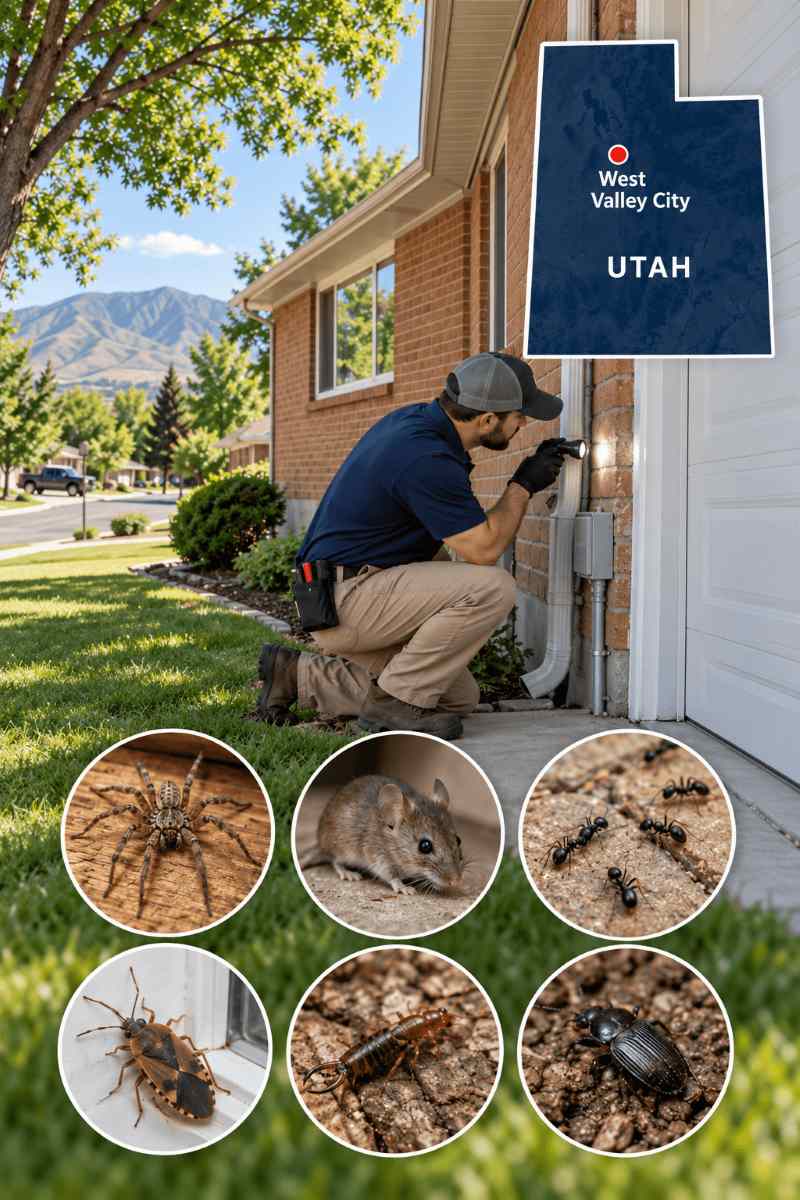
Mice are about one in six of every pest code we log in West Valley City, fourth highest of the 36 cities we service at volume, while wasps run second lowest. We treat for the city you actually live in.
Text (385) 425-1766 with a question or a photo of the bug, and we will get back to you, free, usually same day.
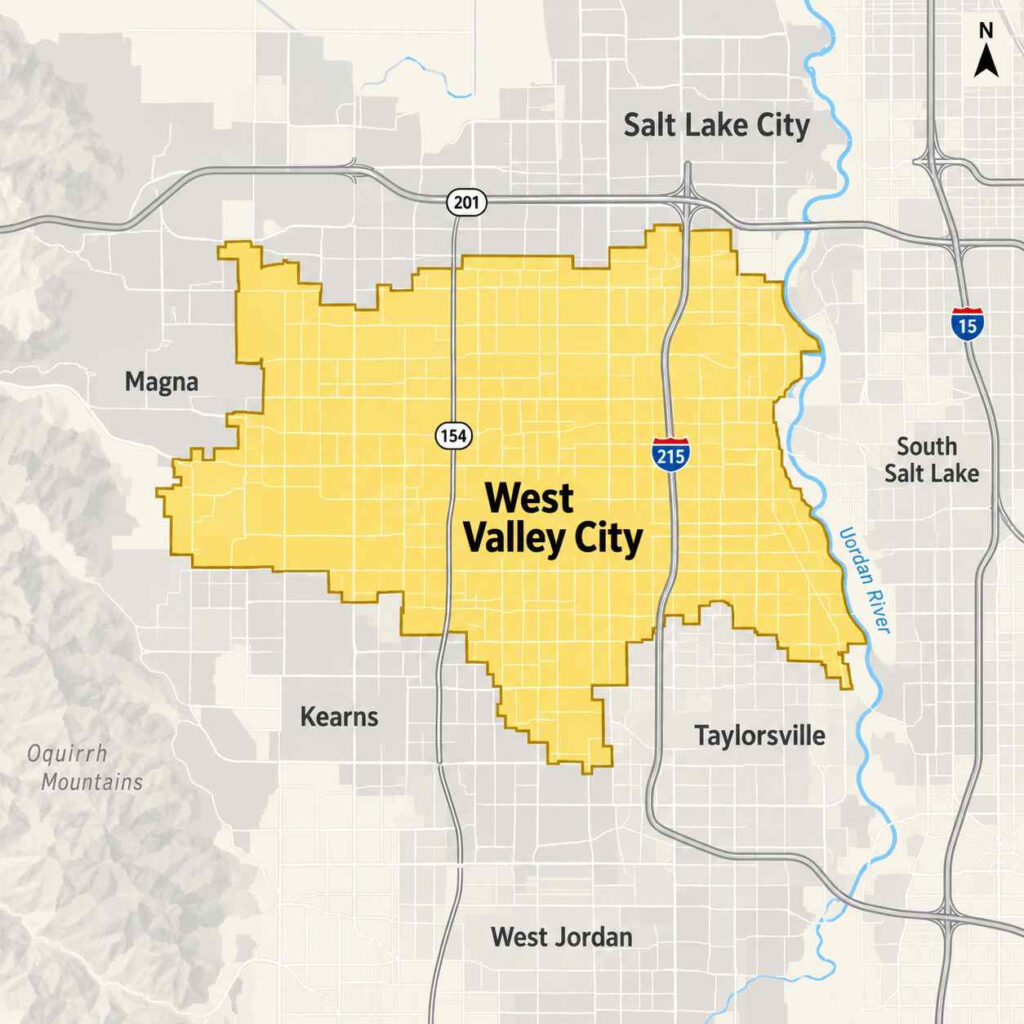
West Valley City is Utah’s second largest city, and it is finished. Granger, Hunter, Chesterfield and Redwood became one city in 1980, and the homes built in the 1960s and 1970s are still standing with the trees planted alongside them. Apart from the far west end, under the Oquirrh Mountains, there is no new ground left to turn.
That matters to your pest problem more than almost anything. We have serviced Utah homes for 29 years, and the mix in a built-out city with a mature canopy looks nothing like the mix in a subdivision that was a hayfield in 2008.
The local picture
What 2,269 West Valley City appointments actually show
First, where these numbers come from. They are our own service records: 2,269 appointments inside West Valley City, measured against the rest of our Utah work, with every ranking drawn from the 36 cities where we log enough volume for a fair comparison. It is a record of what people call us about, not a census of the local insect population.
Scroll the chart sideways to see the full scale →
Spiders are about a third of what we treat, the same as everywhere in Utah, and ants sit on our service-area average. The interesting part is everything else:
- Mice are about a sixth of every pest code we log here, roughly half again our service-area rate, and the fourth highest share among the 36 cities we service at volume.
- Elm seed bug calls run about three quarters higher, top ten among those 36.
- Earwig calls run roughly half again our rate, also top ten.
- Beetle calls are small in number but the third highest share on that list.
Then the pests the city mostly skips. Wasp calls are a little over half our service-area rate, second lowest of the 36. Vole calls run about half. Box elder bugs run a little under six in ten.
Read those two lists together and a pattern falls out. What runs hot are the pests of old walls, old trees and long-established landscaping. What runs cold are the pests of big new lots, fresh sod and farm edges. West Valley City is the opposite number to Syracuse and Farmington.
Not sure what you are looking at?
Text us a question or a photo of the bug. We will identify it and tell you whether it needs treating or not, free, usually the same day.
The big one
Mice: the pest that defines West Valley City’s work
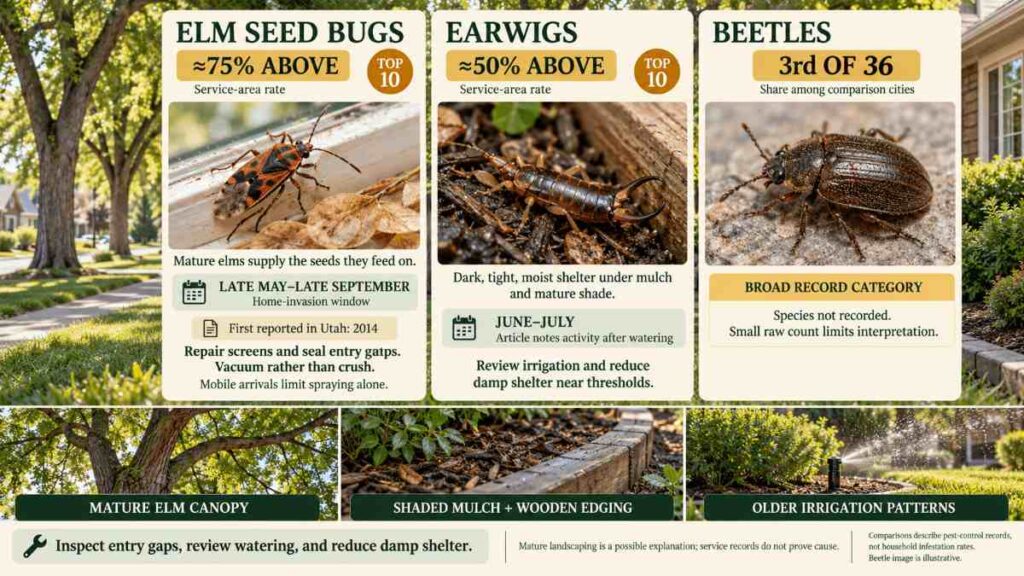
One in six pest codes we log here is a mouse, against about one in ten across the rest of our service area. Two things look like they account for most of it, though service records show a pattern rather than prove a cause.
Fifty-year-old walls have more ways in. The city’s General Plan says the majority of housing units here were built in the 1970s or earlier. The Utah Department of Agriculture and Food puts the entry threshold at a quarter inch: anything bigger is a door for a house mouse, half of what a Norway rat needs. A house built in 1972 has had fifty winters of settling and decades of new lines run through old walls: cable, gas, sprinkler timers, furnace swaps, and in this valley a long history of evaporative coolers ducted straight through a roof or wall. In our experience that last one is the most overlooked mouse highway in older Salt Lake County homes, because the collar around the duct is almost never sealed tight. None of that reflects how a home is kept. It is how many penetrations a wall collects in half a century.
The same agency notes one female can produce as many as 13 litters a year, three to ten young each, breeding at six to eight weeks old. That is why “we heard something once” in October is a population by January.
The west end and the first cold night. The western edge of the city is dry open ground, industrial land and Oquirrh benchland rather than irrigated yards, and rodents head for shelter as soon as cold weather sets in. We do not track results street by street, so we will not pretend to a block-level answer. In our experience the homes that call first every fall back onto open ground.
Either way the fix is carpentry before chemistry: door sweeps, corner seals, vent collars, utility penetrations, the gap under a settled step. We seal first, then trap what is inside.
Elm seed bugs, earwigs and beetles: what a mature canopy costs you
The second cluster traces back to one thing: the trees and landscaping here have had fifty or sixty years to mature.
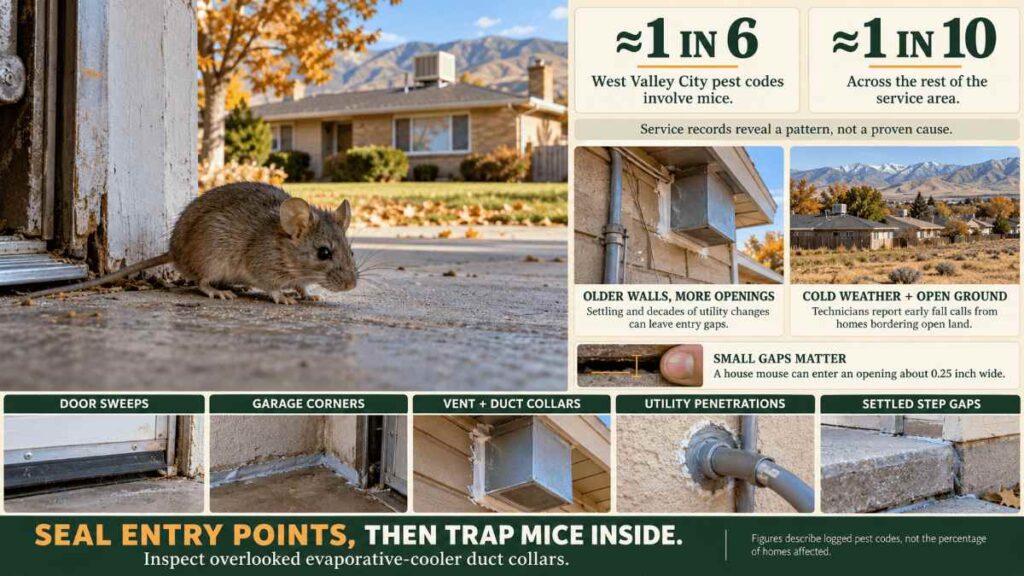
Elm seed bugs run about three quarters above our service-area rate, top ten among the cities we service at volume. They breed on elm seed and only reached Utah in 2014. West Valley City’s older streets have the mature elm they want, while Syracuse and Farmington run a fraction of our average because their street trees mostly went in after 2000. USU Extension notes they invade homes from late May through late September, that insecticide does little against an insect this mobile, and that they smell like bitter almonds when crushed.
Earwigs run about half again our rate, also top ten. They want damp, dark, tight spaces, and established landscaping supplies all three: decades-old mulch beds, mature shade, wooden edging gone soft, irrigation still set for plants that filled in long ago. They come up through weep holes and thresholds in June and July, right after a watering.
Beetles are the third highest share on that 36-city list, though the raw count is small and our records log the category rather than the species.
The other side of the list
The pests West Valley City mostly skips
Wasps. Across our service area, wasps, hornets and yellow jackets are about one call in six. Here they are closer to one in eleven, second from the bottom among the 36 cities we service at volume, with Farmington, Clinton and Syracuse running two to three times that rate.
That does not mean the city has no wasps. Anyone who has eaten outside here in August knows better. It means wasps take up a smaller share of the work. Our best read is structural: paper wasps shop for deep eaves, detached sheds, covered RV parking and playsets, and yellow jackets do well along irrigation ditches and pasture edges. The cities at the top of that list are large-lot suburbs with a farm fringe. West Valley City is built out at close to 3,900 people per square mile, with a dry bench and industrial edge instead.
Voles. About half our service-area rate. Voles move into dense new groundcover beside open ground, which is why Park City, Draper and Clinton run hot. The lawns here went in decades ago and almost no raw ground is becoming turf, so the setup that makes a vole problem is mostly absent.
Box elder bugs. A little under six in ten of our rate, which surprises people with big trees. The insect needs female, seed-bearing boxelder trees specifically, not shade trees in general, and those do best along bench drainages and canyon mouths. Bountiful sits under them, and box elder bugs are its second biggest complaint. Our best read is that this city’s canopy leans elm, maple and ash instead, which also fits the elm seed bug numbers.
Rats, which we expected to run hot. Norway rats usually track older, denser cities, and in our data they do: Holladay, Millcreek and Salt Lake City all run well above average. West Valley City sits slightly below our rate, and we would rather admit we have no confident explanation than invent one.
A West Valley City pest control calendar
What we are treating, and when. The highlighted row is where we are today.
| When | What matters in West Valley City |
|---|---|
| March, April | Seal up before anything wakes: cooler and dryer vent collars, door sweeps, garage corners. |
| May, June | Ants build with the first heat, elm seed bugs show on screens and sunny walls, earwigs appear once irrigation starts. |
| July, August | Peak earwig and elm seed bug season, and spider webbing gets obvious. |
| September, October | Webbing peaks, then the first cold nights push mice toward the walls. Finish exclusion now rather than start thinking about it then. |
| November to February | Rodent and interior work. Mice breed through winter indoors, so a November problem is a bigger one by February. |
Why a West Valley City homeowner should call us
Why West Valley City homeowners call Beeline
We run West Valley City on a regular route, so you are not waiting on a truck from the other end of the state. We have run 2,269 appointments here, we are in these neighborhoods most weeks, and we know what a 1970s Granger-era house and a 2000s west-end build each produce.
Beeline is locally owned, 29 years in Utah, 2,300+ five-star reviews, no hidden charges. Our quarterly service covers every pest on this page, and if something comes back between visits, so do we. Office: 275 W 1700 S, Clearfield, UT 84015.
Get a free quote: (801) 544-9200, or text us at (385) 425-1766.
We also service nearby:


Before you book
West Valley City pest control questions we actually get asked
Why do I get so many more mice than my sister in Syracuse?
Mostly what the two houses are made of, and when. Mice are about a sixth of every pest code we log here and a much smaller share of our Syracuse work. The city's General Plan says most homes here were built in the 1970s or earlier, and a fifty-year-old wall has collected far more cuts and penetrations than one built in 2010. A mouse needs only a quarter inch.
My neighborhood is full of wasps in August. Why does your data say West Valley City runs low on wasps?
Because the measurement is share of calls, not insect count. Wasps are about one call in eleven here against one in six across our service area, second from the bottom of the 36 cities we service at volume. You still have wasps. There are simply fewer of the deep eaves, detached sheds and ditch banks that give Farmington and Clinton their nest volume.
What are the long brown and black bugs on my window screens in June that smell when I squash them?
Almost certainly elm seed bugs, and West Valley City is top ten for them among the cities we service at volume. They breed on elm seed, which the older streets here have plenty of, and they reached Utah only in 2014. USU Extension says sprays do little because the insect is so mobile, so sweeps, tight screens and sealing around window frames do more.
Who actually handles mosquitoes in West Valley City?
Two districts, and which one depends on where you live. The city states that West Valley City is split at 4800 West, with the Magna Mosquito Abatement District covering the western portion and the South Salt Lake Valley Mosquito Abatement District the east. They treat breeding water, not your yard. Mosquito calls here sit on our service-area average, so mosquitoes are not this city’s story.
My parents in Bountiful get box elder bugs all over the house every October and I barely see any. Why?
Most likely a tree difference rather than luck. Box elder bugs need female, seed-bearing boxelder trees to reproduce, and those do best along bench drainages and canyon mouths. Bountiful sits under them, and box elder bugs are its second biggest complaint. Our best read is that this city's canopy leans elm, maple and ash instead, which is why your elm seed bug numbers run the other way.
I have a 1970s house with big trees. Am I stuck with more pests?
It means a different plan, not a worse one. The pests this city runs high on, mice and elm seed bugs and earwigs, respond better to exclusion and moisture work than to volume of spray: sweeps, vent collars, sealed penetrations, mulch pulled off the foundation, irrigation dialed back for plants that filled in long ago. Mature trees are an asset. They just come with a list.
Three ways to get a West Valley City quote
All of them free, all of them with a real person at our Clearfield office.
- 1Send us a photo(385) 425-1766. Fastest answer.
- 2Call us(801) 544-9200. Mon to Fri 7:30am to 7:00pm, Sat 7:30am to 4:00pm.
- 3Fill in the formSend a picture of the bug or the damage and we will tell you what it is and what it costs.