
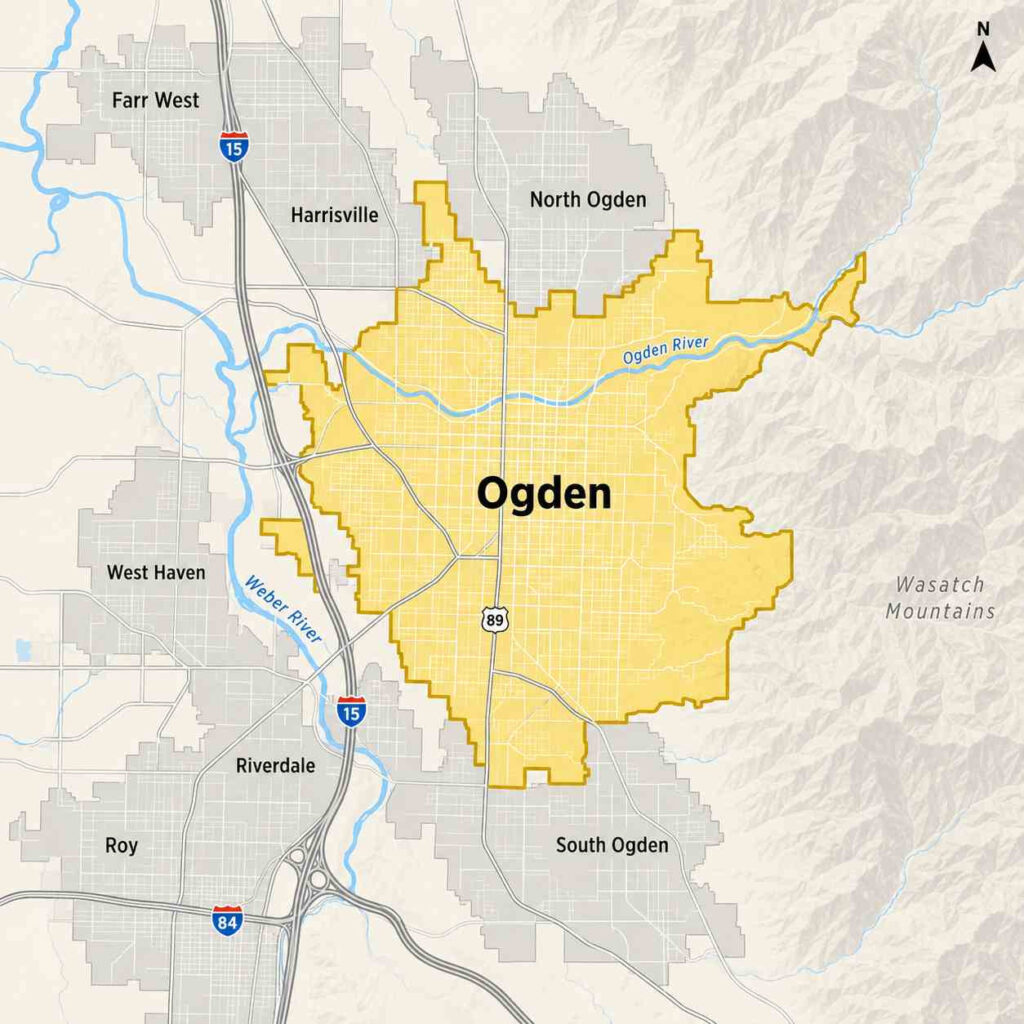
Ogden, UT · 15 minutes from our Clearfield office
Pest Control in Ogden, Utah
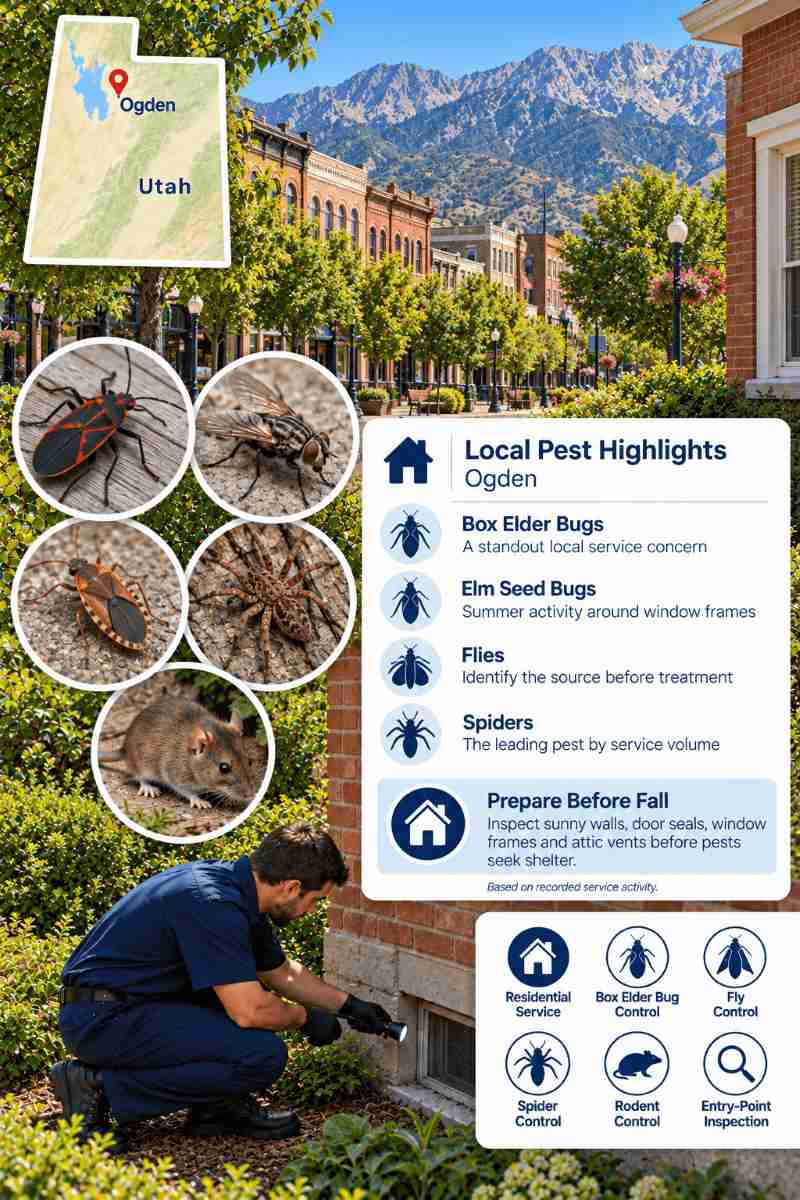
Ogden got here first, in 1846, and its bugs show it. We log box elder bug calls at about one and a half times our rate elsewhere, more flies and elm seed bugs, and far fewer voles. We treat for the city you actually live in.
Text (385) 425-1766. Send a photo of the bug and we will tell you what it is, free, usually same day.
Ogden got here first. Miles Goodyear put Fort Buenaventura on the Weber River bottoms in 1846, the first permanent settlement by people of European descent in what is now Utah, and the city incorporated on February 6, 1851. By the 1940 census Ogden held 43,688 people, while most of the cities we service were still hay ground.
That head start is the most useful thing to know about pest control here, because nearly every unusual number in our Ogden service records traces back to it. If you moved up from a newer city and felt like the bugs changed, you were right.
The local picture
What our Ogden service records actually show
First, what these numbers are. They come from our own work: 6,916 Ogden appointments carrying 7,421 logged pest codes, measured against the rest of our Utah area, with rankings drawn from the 36 cities where we do enough volume to compare fairly. It is a record of what Ogden people call us about, not a census of every insect in the city. Across nearly 7,000 visits, the pattern holds.
Spiders, wasps, ants and mice are the bulk of the work in every Utah city, Ogden included. Here is where Ogden pulls away:
- Box elder bug calls run about one and a half times our rate elsewhere. They are Ogden’s second-biggest complaint behind spiders, top five among those 36 cities.
- Fly calls are Ogden’s biggest multiple of anything, roughly 1.6 times our rate elsewhere, also top five of the 36.
- Elm seed bug calls run about a third higher than our service-area rate.
- Vole calls run near a quarter of our rate elsewhere, landing Ogden in the bottom four of the 36.
- Mosquito calls run under half our service-area rate.
Scroll the chart sideways to see the full scale →
Read those together and a shape appears. The pests that need decades-old trees run hot here. The pests that arrive with brand-new subdivisions run cold. Service records cannot prove a cause, but the fit is hard to miss, and it is the mirror image of the young lake-plain cities twenty minutes south.
Not sure what you are looking at?
Send us a photo. We will identify it and tell you whether it needs treating or not, free, usually the same day.
The big one
Box elder bugs: what a century-old canopy costs you
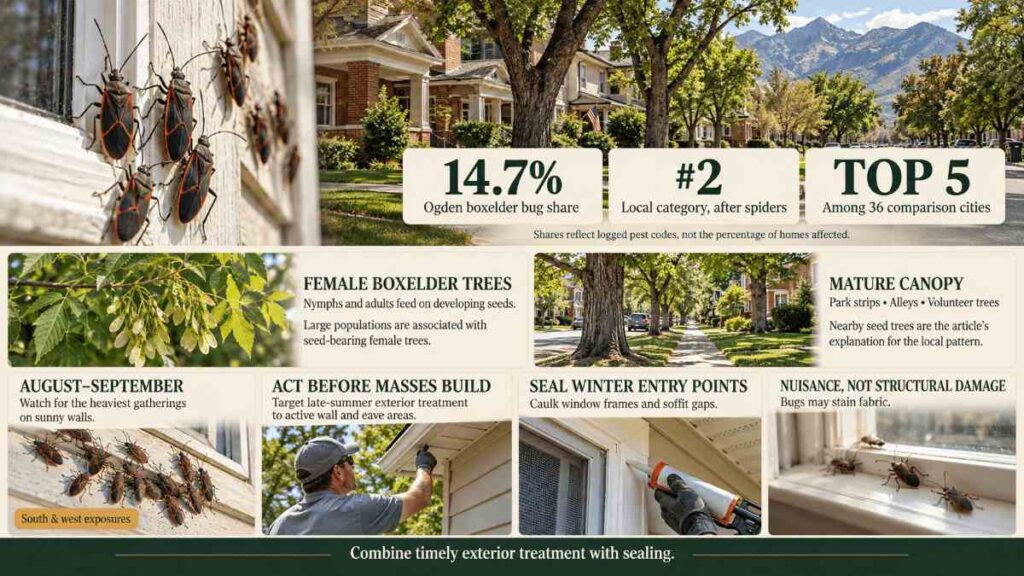
Box elder bugs are 14.7 percent of everything we log in Ogden. Only spiders beat them, and among the 36 cities we service at volume, Ogden is top five.
Here is the part most homeowners never hear: box elder bugs cannot build those numbers without the tree. USU Extension notes that large populations are typically found on female boxelder trees, where nymphs and adults feed on the developing seeds. No seed-bearing female boxelder within a few hundred yards and you get a handful of bugs, not a covered wall. Ogden has them by the hundred, in park strips, in alleys, volunteering in every gap nobody mows.
Our best read is that the trees are here, and Ogden’s own ordinance agrees. City code section 1900-5 lists box elder, Acer negundo, as nonacceptable planting stock for streets and park strips. An ordinance cannot un-plant the trees that went in before the rule, and in a city whose adopted housing element puts over 44 percent of its housing at pre-1940 construction, that is a lot of tree.
The bugs feed on seeds all summer, then hunt a warm dry place for winter. USU puts the heaviest aggregation in August and September, especially on southern exposures. They stain fabric and do no structural damage, which is cold comfort when a few thousand are sunning on your siding. Treat the wall before they mass: a late-summer application on the south and west sides, plus sealing window frames and soffit gaps, beats anything you can do in October.
Elm seed bugs: same story, a different tree
Elm seed bug calls run about a third above our service-area rate, putting Ogden in the upper third of the 36. Same mechanism, running on the city’s mature elm canopy instead.
USU Extension reports the elm seed bug reached Utah in 2014, feeds mostly on elm seeds, and invades buildings from late May through late September. The summer timing catches people out. Homeowners expect the box elder wave in the fall and are surprised by a smaller bug doing the same thing in July, with a bitter-almond smell when disturbed. Ogden’s tree code hedges on elm rather than banning it: every elm variety sits in the “acceptable, but not recommended” list, on insect and disease grounds.
Flies: our biggest Ogden multiple, and the hardest to pin down
Flies are 1.9 percent of Ogden’s pest mix against 1.2 percent across the rest of our area, a multiple near 1.6 and top five among the 36 cities. A small share of the work, but a real gap resting on 140 logged calls.
We will not claim one cause. What we can point at is what an old, dense city offers flies that a 2010 subdivision does not. Ogden’s grid is full of alleys, and the city notes most are abutter’s alleys, private ground maintained by the owners behind them rather than by Ogden City. Add detached garages, older drain lines, pre-war wall voids where cluster flies overwinter, and a dense restaurant corridor along 25th Street. Our best read is that no single one explains the gap and all of them together go a long way.
Diagnosis is the practical part, because “flies” is four different jobs. Drain flies mean a biofilm-lined drain and are solved there. Cluster flies come out of wall voids on warm winter afternoons and need exterior exclusion in early fall. House flies mean a breeding source within a couple hundred feet, usually a can or an alley. Fruit flies mean something fermenting inside.
The other side of the list
What Ogden mostly does not get
Voles. Vole calls run near a quarter of our service-area rate, placing Ogden in the bottom four of the 36 cities. Vole damage follows fresh sod, young bark mulch and lawns backing onto open ground, which is why the new Davis County cities light up every March. Ogden ran out of un-built lots decades ago, and if your lawn has been a lawn since the Eisenhower administration, the meadow voles left long ago.
Mosquitoes. Ogden mosquito calls run under half our rate elsewhere. Two things probably account for most of it. Weber Mosquito Abatement District has worked Weber County since 1947, a long time to be draining and larviciding the same water. And Ogden sits on a bench ten miles east of the Great Salt Lake rather than out on the marsh, so the breeding ground is not next door the way it is in Syracuse. The properties that still get bitten, in our experience, sit close to the river bottoms.
Snails look low here too, but that rests on nine logged calls. We would not read anything into a number that small, and neither should you.
Spiders, wasps, ants and mice: the everyday work
For all that is unusual here, most days look like everywhere else. Spiders are about a third of what we treat, right at our service-area rate, and Ogden’s are overwhelmingly harmless: hobo spiders, cellar spiders, orb weavers in window wells.
Wasp calls run slightly below our service-area rate, which surprises people. Our read is that the wide eaves, vinyl fencing and covered RV parking of the newer cities offer a paper wasp queen more April real estate than a 1925 bungalow does. An eave check every spring still pays: a nest treated in May is one queen and a dozen cells, and the same nest in August is several hundred short-tempered workers. Ant calls land in the bottom third of the 36 cities, and mice sit exactly at our service-area rate, pressing indoors in October and November through any gap the width of a pencil.
Rats deserve a careful sentence. Ogden is top ten of those 36 cities for rat calls but only a hair above our area rate, so the ranking reflects how little most Utah cities see rather than an Ogden rat problem. Norway rats do best where infrastructure is old, dense and plumbing-heavy, which describes central Ogden. We do not track results street by street, so read that as a pattern, not a map.
Why an Ogden homeowner should call us
Why Ogden homeowners call Beeline
Our office is at 275 W 1700 S in Clearfield, about ten miles and fifteen minutes down I-15 from most Ogden addresses, so you get same-week service instead of a technician driving up from Utah County. Locally owned, 29 years in Utah, 2,300+ five-star reviews, no hidden charges. Our quarterly service covers every pest on this page, and if something comes back between visits, so do we.
Get a free quote: (801) 544-9200, or text us at (385) 425-1766.
We also service nearby:


An Ogden pest control calendar
What we are treating, and when. The highlighted row is where we are today.
| When | What matters in Ogden |
|---|---|
| March, April | Elm seed bugs leave winter shelter, spiders reappear, and it is the window to treat eaves before wasp nests establish. |
| May, June | Ants build with the first real heat, elm seed bugs start entering buildings, spider activity climbs. |
| July, August | Peak elm seed bug complaints, wasp nests at working size, fly pressure at its highest, first box elder bugs massing. |
| September, October | The big one: box elder bugs on south and west walls, mice indoors, spider webbing heaviest. |
| November to February | Rodent and interior work, cluster flies waking on warm afternoons, box elder bugs wandering out of wall voids. |
Before you book
Ogden pest control questions we actually get
Why does my house get swarmed with box elder bugs every fall when my sister's place in Syracuse never does?
Almost certainly the trees. Box elder bugs build big populations on female seed-bearing boxelder trees, and Ogden has had those for generations while Syracuse was farm ground into the 2000s. Among the 36 cities we service at volume, Ogden is top five for box elder bug calls and Syracuse is last.
If Ogden City banned box elder trees, why do I still have the bugs?
Because the ban only covers new planting. Ogden code section 1900-5 lists box elder as nonacceptable planting stock for streets and park strips, which stops the next tree going in. It does nothing about the mature seed-bearing boxelders already standing in yards and alleys, and those are the ones feeding the bugs on your siding.
What is the bug that looks like a box elder bug but shows up in July and smells awful?
Elm seed bug. USU Extension says they reached Utah in 2014, feed mostly on elm seeds, invade buildings from late May through late September, and give off a bitter-almond smell. Ogden's elm canopy is our best read on why elm seed bug calls here run about a third above the rest of our service area.
Weber Mosquito Abatement District already treats the county. Do I need mosquito service too?
Most Ogden homes genuinely do not, and we will say so. The district has worked Weber County since 1947, and Ogden mosquito calls run under half our service-area rate. The households that still benefit usually sit close to the Ogden or Weber river bottoms, where water stands after runoff drops.
My neighbors in Layton get vole damage every spring. Why does my lawn never have those trails?
Voles follow new landscaping and open ground, and Ogden has little of either. Fresh sod, young bark mulch and lots backing onto un-built ground are what meadow voles move into. Ogden is one of the four lowest cities for vole calls among the 36 we service at volume, and a fifty-year-old lawn is poor vole habitat.
Why do I have more flies than I did at my last place?
If your last place was a newer subdivision, Ogden simply gives flies more to work with: alleys, detached garages, older drain lines and wall voids where cluster flies overwinter. Ogden fly calls are our fourth highest share among the 36 cities. Work out which fly it is before anything gets sprayed, because drain flies, cluster flies and house flies are three different fixes.
Three ways to get an Ogden quote
All of them free, all of them with a real person at our Clearfield office.
- 1Send us a photo(385) 425-1766. Fastest answer.
- 2Call us(801) 544-9200. Mon to Fri 7:30am to 7:00pm, Sat 7:30am to 4:00pm.
- 3Fill in the formSend a picture of the bug or the damage and we will tell you what it is and what it costs.