
Farmington, UT 84025 · 15 minutes from our Clearfield office
Pest Control in Farmington, Utah
Farmington sits between the canyons and the bay, and its bugs show it. Wasp calls here run nearly double our rate elsewhere, the highest of any city we service at volume, while mice run dead last. We treat for the city you actually live in.
Text (385) 425-1766 with a question or a photo of the bug, and we will get back to you, free, usually same day.
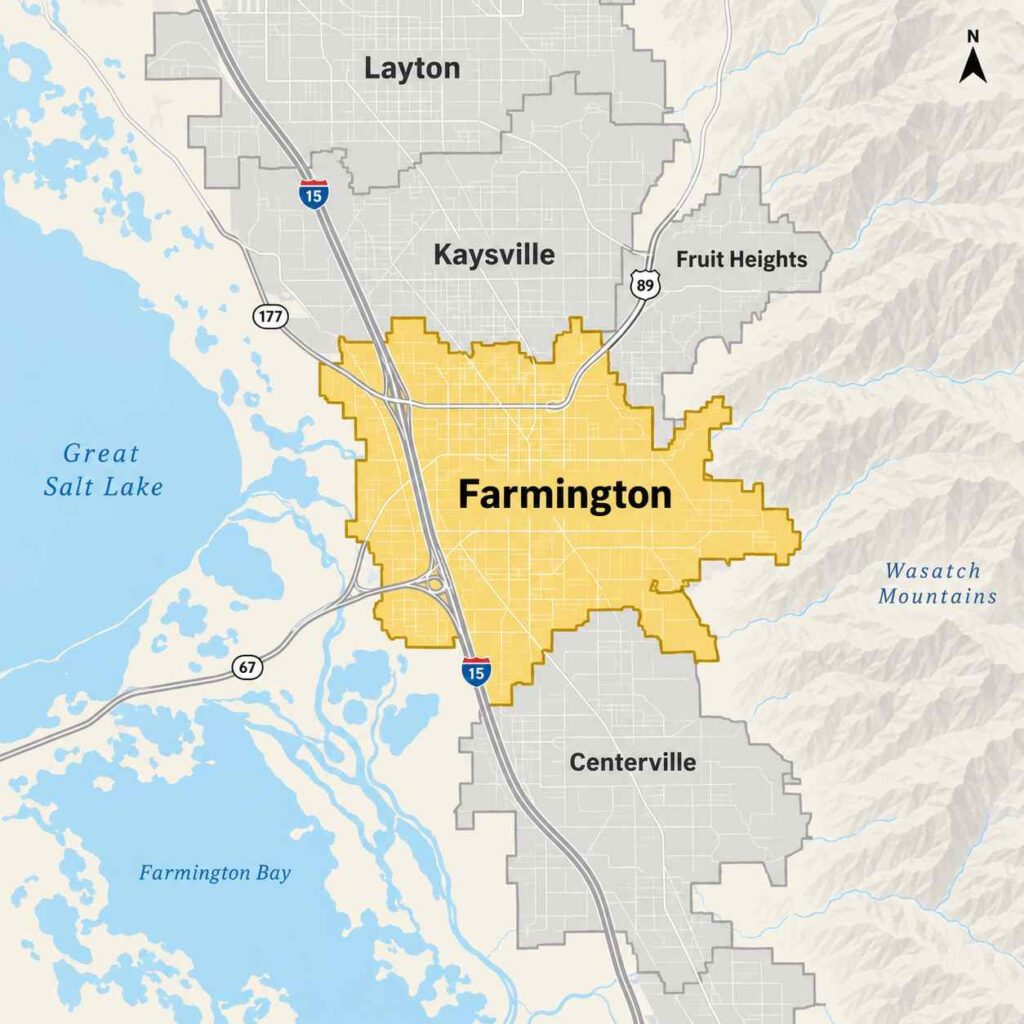
Farmington sits between two very different kinds of water. East of Main Street the Wasatch goes straight up, and by the city’s own count five canyons above town send streams through Farmington to the Great Salt Lake. West of I-15 the ground flattens into the Farmington Bay marsh. In between sit Lagoon, Station Park, a pioneer grid of stone houses and a lot of newer homes up the bench.
We’ve serviced Utah homes for 29 years, thousands of those visits in Farmington, and one complaint here outruns every other city on our list.
The local picture
What 3,092 Farmington appointments actually tell us
First, what these numbers are. They come from our own service records: 3,092 Farmington appointments measured against the rest of our Utah work, with rankings drawn from the 36 cities where we log enough volume for a fair comparison. It’s a record of what people call us about, not a census of the local insect population.
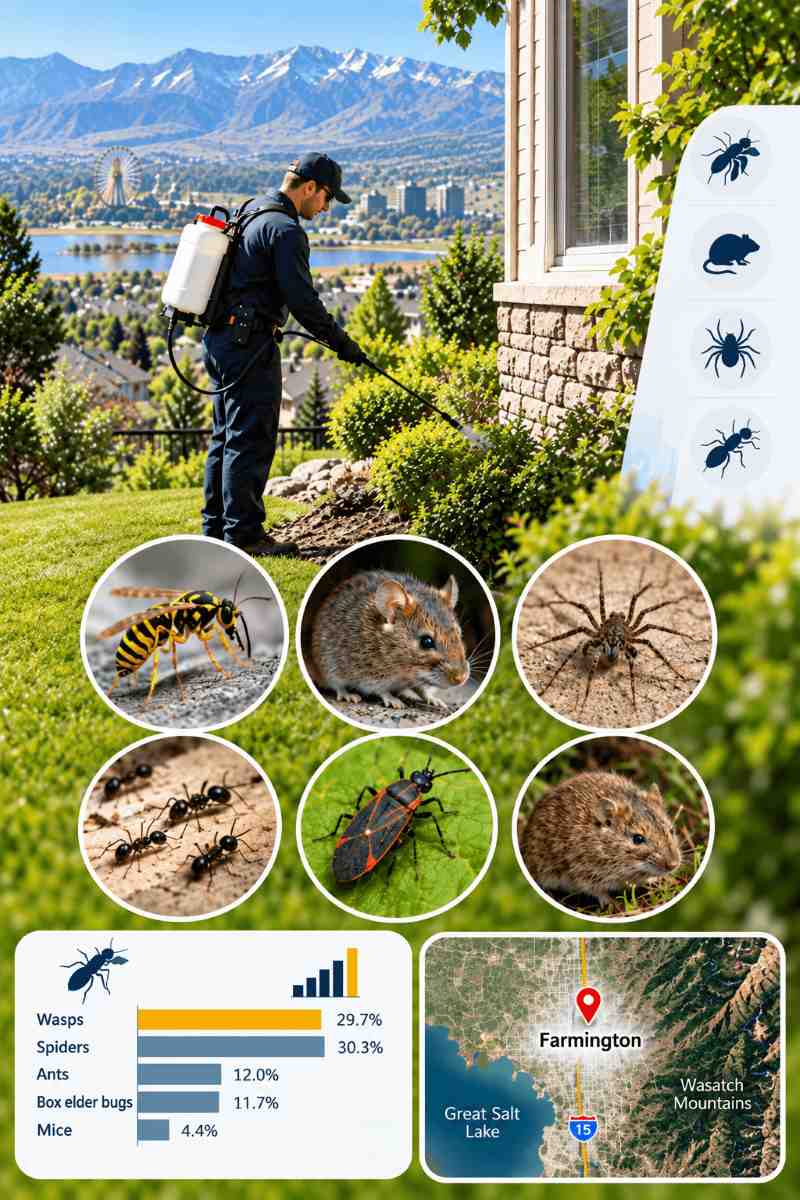
- Wasp calls are 29.7% of every pest we log in Farmington, against 16.4% across the rest of our service area. That’s the highest wasp share of any city we service at volume, number one of 36.
- Mouse calls sit dead last, 36th of 36, at well under half the rest-of-area rate.
- Vole calls run about 1.4 times our rate, top dozen on that same list.
- Elm seed bugs, flies, earwigs and springtails are all scarce, each between a fifth and three fifths of what we see elsewhere.
Scroll the chart sideways to see the full scale →
Line those up and something clicks. Nearly everything Farmington calls us about lives outdoors, on the structure or in the landscape. The pests that want a damp basement or a gap under a garage door barely register. Our best read is that this is a bench city on fast-draining canyon gravel, with big lots and newer, tighter houses than average. Service records can’t prove that, but it fits what our technicians find here.
Not sure what you are looking at?
Text us a question or a photo of the bug. We will identify it and tell you whether it needs treating or not, free, usually the same day.
The big one
Wasps: no city we service calls about them more
Nearly three in ten pests we log in Farmington are wasps, close to double the rest of our service area, and nothing on that list tops it.
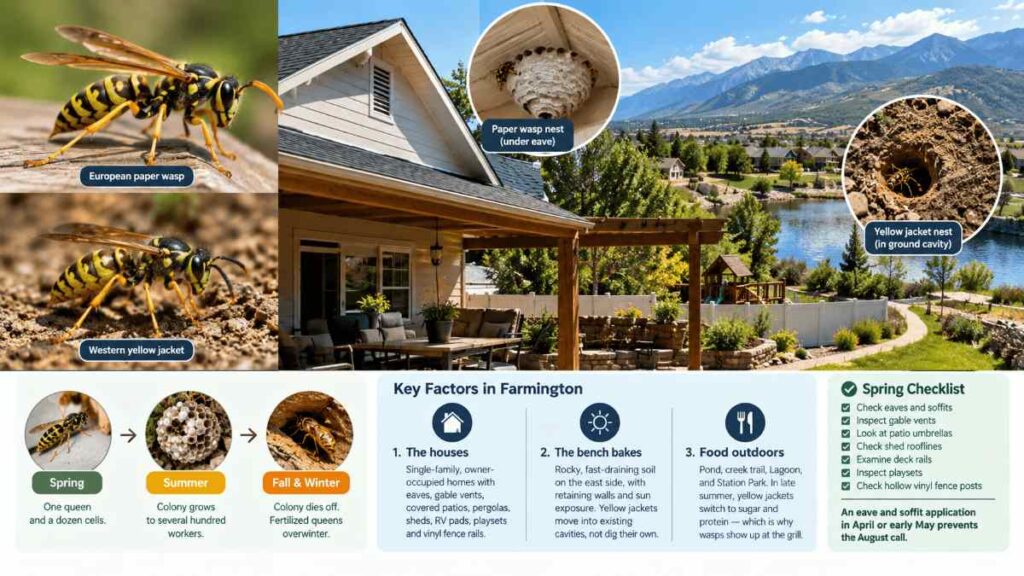
One clarification sharpens the point. Hornets and bees are logged separately in our records, and Farmington’s hornet share is unremarkable, mid-pack at 15th of 36. This isn’t a general stinging-insect bump. It’s wasps specifically: European paper wasps on the house and western yellow jackets in the ground.
Three things about Farmington probably have a lot to do with it.
The houses are built the way a paper wasp queen shops. Farmington’s housing is heavily owner-occupied single-family, and the median home here is one of the pricier in Davis County. That means deep eaves, gable vents, covered patios, pergolas, sheds, RV pads, playsets and vinyl fence rails. USU Extension describes paper wasp nests as umbrella shaped and exposed, tucked under eaves, porch decks and dark cavities. Farmington has an unusual amount of that real estate per address.
The bench bakes. The east side of town climbs the alluvial fan below the canyon mouths: rocky, fast-draining ground that takes sun all afternoon, with retaining walls everywhere. Western yellow jackets don’t dig their own hole. They move into an existing cavity: a rodent burrow, a gap behind a wall, a void under a step.
There’s food outdoors all summer. Farmington Pond, the creek trail, Lagoon and the patios at Station Park. Late-season yellow jackets switch hard toward sugar and protein, which is why August here means wasps at the grill.
Spring is when this gets decided
USU Extension puts the cycle plainly: the colony dies off each fall, fertilized queens overwinter, and new queens start fresh every spring. A nest in May is one queen and a dozen cells. The same nest in August is several hundred workers, which Extension notes is when wasps become a serious nuisance problem.
So the treatment that matters most costs the least. An eave and soffit application in April or early May, before the queens commit, prevents the August call where nobody can sit on the deck. Check eaves and gable vents, patio umbrellas, shed rooflines, deck rails, playsets and hollow fence posts. For ground nests, watch for steady traffic into one hole in a slope or wall.
Mice last of 36: the rodent story here happens outside
This is the pairing that surprises people. Farmington is our wasp capital and our lightest mouse city on that same list, at under half the rest-of-area rate.
We won’t pretend to know exactly why. Our honest read is a combination. Farmington’s residential area is hemmed in by the mountain on the east and the Legacy Parkway and wetland on the west, so fewer homes back onto active row-crop farmland than in the cities west of I-15. The housing also skews newer and well maintained, and garage weatherstripping, dryer vents and utility penetrations are the gaps mice use.
None of that means never. A mouse still needs only a gap the width of a pencil, and October pushes them toward warm walls. It means that if you have mice in Farmington, you likely have one specific opening rather than neighborhood-wide pressure, and an opening can be found and closed. Rats run right at our average here.
Voles: the rodent that does cost Farmington money
Voles are the outdoor half of the story, about 1.4 times our service-area rate, 11th of 36.
That fits the geography. Bench lawns, mulch beds, greenbelt strips, creek banks and trail corridors are the dense groundcover meadow voles want, and Farmington has miles of it. USU Extension calls the meadow vole the most common of Utah’s five species and notes an epidemic year can exceed 400 per acre.
You almost never see the animal. You see March: winding runways carved into the turf, dime-sized holes, and chewed bark at the base of young landscape trees. That last one is the expensive part, because a girdled tree can’t usually be saved.
In our experience the worst of it lands on lots backing onto open ground, a creek corridor or an un-built site. Pulling mulch back from trunks and keeping grass short along fence lines both help.
The other side of the list
The pests Farmington mostly skips
Elm seed bugs. They breed on elm, reached Utah in 2014, and are a real problem in Ogden. Farmington runs about a fifth of the rest-of-area rate, 33rd of 36. Our best read is the tree mix: the canopy here is old, but it leans maple, locust and boxelder rather than the Siberian elm those bugs need.
Earwigs, springtails and centipedes. All three want constantly damp ground and all run well below our average. Water that would sit in a lake-plain yard drains straight through Farmington gravel.
Flies. A third of the rest-of-area rate, 33rd of 36. Fly calls track livestock, dumpsters and older dense housing, and Farmington’s core has little of that.
Spiders, ants and box elder bugs: the everyday work
Spiders are still our biggest Farmington complaint, just barely, at 30.3% against the wasps’ 29.7%. They’re overwhelmingly harmless: hobo spiders, cellar spiders and orb weavers on eaves and window wells. Ants come in at 12.0%, slightly under our rate, and peak with the first real heat in May.
Box elder bugs deserve a note. At 11.7% they run a bit above average, ninth of 36, which tracks with Farmington’s old town core. They need female, seed-bearing boxelder trees to reproduce, and the historic streets around Main and Clark have the canopy. Expect them on sunny walls in October.
What about mosquitoes, with Farmington Bay right there?
Milder than you’d guess. Mosquito calls run only slightly above our rate, eighth of 36.
The Davis Mosquito Abatement District says on its own Farmington page that the city “is located just east of very productive mosquito breeding sites,” and that it has found West Nile Virus in mosquitoes trapped here every summer for over a decade. Your taxes pay for that source work. Our read on why the numbers stay moderate: most of Farmington lives east of I-15 and uphill, with the freeway and open ground in between.
Why a Farmington homeowner should call us
Why Farmington homeowners call Beeline
Our office is at 275 W 1700 S in Clearfield, about fifteen minutes up I-15 from most Farmington addresses, so you get same-week service instead of a technician driving up from Utah County. Locally owned, 29 years in Utah, 2,300+ five-star reviews, no hidden charges. Our quarterly service covers every pest on this page, and if something comes back between visits, so do we.
Get a free quote: (801) 544-9200, or text us at (385) 425-1766.
We also service nearby:


A Farmington pest control calendar
What we are treating, and when. The highlighted row is where we are today.
| When | What matters in Farmington |
|---|---|
| March, April | Check for vole damage as the snow pulls back, and treat eaves before wasp queens commit. |
| May, June | Ant pressure builds with the first heat, spider webbing starts, wasp nests go up fast. |
| July, August | Peak wasp season and peak aggression, especially around food outdoors. |
| September, October | Nests at maximum size, box elder bugs on sunny walls, spider webbing heaviest. |
| November to February | Interior and rodent work, and the months voles do their damage under snow. |
Before you book
Farmington pest control questions we actually get asked
Why does Farmington get so many more wasps than Kaysville or Centerville?
Of the 36 cities we service at volume, Farmington has the highest wasp share, nearly double the rest-of-area rate. Service records can't prove a cause, but the ingredients are unusual: large homes with deep eaves and covered patios, a dry rocky bench full of retaining walls where yellow jackets take over cavities, and food outdoors all summer.
When is the right time to treat for wasps in Farmington?
April into early May, before the queens commit. A nest that early is one queen and a few cells, and treating eaves, gable vents and shed rooflines then is far cheaper than the August call. By late summer the same nest can hold several hundred workers, which USU Extension notes is when wasps become a serious nuisance.
There's a hole in my hillside with wasps going in and out. Is that different from a nest under my eave?
Yes. An exposed umbrella-shaped comb under an eave is usually paper wasps, less aggressive and simpler to treat. Steady two-way traffic into one hole in a slope or retaining wall is almost always a western yellow jacket colony, which can be large and defensive. Don't seal that opening, because it pushes them somewhere worse.
My sister in Syracuse gets mice every fall and I never do. What's different?
Your odds really are lower. Farmington ranks last of the 36 cities we service at volume for mouse calls, and Syracuse runs roughly double its share. Our read is that fewer Farmington homes back onto active farm ground, and the housing skews newer and tighter.
I found winding trails and dead patches in my lawn right after the snow melted. What is that?
Vole runways. They tunnel under snow all winter and the damage only shows at melt. Check young landscape trees for chewed bark at the base right away, because a girdled tree rarely recovers. Vole calls run about 1.4 times our rate here.
My house is in the old part of town with big mature trees. Should I expect elm seed bugs?
Probably not. Farmington runs about a fifth of the rest-of-area rate for elm seed bugs, 33rd of 36. They breed on elm, and Farmington's old canopy leans toward maple, locust and boxelder. Box elder bugs are what to expect on sunny walls in October, and those do run above our average.
Do the newer homes on the east bench get different pests than the old town core?
We don't track results street by street, so we won't pretend to a precise answer. Honestly: voles follow open ground, creek corridors and un-built lots, wherever those sit. Box elder bugs follow mature boxelder trees, which the historic core has more of. Wasps turn up everywhere.
Three ways to get a Farmington quote
All of them free, all of them with a real person at our Clearfield office.
- 1Send us a photo(385) 425-1766. Fastest answer.
- 2Call us(801) 544-9200. Mon to Fri 7:30am to 7:00pm, Sat 7:30am to 4:00pm.
- 3Fill in the formSend a picture of the bug or the damage and we will tell you what it is and what it costs.