
South Jordan, UT · on our regular Salt Lake County route
Pest Control in South Jordan, Utah
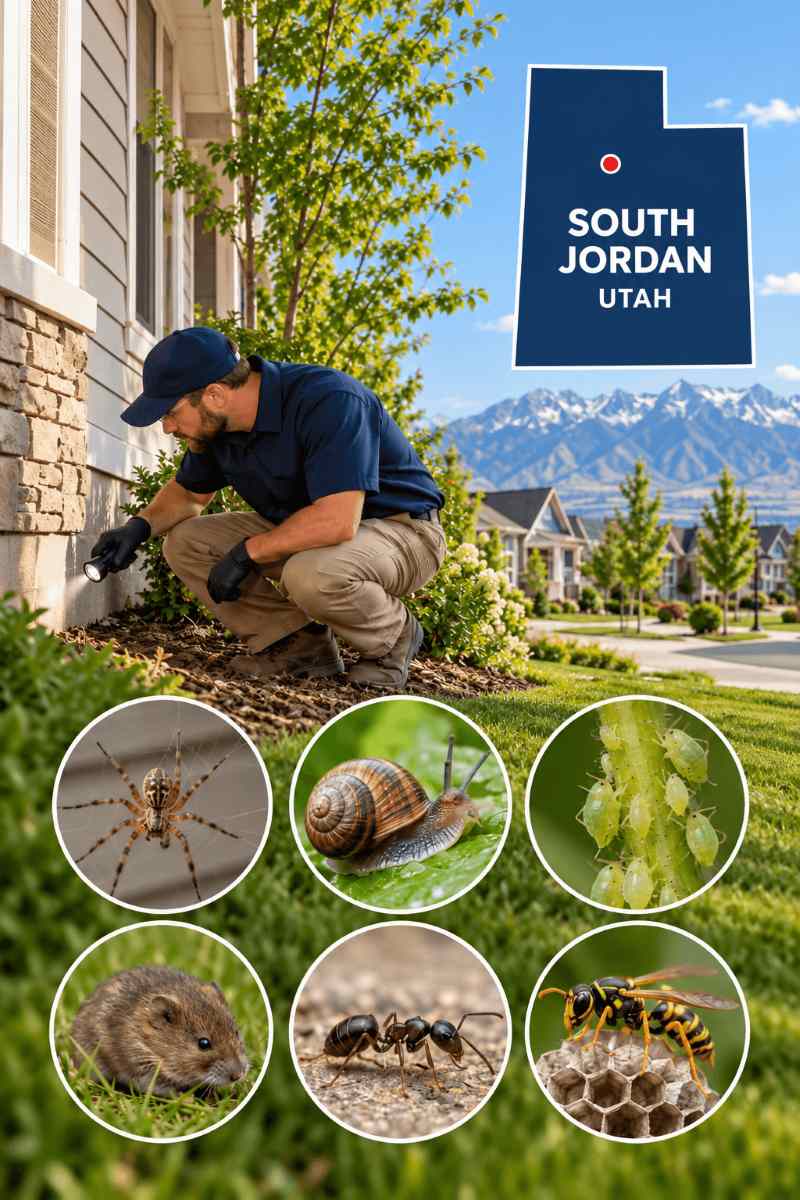
South Jordan is our heaviest spider city of the 36 we service at volume, and snail calls run more than three times our rate elsewhere. Young, well-watered yards drive almost all of it. We treat for the city you actually live in.
Text (385) 425-1766 with a question or a photo of the bug, and we will get back to you, free, usually same day.
South Jordan has rebuilt itself faster than almost any city in Salt Lake County. The 1990 census counted 12,220 people and a lot of alfalfa ground. The 2020 census counted 77,487. Daybreak alone covers 4,200 acres of old Kennecott land, with a 67 acre lake, 37 parks and 20,000 homes planned.
So almost every yard here is young, and young yards drink. South Jordan City maintains roughly 96 miles of secondary water line, pushing untreated canal water out of Utah Lake onto lawns and beds from about May 1 to October 15.
South Jordan’s pest mix does not read like a map of the valley. It reads like a landscaping report.
The local picture
What South Jordan actually calls us about
First, what these numbers are. They come from our own service records: 2,652 South Jordan appointments measured against the rest of our Utah work, with every ranking drawn from the 36 cities where we log enough volume for a fair comparison. It is a record of what people call us about, not a census of the city’s insects.
Scroll the chart sideways to see the full scale →
Four things stand out, and they all point the same direction:
- Spiders are a bigger share of our South Jordan work than in any other city we service at volume. Number one of the 36.
- Snail calls run more than three times the rest-of-area rate, second of the 36.
- Aphid calls run about two thirds higher than our rate, top five of the 36.
- Vole calls run about half again our rate, top ten of the 36. Fly calls land in the top five.
The other side: box elder bug calls run about a third of our rate, third lowest of the 36. Rat calls run under half, bee and moth calls about half.
Spiders, snails, aphids and voles are all creatures of watered, planted, growing ground. Box elder bugs and rats want something South Jordan does not have yet. Service records cannot prove a cause, but the pattern is hard to miss.
Not sure what you are looking at?
Text us a question or a photo of the bug. We will identify it and tell you whether it needs treating or not, free, usually the same day.
The big one
Spiders: our heaviest spider city
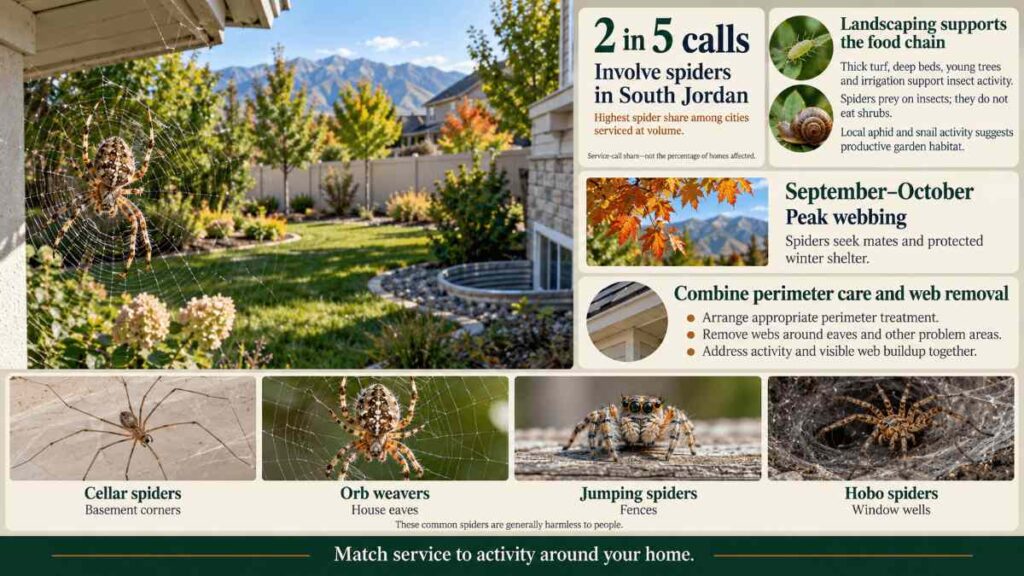
Two in five South Jordan pest calls involve spiders, the highest share of any city we service at volume.
Nobody wants to hear this, but the likeliest reason is that your landscaping is working. Utah State University Extension puts it plainly: “All spiders are predators, usually feeding on small insects and sometimes other spiders.”
Spiders do not eat your shrubs. They eat whatever your shrubs are feeding. Thick turf, deep beds, young trees and a sprinkler schedule produce a lot of soft bodied insects, and those produce a lot of spiders. South Jordan’s aphid and snail numbers say the food supply is generous here.
The species list is the good news: cellar spiders, orb weavers on the eave, jumping spiders on the fence, hobo spiders in window wells, all harmless.
Webbing peaks in September and October, when USU says spiders “scurry to find mates and protected winter hideouts.” Treating the perimeter and knocking webs down beats either alone, because a cleared eave gives the next spider nothing to anchor to.
Snails: the clearest single signal in our South Jordan data
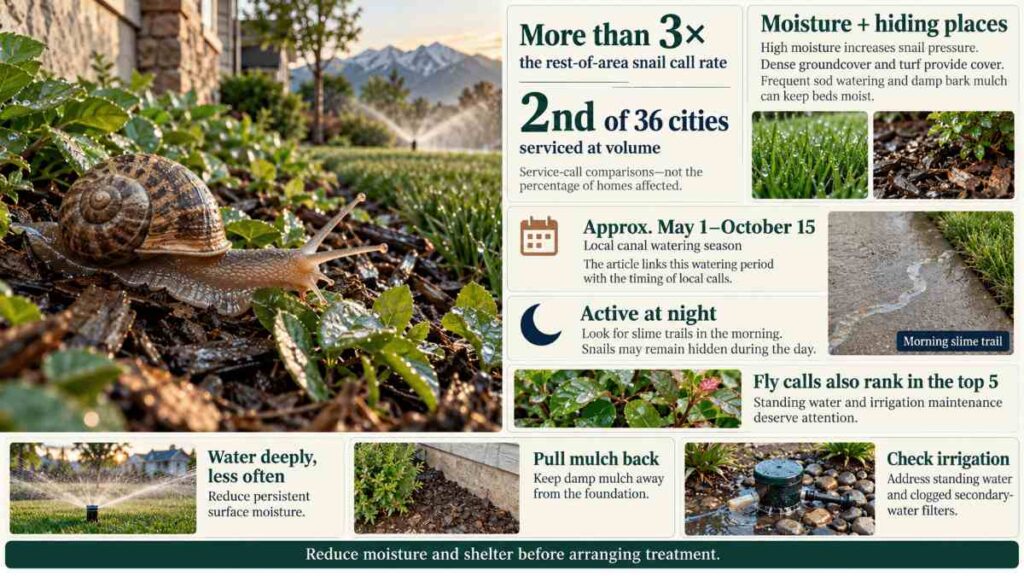
Snail calls here run more than three times the rest-of-area rate, second of the 36 cities we service at volume.
USU Extension is direct about the cause: slugs and snails “are always a more serious problem under high moisture conditions,” and the same fact sheet notes that “dense groundcovers and turf are ideal hiding places.”
Now read that back as a description of a newer South Jordan yard: bark mulch piled to the foundation, new sod on a short cycle, shrub beds still filling in, and secondary water running five and a half months of the year. The city’s own canal season, roughly May 1 to October 15, lines up almost exactly with when these calls come in.
Snails feed at night, so most people never see the animal and just find slime trails in the morning. Fly calls run in the top five of the 36 as well, and standing water in a bed or a clogged secondary water filter feeds both. Watering deeply and less often, and pulling mulch back from the foundation, cut the pressure before anything gets treated.
Aphids: that sticky film on your car is not sap
Aphid calls are a small category everywhere. In South Jordan they run about two thirds above our rate, top five of the 36.
Aphids feed on plant sap, and USU Extension notes they “exude honeydew onto plants, homes and cars,” with “sooty mold growing on honeydew” turning the mess black afterward. Park under a parkstrip tree in June, come back to a windshield you cannot wipe clean, and what happened.
Our best read on why South Jordan runs high is tree age. Aphids go for tender new growth, and a city that planted most of its trees after 2000 is full of young, heavily watered ornamentals. They rarely kill an established tree. They do coat your car, and they feed the ant traffic marching up the trunk.
Voles: the damage you find at snowmelt
Vole calls run about half again our rate here, top ten of the 36.
USU Extension counts five vole species in Utah, the meadow vole most common. Two details matter here. First, “voles love low cover. Groundcovers and thick litter provide preferred nesting habitat,” which describes a new subdivision almost perfectly. Second, they are “active throughout the year and do not hibernate,” and in winter they “will feed on the lower bark of woody plants, girdling them beneath the snow line.”
So you see nothing in January and everything in March: two inch winding runways cut into the turf, dime sized holes, and chewed bark at the base of young trees. That last one is the expensive part, because a girdled tree usually cannot be saved, and South Jordan is full of trees young enough to lose.
In our experience the worst of it lands on lots backing onto open ground, a canal bank or the Jordan River Parkway corridor. We do not track results street by street, so we will not pretend one neighborhood is worse than another. What we can say: the more unmanaged groundcover meets your lawn, the more vole pressure.
The other side of the list
The pests South Jordan mostly does not get
Box elder bugs. The classic Utah nuisance bug, the one that masses on a sunny south wall every October. In Bountiful and Ogden it is our second biggest complaint. Here it runs about a third of our rate, third lowest of the 36. Box elder bugs need female, seed bearing boxelder trees to reproduce, and our best read on the gap is tree age. Farm ground subdivided after 2000 has no eighty year old shade trees. The long settled towns do.
Rats. Under half our rate, which surprises people, since the Jordan River runs straight through the city. Norway rats do best in older, denser, plumbing heavy urban cores, and South Jordan’s housing and sewer lines are mostly new.
Bees, moths and wasps. Bee and moth calls run about half our rate, wasp calls about four fifths. For a city with this many yards, an easy wasp market.
Ants and mice: the everyday work
Ant calls are about one in six here, modestly above our rate and top ten of the 36. Odorous house ants and pavement ants are the usual pair, and on secondary water they follow moisture: the sprinkler box, the patio slab seam, the trunk of whatever tree the aphids found first.
Mice sit exactly on our service-area rate. They press indoors in October and November, and homes backing onto open ground get them first, since a mouse needs only a pencil-width gap.
A South Jordan pest control calendar
What we are treating, and when. The highlighted row is where we are today.
| When | What matters in South Jordan |
|---|---|
| March, April | Walk the lawn for vole runways and check young tree trunks for chewed bark. |
| May, June | Secondary water comes on, snails and aphids start, ant trails appear, wasp queens build. |
| July, August | Peak snail and fly activity, honeydew at its stickiest, spiders building on it. |
| September, October | Heaviest spider webbing of the year, mice moving indoors, secondary water off mid October. |
| November to February | Rodent and interior work, and the months voles do their damage under the snow. |
Why a South Jordan homeowner should call us
Why South Jordan homeowners call Beeline
We run South Jordan on a regular route, so you are not waiting on a truck dispatched from the other end of the state. We are in the city most weeks, and 2,652 completed appointments is the proof.
Beeline is locally owned, more than 29 years in Utah, 2,300+ five-star reviews, no hidden charges. Our quarterly service covers everything on this page, and if something comes back between visits, so do we.
Get a free quote: (801) 544-9200, or text us at (385) 425-1766.
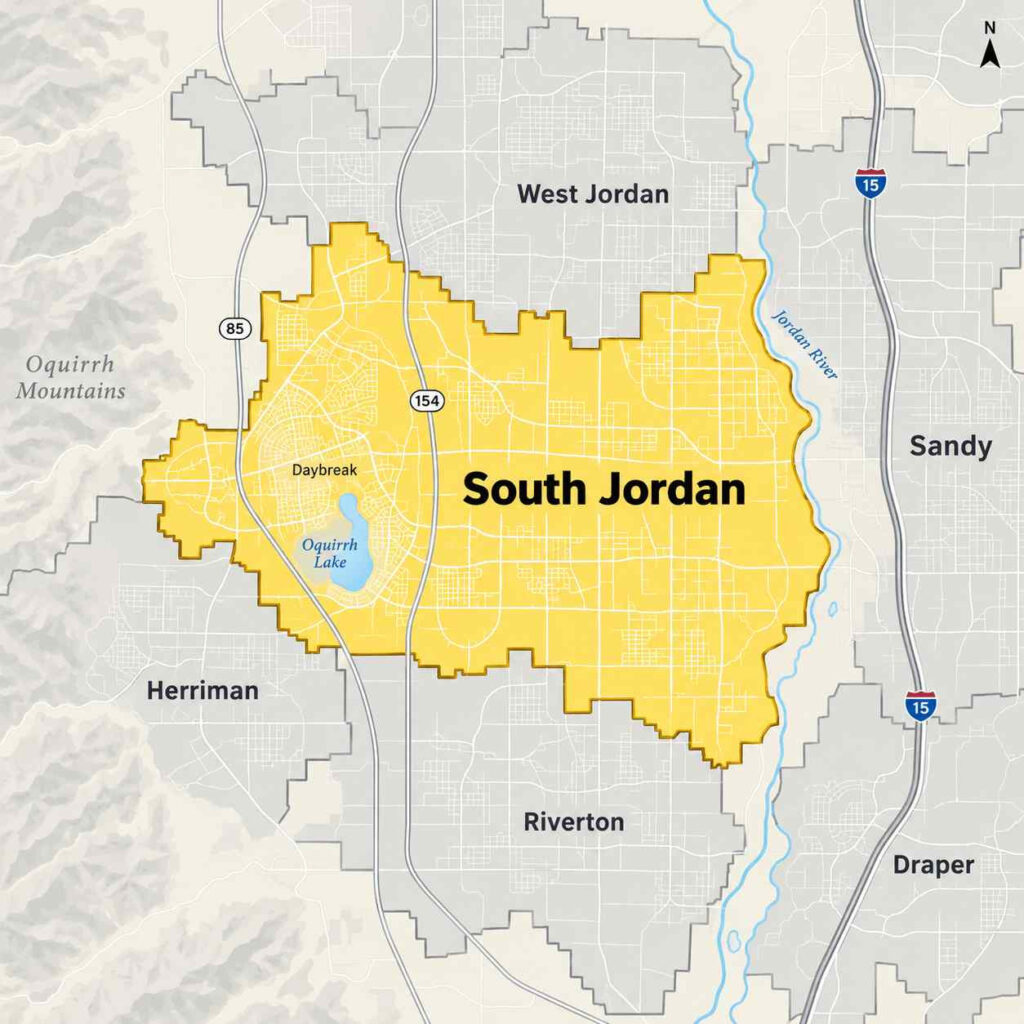
We also service nearby:


Before you book
South Jordan pest control questions we actually get asked
Why do I see so many more spiders here than at my last house?
Because South Jordan is our heaviest spider city out of the 36 we service at volume. Spiders are predators, and USU Extension notes they feed on small insects, so they follow the food. Irrigated lawns, deep beds and young trees produce plenty of it.
There are snails all over my patio every morning. Is that a South Jordan thing?
It is. Snail calls here run more than three times our rest-of-area rate, second of the 36 cities we service at volume. USU Extension says slugs and snails are always a more serious problem under high moisture conditions, and that mulch and dense turf keep them protected. Secondary water from May to October supplies both.
Something sticky is dripping onto my car under the parkstrip tree. What is it?
Aphid honeydew. USU Extension describes it dripping onto sidewalks and cars below infested trees, and the black film that follows is sooty mold growing on it. Aphid calls run about two thirds above our rate here, top five of the 36, with young ornamentals the usual host.
Does anything change when the secondary water shuts off in October?
Yes, and it is the one seasonal shift South Jordan homeowners can actually feel. The city puts the canal season at roughly May 1 to October 15. Once the beds dry out, snail, fly and ant pressure drops quickly. Spiders and mice do not care, and October is when both come indoors.
My parents in Bountiful get box elder bugs all over the house every fall. Why don't I?
Most likely you do not have their trees. Box elder bugs need female, seed bearing boxelder trees to reproduce, and South Jordan's canopy is mostly younger than 2000. Box elder bug calls here run about a third of our rate, third lowest of the 36 cities we service at volume. Bountiful is near the top.
The Jordan River runs through town. Shouldn't that mean rats?
It is a fair question, and the data says no. Rat calls here run under half our service-area rate. Norway rats do best in older, denser, plumbing heavy urban cores, and that goes a long way toward explaining what we see: South Jordan's housing and sewer lines are mostly new. Mice run right on our average.
West Jordan is right next door. Why would my pest problems be different?
Mostly tree and landscape age. Both cities run high on snails, but South Jordan runs higher: second of the 36 against West Jordan's top ten. West Jordan gets noticeably more elm seed bugs, because it has the mature elm canopy South Jordan has not grown yet.
Do new Daybreak homes need pest control?
New builds are more vulnerable for the first couple of years, not less. Construction pushes whatever lived in the ground somewhere else, fresh sod and new irrigation create the damp conditions snails want, and gaps at utility penetrations and garage corners are usually unsealed. A builder's treatment at closing will not carry you through summer one.
Three ways to get a South Jordan quote
All of them free, all of them with a real person at our Clearfield office.
- 1Send us a photo(385) 425-1766. Fastest answer.
- 2Call us(801) 544-9200. Mon to Fri 7:30am to 7:00pm, Sat 7:30am to 4:00pm.
- 3Fill in the formSend a picture of the bug or the damage and we will tell you what it is and what it costs.