
West Jordan, UT · Salt Lake County
Pest Control in West Jordan, Utah
West Jordan went from 4,221 people in 1970 to Utah’s third-largest city, and its bugs show it. Mouse calls run about 1.4 times our rate elsewhere while rats run at six-tenths, and almost everything that flies runs light. We treat for the city you actually live in.
Text (385) 425-1766. Send a photo of the bug and we will tell you what it is, free, usually same day.
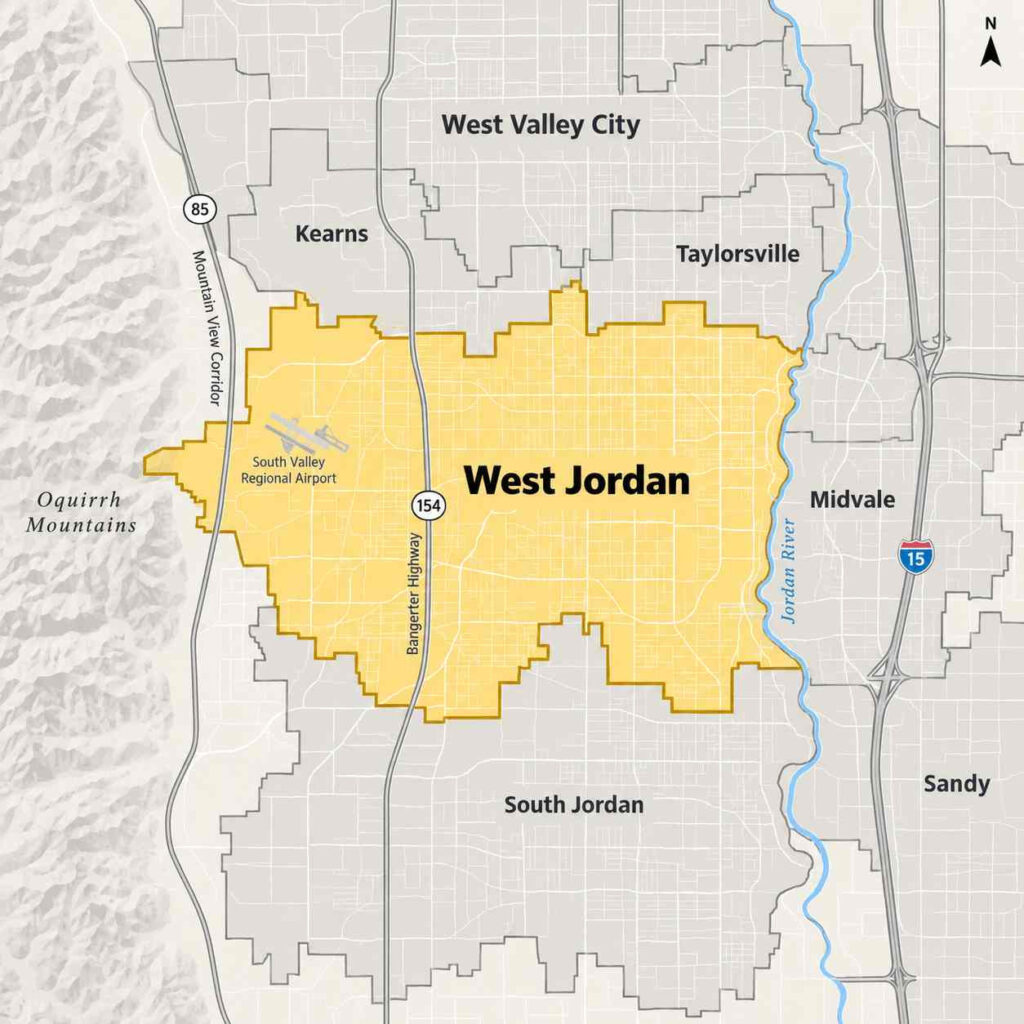
West Jordan is Utah’s third-largest city, and it does not behave like one. In 1970 it had 4,221 people. By 2020 it had 116,961, spread over 32 square miles between the Jordan River on the east and the Oquirrh Mountains on the west, nearly all of it detached houses on their own lots.
That history shows up in the bugs. We have serviced Utah homes for 29 years, thousands of those visits inside West Jordan, and the mix here looks nothing like Salt Lake City’s or Holladay’s twenty minutes away.
The local picture
What West Jordan actually calls us about
First, what these numbers are. They come from our own service records: 3,415 West Jordan appointments measured against the rest of our Utah work, with every ranking drawn from the 36 cities where we log enough volume for a fair comparison. It records what people call us about, not a census of the local insect population.
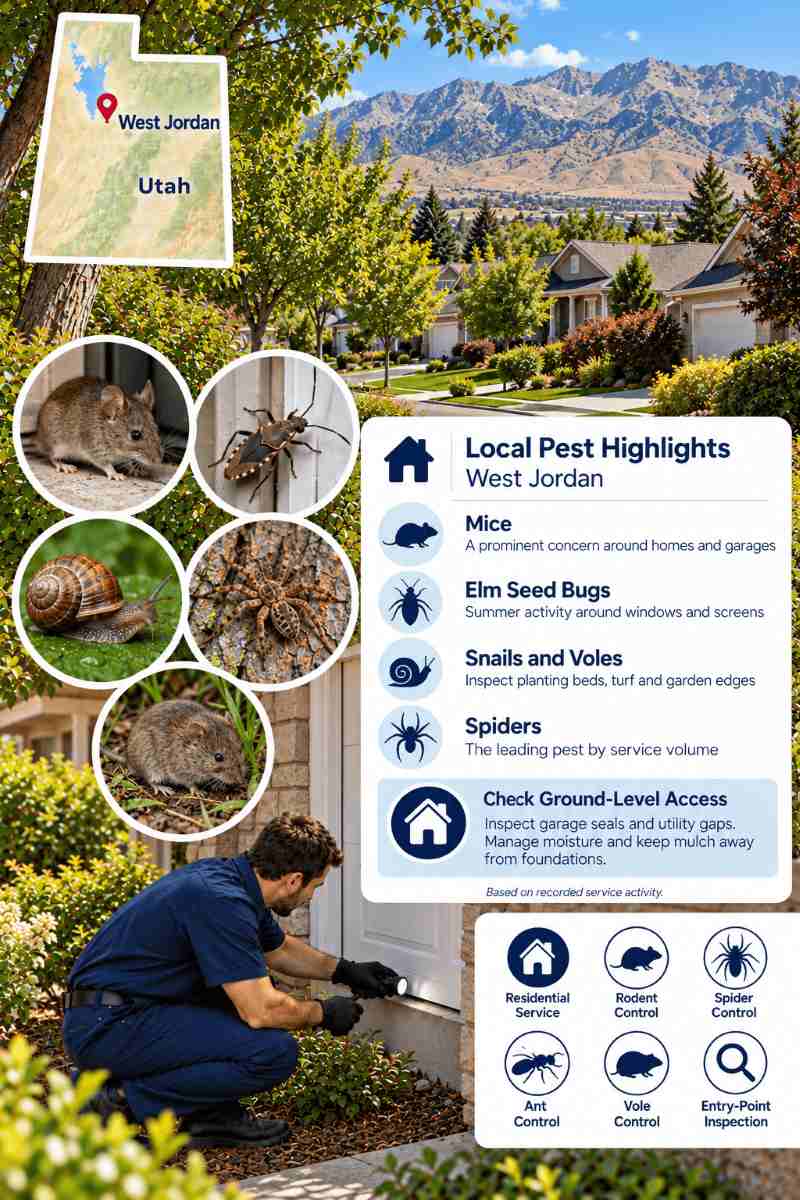
Spiders, mice, ants and wasps are the bulk of the work, as in every Utah city. The shape of everything else is the interesting part:
- Mouse calls run about 1.4 times the rest of our service area. Mice are West Jordan’s second-biggest complaint, roughly one call in seven, and top ten among the cities we service at volume.
- Rat calls run a little under six-tenths of our service-area rate, the opposite of what a city this size usually looks like.
- Snail calls are about twice our service-area rate, top ten of the 36.
- Elm seed bugs run about 1.6 times higher, centipedes about the same, voles about 1.4. All three are top ten.
Then the other half of the pattern: almost everything arriving through the air runs light. Wasps, flies and mosquitoes all sit below the service-area rate, wasps notably so.
Scroll the chart sideways to see the full scale →
Put simply, West Jordan’s pest pressure comes in at ground level. What walks, tunnels and climbs a foundation runs hot. What flies in runs cool. Service records cannot prove why, but the city’s building age and its position against the Jordan River both fit what our technicians see.
Not sure what you are looking at?
Send us a photo. We will identify it and tell you whether it needs treating or not, free, usually the same day.
The big one
Mice are the story here. Rats are not.
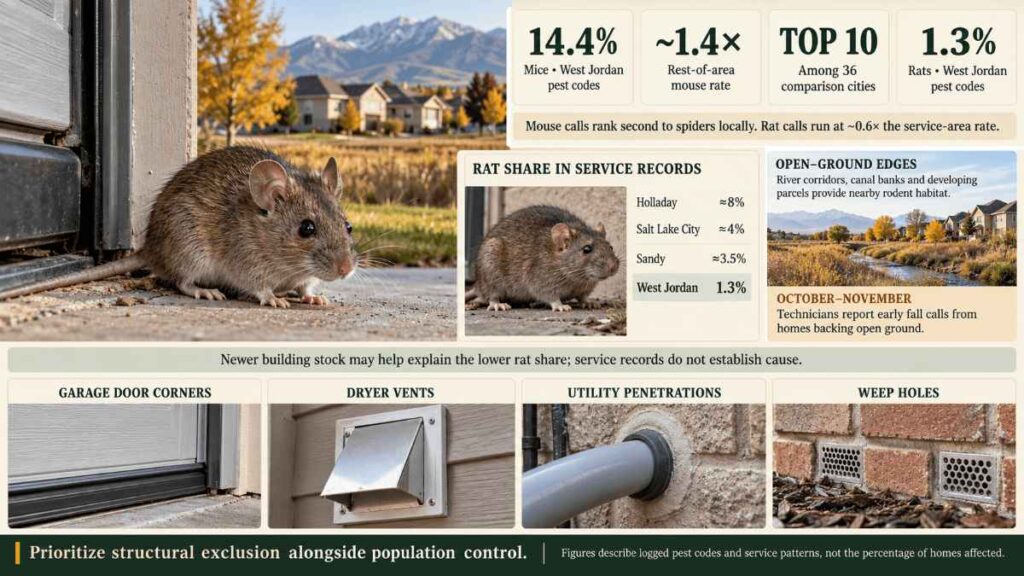
Mice are 14.4% of everything we log in West Jordan, second only to spiders, and they run about 1.4 times the rest-of-area rate. That is top ten among the 36 cities we service at volume.
Rats are the mirror image, at roughly six-tenths of our service-area rate. For scale: rats are almost 8% of our work in Holladay, the heaviest rat city of the 36, close to 4% in Salt Lake City and about three and a half percent in Sandy. In West Jordan they are 1.3%.
Why a city this size does not have a rat problem
Norway rats want old, dense, plumbing-heavy building stock: aging sewer laterals, gapped masonry foundations, alleys, basements remodeled four times over. Salt Lake City’s older neighborhoods and Holladay’s have all of that. West Jordan largely does not, because almost none of it existed before 1970. The city added twenty-three thousand people in that one decade and kept going, so the housing is postwar tract and later, on modern sewer.
House mice need none of that. They need a gap the width of a pencil and somewhere to come in from, and West Jordan supplies plenty: the Jordan River corridor on the eastern boundary, canal banks across town, open ground toward the Oquirrhs, and parcels still being subdivided past Mountain View Corridor. In our experience the first fall calls come from homes backing onto that open ground, in October and November.
So mouse work here is mostly exclusion, not bait: garage door corners, dryer vents, the gas line penetration, weep holes.
Elm seed bugs: the tree that came with the subdivision
Elm seed bug calls run about 1.6 times the rest of our service area, top ten of the 36. At 4.5% of everything we log here it is the city’s sixth-biggest complaint, ahead of rats, bees and beetles combined.
USU Extension confirmed the first Utah record in July 2014, and it has spread quickly since. It breeds on elm seed, and unlike box elder bugs it peaks in the heat: USU puts peak nuisance activity from mid-June through August. So you meet it in July on a window screen or a hot south wall, then again inside a window at dusk. It does not bite and cannot breed indoors, but it does smell when crushed.
Our best read on why West Jordan runs high is tree age. Neighborhoods built between the late 1970s and the early 1990s now carry forty-year-old canopies, and Siberian elm went in heavily through that era because it grows fast and survives anything. USU Extension calls it aggressive enough to turn weedy when its seed is not managed. Treatment is a perimeter application timed to June, plus screen and weatherstrip repair.
Snails, centipedes and earwigs: the damp-ground crowd
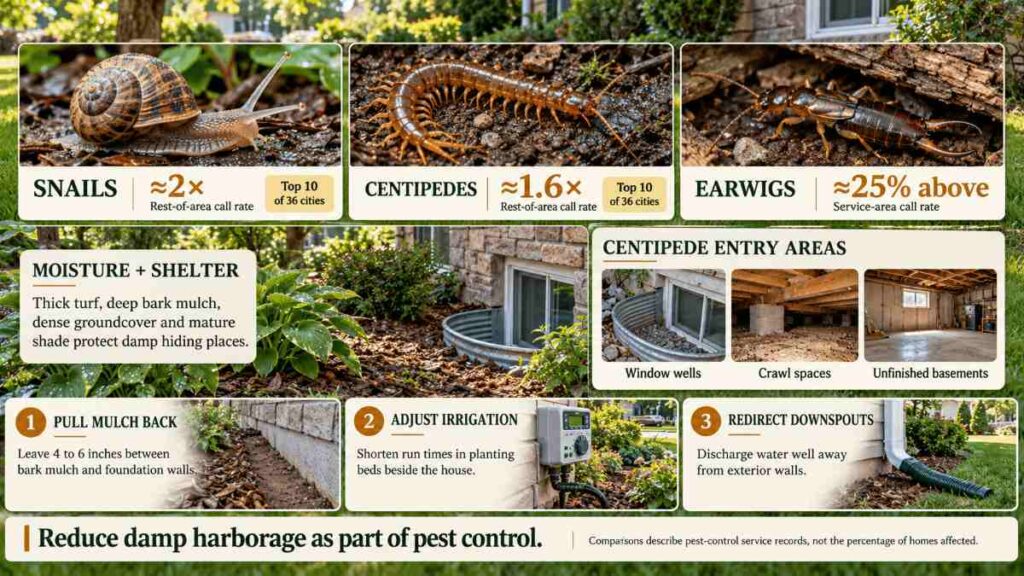
Three ground dwellers run above our service-area rate at once. Snail calls are about twice the rest-of-area rate and centipedes about 1.6 times higher, both top ten of the 36. Earwigs run about a quarter above average.
All three want the same conditions, and USU Extension is blunt about it: slugs and snails are “always a more serious problem under high moisture conditions,” and organic matter that holds soil moisture keeps them protected, with dense groundcover and turf as ideal hiding places. Mature West Jordan landscaping supplies every piece of that: thick lawn, deep bark mulch against the foundation, established shrub beds, and shade from trees given thirty years to fill in.
Centipedes are the same story one step further inside, following that damp harborage into window wells, crawl spaces and unfinished basements. They are harmless to the house, but nobody wants to meet one at midnight on the bathroom floor.
The fix is as much drainage as chemistry: mulch pulled back from the foundation, shorter irrigation runs in the beds nearest the house, downspouts discharging away from the wall.
Voles: the damage you find at snowmelt
Vole calls run about 1.4 times the rest-of-area rate, top ten of the 36. That is unusual for a city this built out, and the corridors are the likeliest reason: the Jordan River Parkway down the eastern boundary, canal banks across the middle of town, un-built parcels on the west side.
You rarely see the animal. You find the aftermath in March: winding two-inch runways carved into the turf, dime-sized holes, and chewed bark at the base of young landscape trees. A girdled tree usually cannot be saved, which makes that the expensive part.
In our experience the worst of it lands on lots backing onto a trail, a canal bank or open ground. We do not track results street by street, so we will not guess at which subdivision fares worst.
The other side of the list
What West Jordan mostly does not get
Wasps. Still the fourth-biggest thing we treat here, so nobody is claiming West Jordan has no wasps. As a share of our work, though, they run about two-thirds of the rest-of-area rate, near the bottom of the 36. Compact lots, shallow modern eaves and far less agricultural fringe than the Davis County cities probably have a lot to do with it. Treat your eaves in spring anyway, but wasps are not the defining problem here that they are in Farmington.
Flies. About a third of our service-area rate, close to the lowest of the 36. Fly complaints track dairies, feedlots, canneries and river bottoms, and West Jordan’s farm ground went to houses decades ago.
Mosquitoes. Under half our service-area rate. The South Salt Lake Valley Mosquito Abatement District is headquartered in West Jordan, at 7308 Airport Road, and covers the city along with most of Salt Lake County. Between that work and the absence of any marsh, mosquitoes barely register here.
Box elder bugs. A little over three-quarters of the rest-of-area rate, middle of the pack. Present, but not the October event they are in Bountiful.
Why a West Jordan homeowner should call us
Why West Jordan homeowners call Beeline
Our office is at 275 W 1700 S in Clearfield, about forty minutes up I-15, and we run West Jordan routes on a set schedule rather than sending someone on a one-off. Locally owned, 29 years in Utah, 2,300+ five-star reviews, no hidden charges. Our quarterly service covers every pest on this page, and if something comes back between visits, so do we.
Get a free quote: (801) 544-9200, or text us at (385) 425-1766.
We also service nearby:


A West Jordan pest control calendar
What we are treating, and when. The highlighted row is where we are today.
| When | What matters in West Jordan |
|---|---|
| March, April | Walk the lawn for vole runways after snowmelt and check young trees for girdling. Treat eaves before wasp queens establish. |
| May, June | Ant pressure builds, spiders come out, elm seed bugs start moving mid-June. |
| July, August | Peak elm seed bug season, peak snail and centipede activity in irrigated beds. |
| September, October | Mice press indoors, wasp nests hit full size, earwigs move toward foundations. |
| November to February | Rodent exclusion and interior work, plus the months when voles do their worst under the snow. |
Before you book
West Jordan pest control questions we actually get asked
Everyone I know in Holladay and Salt Lake City complains about rats. Why don't I see them in West Jordan?
Mostly it comes down to what your house is made of and when it went up. Norway rats do best in older, denser, plumbing-heavy building stock, and West Jordan had barely 4,000 residents in 1970. Rats are close to 8% of our work in Holladay, the heaviest of the 36 cities we service at volume, and 1.3% of it here.
Then why do I keep catching mice in a house that is only twenty-five years old?
Age is not the issue with mice. Access is. Mice are our second-biggest West Jordan complaint and run about 1.4 times the rest-of-area rate, top ten of the 36 cities we service at volume. A mouse needs a gap the width of a pencil, and open ground, canal banks and the river corridor feed them in every October.
What is the bug on my window screen in July that smells terrible when I squash it?
Almost certainly an elm seed bug. USU Extension confirmed the first Utah record in 2014 and puts peak nuisance activity from mid-June through August, which matches when our West Jordan calls spike. They breed on elm seed, so a mature elm on or near your lot is usually the source.
There are snails all over my patio and planter beds. Where did they come from?
From the beds themselves. Snail calls here run about twice our service-area rate, top ten of the 36 cities we service at volume, and USU Extension notes they are always worse under high moisture conditions. Deep bark mulch, thick turf and daily irrigation supply all of it.
The mosquito abatement district is based right here in West Jordan. Do I still need mosquito service?
Usually not, and we will tell you so. The South Salt Lake Valley Mosquito Abatement District sits at 7308 Airport Road and covers the city, and mosquito calls here run under half our service-area rate. If you are bitten in your own yard, look first for standing water on it.
I found winding trails in my lawn right after snowmelt, and my yard backs onto the Jordan River Parkway. What are they?
Those are vole runways, and backing onto a trail or canal bank is the common thread on the West Jordan vole calls we run. Vole calls here go about 1.4 times our service-area rate, top ten of the 36 cities we service at volume. Check young trees for chewed bark at the base, because a girdled tree rarely recovers.
Three ways to get a West Jordan quote
All of them free, all of them with a real person at our Clearfield office.
- 1Send us a photo(385) 425-1766. Fastest answer.
- 2Call us(801) 544-9200. Mon to Fri 7:30am to 7:00pm, Sat 7:30am to 4:00pm.
- 3Fill in the formSend a picture of the bug or the damage and we will tell you what it is and what it costs.