
Cottonwood Heights, UT · on our regular Salt Lake County route
Pest Control in Cottonwood Heights, Utah
Rat calls in Cottonwood Heights run nearly three times our rate elsewhere, third of the 36 cities we service at volume, while mosquitoes and mice barely register. We treat for the city you actually live in.
Text (385) 425-1766. Send a photo of the bug and we will tell you what it is, free, usually same day.
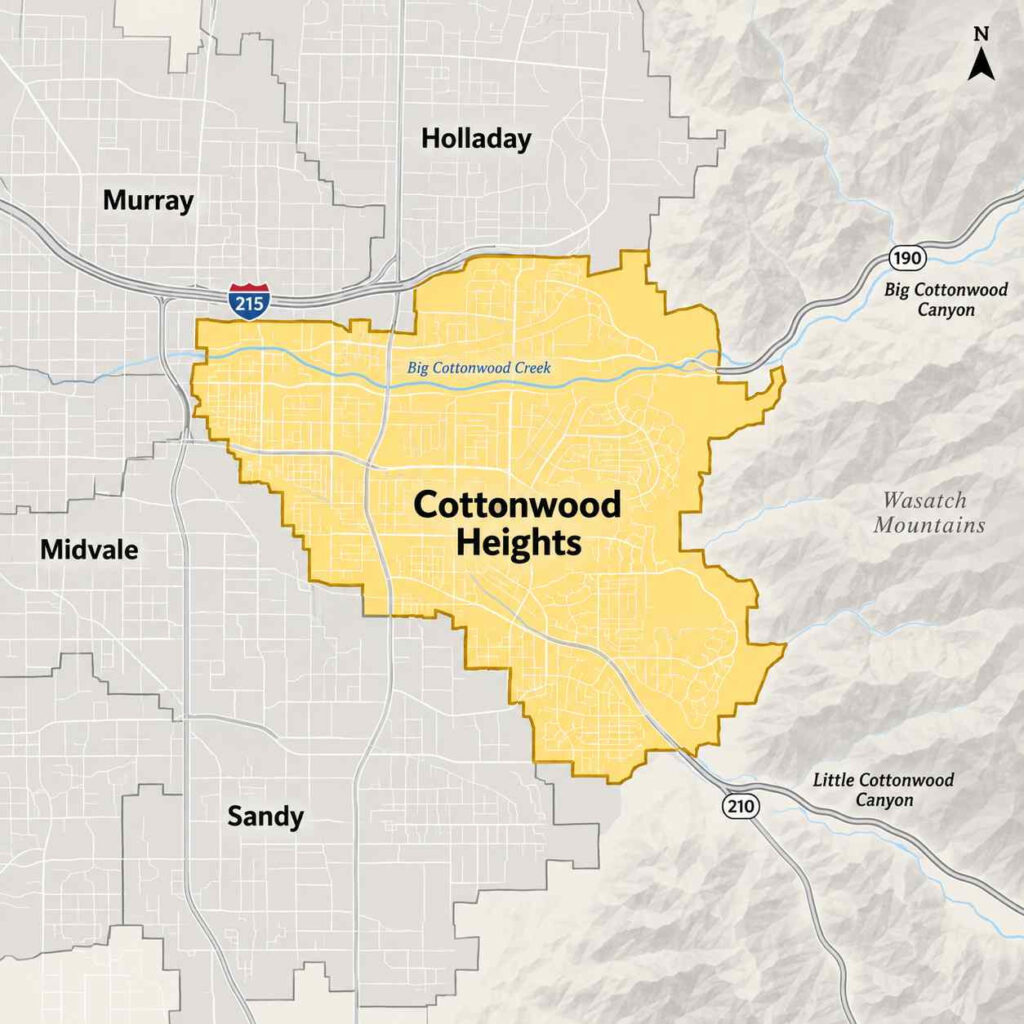
Cottonwood Heights calls itself the city between the canyons, and for once a municipal nickname is doing real work. The city is draped over the ridge separating the Big Cottonwood and Little Cottonwood creek valleys, on the east bench at about 4,820 feet, with the Wasatch going straight up behind the back fence.
That shapes the pest work here more than anything else. We have run 2,386 appointments in Cottonwood Heights, and the file they produced is quieter than most. One signal stands clear. The rest of what makes this place unusual is what it does not get.
The local picture
What our Cottonwood Heights records actually show
First, what these numbers are. They come from our own service records: 2,386 Cottonwood Heights appointments measured against the rest of our Utah work, with every ranking drawn from the 36 cities where we log enough volume to compare fairly. It is a record of what people call us about, not a census of what lives here.
Some Utah cities hand us four or five loud signals. Cottonwood Heights hands us two, and four quiet ones pointing the other way:
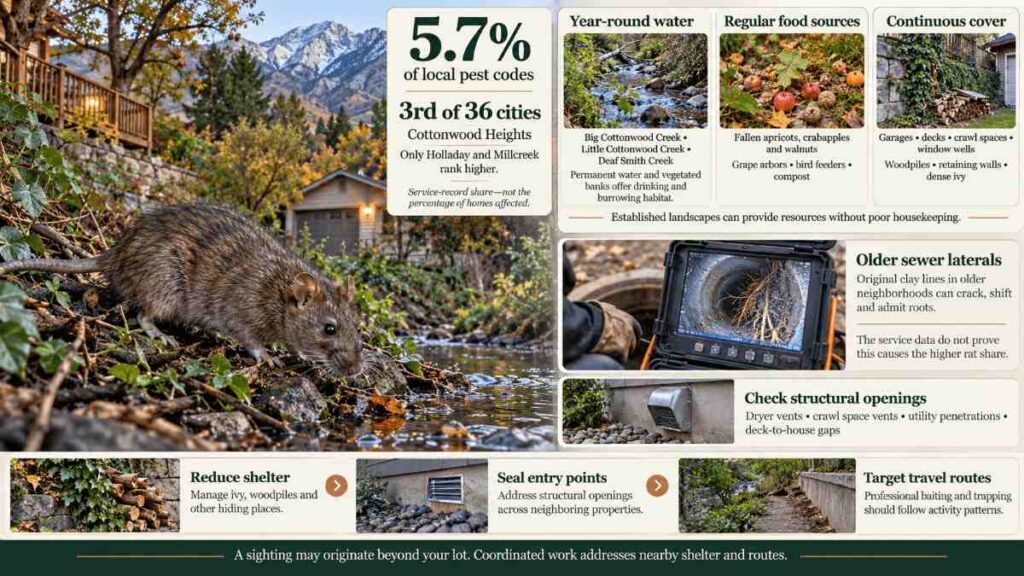
- Rat calls are 5.7% of our Cottonwood Heights work against 2.1% across the rest of our area. Nearly three times the rate, and third-highest of the 36 cities we service at volume.
- Moth calls run about one and two thirds the rest-of-area rate, also third of those 36, though on a much smaller base.
- Mosquito calls are a fifth of the rest-of-area rate, 34th of 36.
- Mouse calls are under half, 35th of 36, in a city that ranks third for rats.
- Fly calls and earwig calls both run a little over 40% of the rest-of-area rate, 29th and 30th.
Scroll the chart sideways to see the full scale →
Ant calls run modestly high, fifth of those 36, and box elder bugs and hornets sit in the top ten.
Read the hot row and the cold rows together and most of it comes down to one thing: a bench at the mouth of two canyons drains hard and fast. Water does not sit here, which takes a whole family of pests off the table. What it does not touch is whatever lives in the creek corridors and the pipe underneath.
Not sure what you are looking at?
Text us a photo. We will identify it and tell you whether it needs treating or not, free, usually the same day.
The big one
Rats: the one signal that stands clear
At 5.7% of the pest codes we log here, Cottonwood Heights is third of the 36 cities we service at volume, behind Holladay and Millcreek. That is not three towns coincidentally. It is one bench: the signal runs north along the same strip of older east-side neighborhoods, eases in Sandy next door, and falls away in the newer south-valley cities.
Before anything else: this is a habitat and infrastructure story, not a housekeeping one. Norway rats are drawn to water, food and cover sitting close together, and Cottonwood Heights supplies all three without anyone doing a thing wrong.
Water that runs year round. The city’s own flood control page tracks three creeks through nine square miles: Big Cottonwood Creek, Little Cottonwood Creek and Deaf Smith Creek, with live gauges at Crestwood Park and the Big Cottonwood canyon mouth. Canyon water is cold and fast, terrible for mosquitoes and excellent for rats, because a rat wants a permanent drink and a soft bank to dig into.
Food on a schedule. This was orchard and farm ground before the first subdivisions went in between 1953 and 1955, and a lot of the fruit and nut trees stayed. Fallen apricots, crabapples and walnuts, plus grape arbors, bird feeders and compost, feed a block year round.
Cover. Big sloped lots, detached garages, decks over crawl space, window wells, woodpiles, retaining walls, and ivy thickening in the same bed since the Johnson administration.
Underneath sits a fourth factor. Sewer here runs through the Cottonwood Improvement District, and a good share of the lateral pipe from house to main in the older neighborhoods is original, which cracks, offsets and takes root intrusion. Our records cannot prove that produces the number. What we can say: our three highest rat cities are three adjoining bench cities with the valley’s oldest residential plumbing.
USU Extension puts the gap a Norway rat needs at two inches or more, against a quarter inch for a mouse. That sounds like good news until you walk your own foundation counting two-inch gaps: dryer vents, hose bibs, crawl space vents, where the deck meets the house. The rat you saw probably does not live on your lot either, so treating one property hard while the burrow sits two doors down buys a quiet month. What holds is harborage reduction and sealing across a run of properties, with bait and trapping on travel routes rather than on the sighting.
Mice run cold here, and that is not a typo
Mouse calls are 4.8% of our work here against 10.7% everywhere else. That is 35th of 36, nearly last, in the city that ranks third for rats.
Two things probably contribute. House mice in our records track open ground hardest: fields, canal banks, unbuilt lots. Cottonwood Heights has no fringe left, boxed in by Holladay and Murray to the north, Midvale to the west and Sandy to the south, with the canyon wall on the fourth side. The second is competition, since established Norway rats crowd house mice out of the same harborage. We would not bet the house on that one, but it fits both numbers at once.
So if you hear something in a wall here, do not assume mouse. The two need different gaps, different bait and different placement.
Moths, and the two very different things people mean by that
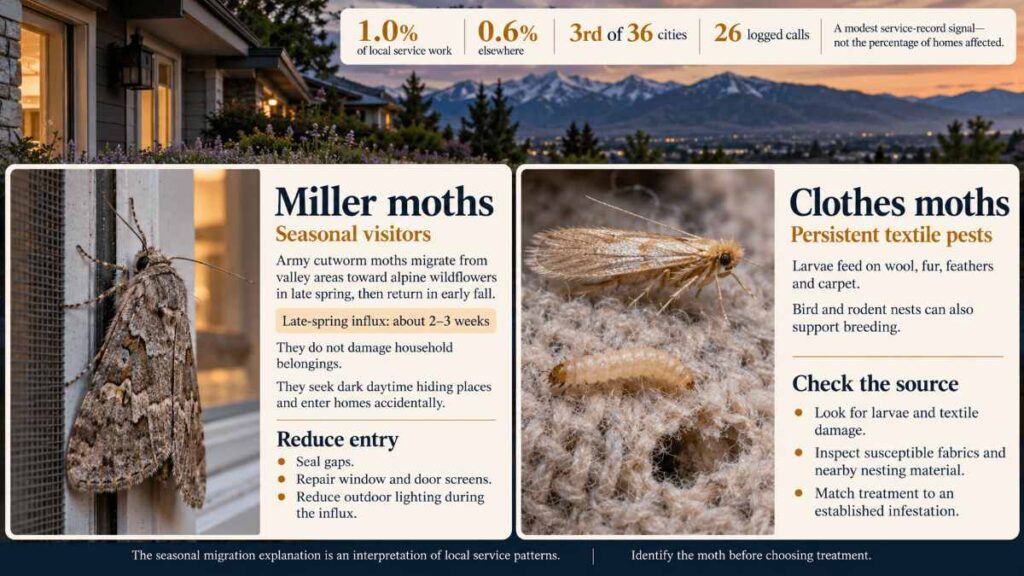
Moth calls are 1.0% of our work here against 0.6% elsewhere, third of the 36 cities, on 26 logged calls. A real signal, but a modest one.
What makes it interesting is that the two cities above us are Park City and Salt Lake City, both canyon adjacent. In our experience that points at the spring miller moth run more than at anything in your kitchen. Army cutworm moths emerge in the valley in late spring and migrate up to alpine wildflowers in the Wasatch, then drop back down in early fall to lay eggs. A house at the mouth of Big or Little Cottonwood Canyon sits in that lane, and USU Extension describes the result plainly: mass migrations in late spring that inundate homes and buildings, for two to three weeks.
They eat nothing of yours. They want a dark crevice to hide in by day and end up indoors by accident, so sealing gaps, fixing screens and cutting outdoor lighting for those two weeks beats any spray. The other moths are the ones that stay: clothes moths feed on wool, fur, feathers and carpet, and USU Extension notes they also breed in bird and rodent nests. In a city with our rat numbers, worth keeping in mind.
The other side of the list
The pests Cottonwood Heights mostly skips
The cold rows matter as much as the hot one, because they save you money.
Mosquitoes. A fifth of the rest-of-area rate, 34th of 36. The bench is the reason. Mosquitoes need standing, warm, slow water, and a steep slope fed by cold canyon streams gives them almost none. The South Salt Lake Valley Mosquito Abatement District covers the city, and the breeding sites it names up here are small and mostly on private property: catch basins, ornamental ponds, horse troughs, tree holes. Most homes here do not need a mosquito program.
Flies. A little over 40% of the rest-of-area rate, 29th of 36. Fly pressure in our file tracks livestock, dairy and open irrigation, none of left here.
Earwigs. Also a little over 40%, 30th of 36. Earwigs want constant damp: fresh sod, new mulch, heavy sprinklers on flat ground. A bench lot that drains overnight does not produce them the way a three-year-old west-side yard does.
The ordinary three quarters of the work
Spiders are a third of the file and overwhelmingly harmless. Ants are 18%, which fits mature irrigated landscaping and stone retaining walls. Wasps are 14% and below our service-area average, so you get off easier than Farmington there. Box elder bugs are what a 70-year-old canopy buys you every October.
A Cottonwood Heights pest calendar
What we are treating, and when. The highlighted row is where we are today.
| When | What matters in Cottonwood Heights |
|---|---|
| March, April | Walk the foundation for two-inch gaps while vegetation is down. The best window of the year for spotting burrows. |
| May, June | Ants with the first real heat, wasp queens starting nests, the miller moth run. |
| July, August | Spiders, ants and hornets, plus the low mosquito pressure this city’s bragging right over Davis County. |
| September, October | Box elder bugs on sunny south and west walls, spider webbing at its peak, rat activity rising as the creek corridors dry back. |
| November to February | Rodent and interior work. Rats do not hibernate, they move indoors, and a warm crawl space in January is the prize. |
Why a Cottonwood Heights homeowner should call us
Working in Cottonwood Heights
We run Cottonwood Heights on a regular route, so you are not waiting on a truck from the other end of the state. Our technicians work these neighborhoods most weeks and know what bench lots produce. Beeline is locally owned, 29 years in Utah, with 2,300+ five-star reviews. Our quarterly service covers every pest on this page, no hidden charges, and if something comes back between visits, so do we.
Get a free quote: (801) 544-9200, or text us at (385) 425-1766.
We also service nearby:
Review slot 1
Pull a real Cottonwood Heights or Salt Lake County review from Google. Do not write one.
Review slot 2
Ideally one that mentions rats.
Before you book
Cottonwood Heights pest control questions we actually get asked
I saw a rat on my fence. Does that mean something is wrong with my house?
No. Rat calls are the one thing that separates Cottonwood Heights from most of Utah, at nearly three times the rest-of-area rate and third of the 36 cities we service at volume, and none of it is about housekeeping. Three creeks, old orchard trees dropping fruit, deep cover on big lots, and the valley's older sewer pipe underneath. Spotless houses here get rats too.
Is it worse here or in Holladay?
Why do I have almost no mice when everyone talks about fall mouse season?
Because there is no open ground left to push them in from. We rank 35th of 36 for mouse calls, at under half the rest-of-area rate. The city is boxed in by Holladay, Murray, Midvale and Sandy on three sides and the canyon wall on the fourth, so there is no field edge to cross in October.
Do I need mosquito service at the mouth of the canyon?
Usually not, and we would rather tell you that than sell it. Mosquito calls here are a fifth of the rest-of-area rate, 34th of 36. The South Salt Lake Valley Mosquito Abatement District already covers the city, and the breeding sites it names are things on your own property: an ornamental pond, a trough, a plugged catch basin, a tree hole. Dump the water and that usually settles it.
What are the moths that appear all at once in late May and vanish in two weeks?
Almost certainly miller moths, the adult army cutworm, migrating from the valley up to alpine wildflowers in the Wasatch. Cottonwood Heights sits at two canyon mouths, so that lane runs right over you. They feed on nothing in your house, so seal gaps and cut porch lighting rather than spray.
Is the Big Cottonwood canyon mouth worse than down by Fort Union Boulevard?
We do not track results street by street, so we will not pretend to a precise answer. What we can say: the creek corridors hold the rat habitat, so a lot backing onto a creek bank or greenbelt sees more pressure than one mid-block. For spiders and ants, no difference at all.
Three ways to get a Cottonwood Heights quote
All of them free, all of them with a real person at our Clearfield office.
- 1Text us a photo(385) 425-1766. Fastest answer. Send a picture of the bug or the damage and we will tell you what it is and what it costs.
- 2Call us(801) 544-9200. Mon to Fri 7:30am to 7:00pm, Sat 7:30am to 4:00pm.
- 3Fill in the formBest if you are reading this at midnight. We will come back to you the next working morning.