
Sandy, UT · Salt Lake County
Pest Control in Sandy, Utah
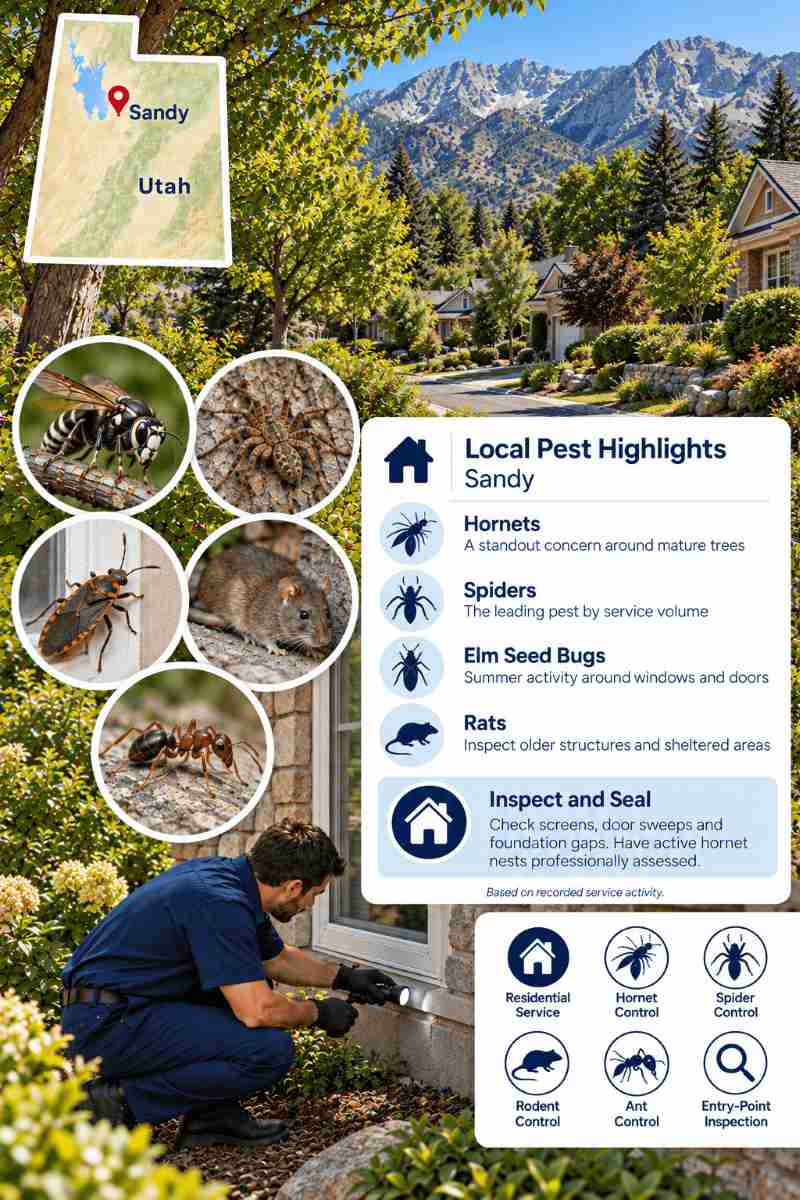
Sandy sits on a dry bench under fifty-year-old shade trees, and its bugs show it. It is our number one hornet city of the 36 we service at volume, runs high on rats, and barely logs a mosquito. We treat for the city you actually live in.
Text (385) 425-1766 with a question or a photo of the bug, and we will get back to you, free, usually same day.
Sandy is the driest pest environment we work in, and almost nobody living here knows it.
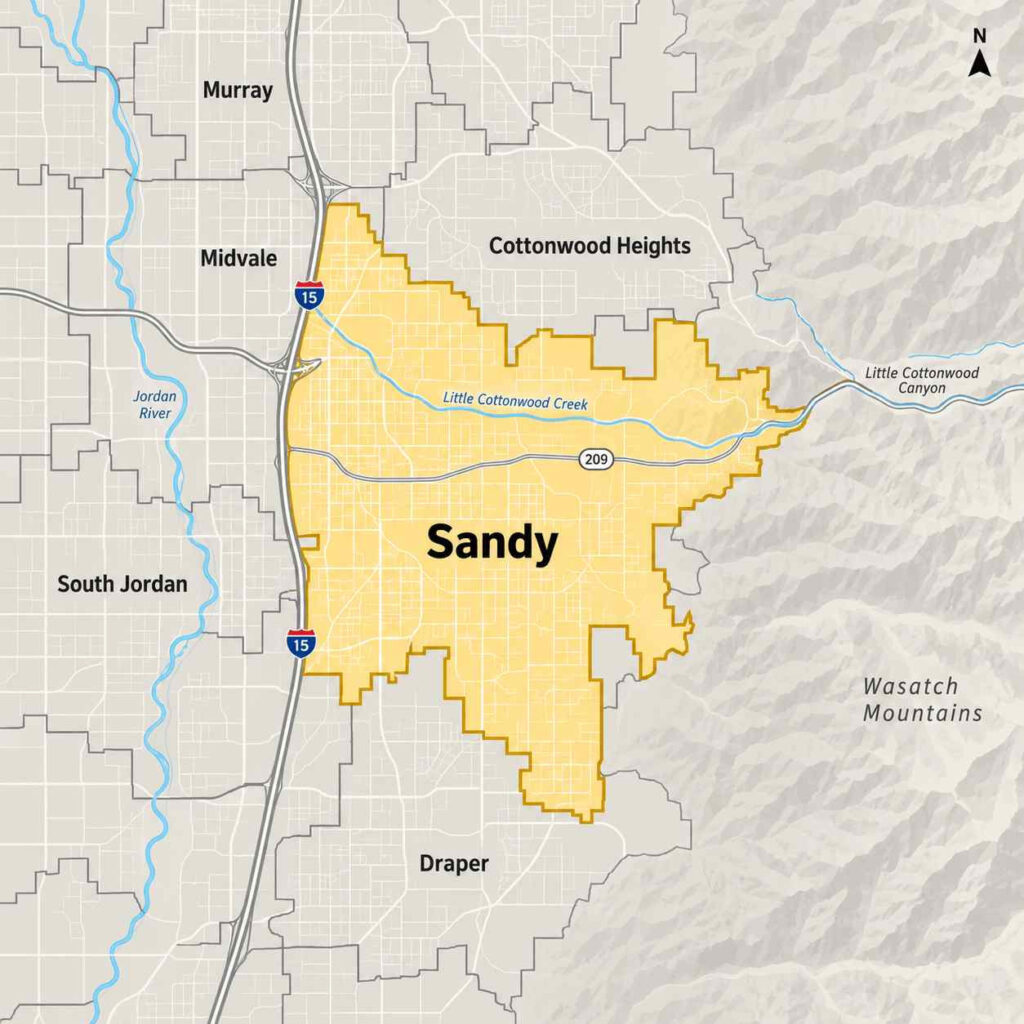
The city runs up the bench at the mouth of Little Cottonwood Canyon, 4,449 feet and climbing as you head east toward Alta. That is coarse, fast draining ground: no marsh, no lake plain, no wetland pushing water toward anybody’s back fence.
What Sandy does have is trees. The city went from 6,438 people in 1970 to 52,210 in 1980, and every one of those subdivisions got planted. Those shade trees are fifty years old now. Forty feet of canopy over a quiet street is lovely to live under, and it is also a habitat.
The local picture
What Sandy’s service calls actually look like
First, what these numbers are. They come from our own service records: 5,672 Sandy appointments measured against the rest of our Utah work, with rankings drawn from the 36 cities where we log enough volume for a fair comparison. It is a record of what people call us about, not a census of every insect inside the city limits.
Spiders, ants and wasps are the bulk of the work in every Utah city, Sandy included. The differences sit underneath them:
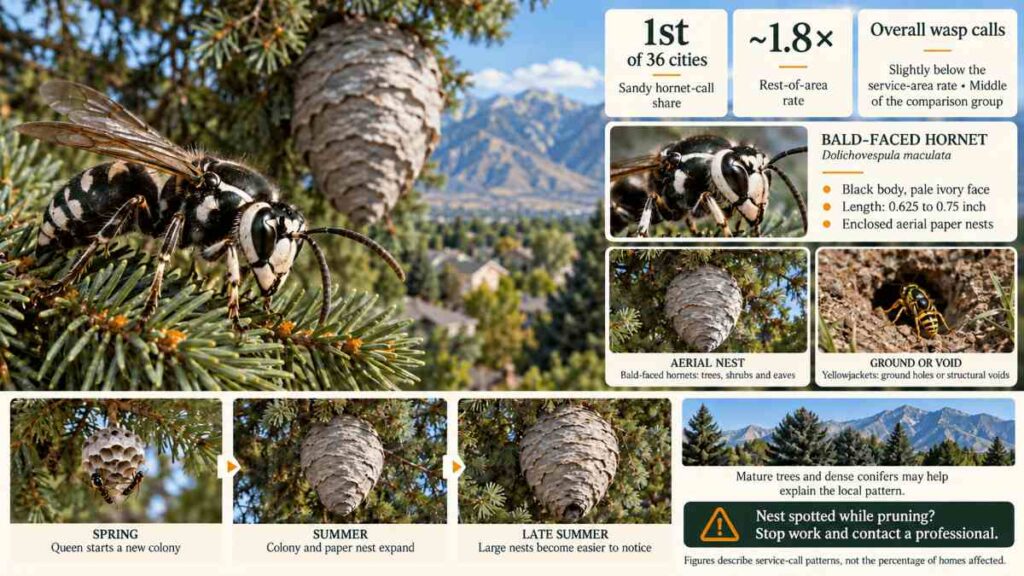
- Hornet calls run about 1.8 times the rest of our service area, the highest share of any city in that 36-city set. Sandy is our number one hornet city.
- Rat calls run roughly two-thirds above our service-area rate, top ten of the 36.
- Aphid calls and bee calls both land in the top ten of the same set.
- Elm seed bug calls run about 40 percent above our average, also top ten.
Then the part that makes Sandy genuinely unusual. Mosquitoes are almost absent from our Sandy work: ten mosquito codes across 5,672 appointments, roughly a fifth of our rest-of-area rate, near the bottom of the 36.
Scroll the chart sideways to see the full scale →
The hot list sorts itself: hornets, bees, aphids and elm seed bugs all live in trees. The cold list reverses it, because mosquitoes, flies, earwigs and mice want moisture or open ground. Service records cannot prove a cause, but a dry bench under an old canopy fits what we see better than anything else.
Not sure what you are looking at?
Text us a question or a photo of the bug. We will identify it and tell you whether it needs treating or not, free, usually the same day.
The big one
Hornets: Sandy is our number one city
Of the 36 cities we service at volume, Sandy has the highest share of hornet calls, running about 1.8 times the rest-of-area rate. That claim is narrower than it sounds: overall wasp calls here sit a little below our service-area rate, mid-pack in the same set. It is hornets specifically that top the list.
The insect is almost always the baldfaced hornet. USU Extension describes a black insect with a yellowish-white face, five-eighths to three-quarters of an inch long, building aerial nests “on building eaves, trees, and shrubs.” Queens start fresh each spring and colonies grow all summer, which is why the nest nobody noticed in June is a grey paper football in the spruce by Labor Day.
Aerial is the operative word. A yellow jacket drops into a hole in the ground or a wall void. A baldfaced hornet hangs its nest out in the open, usually in a mature tree or a dense conifer, and Sandy has more of those per block than most of the valley.
USU says the nests “pose a serious health risk to humans” and recommends removal at night by someone in a veil, suit and gloves. One thing from the field: people find these nests with a pole saw, in August, on a ladder. If you spot one, stop pruning and call somebody.
Bees, aphids and the rest of the canopy
Bee calls and aphid calls both land in our top ten of 36, and neither is a coincidence next to the hornet number. Aphids feed on tree sap and drip honeydew, the sticky film on the car you parked under the maple. Late in the season, once flowers are finished, honeydew is what wasps, hornets and bees are working, which is why a heavy aphid year means a street loaded with stinging insects by August.
Bees get a different answer. Most Sandy bee calls are spring swarms, which move on by themselves, so we refer those to a beekeeper. An established colony inside a wall void or soffit is the one that needs us.
Elm seed bugs: the June arrival that is not a box elder bug
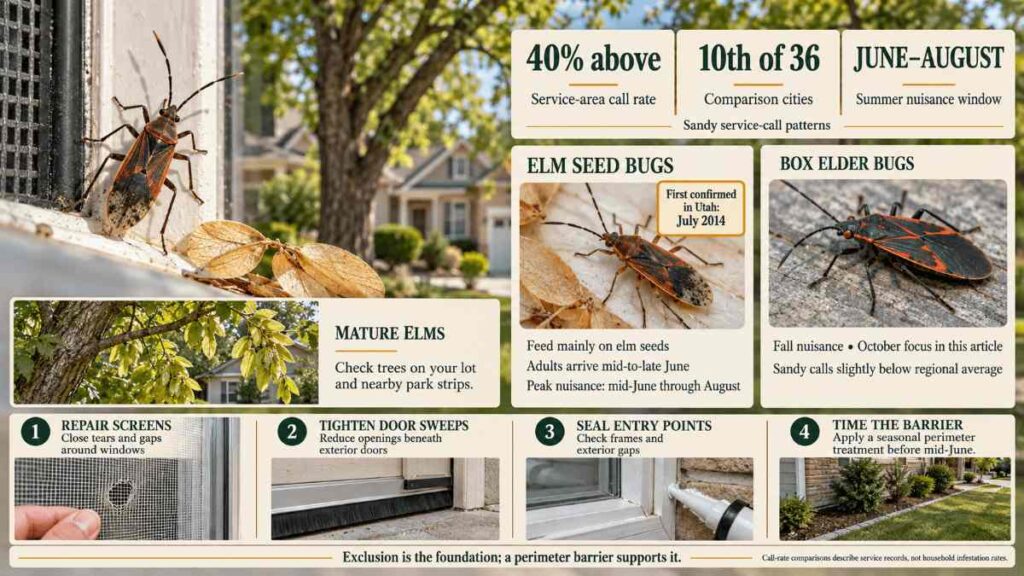
Elm seed bug calls run about 40 percent above our service-area rate here, top ten of the 36.
USU Extension confirmed the first Utah occurrence in July 2014 and says the insect “feeds primarily on elm seeds, but has also been reported on linden and oak.” Adults appear in northern Utah by mid to late June, and peak nuisance activity runs mid-June through August.
That timing is why this matters. Box elder bugs are an October problem, and Sandy gets them at slightly below our average rate. Elm seed bugs are a July problem, so homeowners who think they have box elder bugs treat in the wrong season and wonder why nothing worked.
The tell is the tree: a mature elm on your lot or over the park strip is your source. Exclusion does more here than spray, so start with window screens in real repair and door sweeps. A perimeter barrier before mid-June handles the rest.
Rats: the one signal the trees do not explain
Rat calls run roughly two-thirds above our service-area rate in Sandy, top ten of the 36. Mice run about two-thirds of our average and sit in the bottom ten. That combination is unusual, and it points somewhere specific.
Norway rats do best with older, denser development, aging sewer lines, steady food and continuous cover. Sandy has a core of exactly that. The Sandy Historic District, the blocks bounded by State Street, 700 East, 9000 South and Pioneer Avenue, holds buildings dating to 1875, because the town was a smelter hub long before it was a bedroom community. Add Dimple Dell Regional Park, 630 acres of natural area that Salt Lake County describes as running “from east to west among the growing neighborhoods of Sandy,” and you have connected cover threaded through a dense city.
We do not track results street by street, so we will not tell you which block is worst. Our Sandy rat calls skew toward older neighborhoods, toward lots backing onto a gully or creek, and toward homes with fruit trees, chicken coops or dog food in the garage.
The other side of the list
What Sandy mostly does not get
This is the part worth knowing before you pay for something you do not need.
Mosquitoes. About a fifth of the rest-of-area rate, near the bottom of the 36. Mosquitoes need standing water and the bench does not hold it.
Mice. About two-thirds of our average, bottom ten of the set. Real in October and November where yards meet open ground, but nothing like the farm-fringe cities see.
Earwigs and flies. Both run between half and two-thirds of our rate. Earwigs want damp mulch and shade, which a hot dry August on fast draining soil does not give them.
Box elder bugs. Slightly below average, mid-pack. Sandy gets plenty, they are just not the standout complaint they are in Bountiful or Ogden.
So what does the abatement district actually do here?
Sandy sits inside the South Salt Lake Valley Mosquito Abatement District, which lists the city by name among those it services across most of Salt Lake County. The district handles the source: monitoring, treating breeding water, and running night treatments when counts justify them.
Given how few mosquito calls we take here, our honest answer to most Sandy homeowners is that the district has it covered and you do not need a residential mosquito program. That is not what we would tell a customer in Davis County.
Spiders and ants: the everyday work
For everything unusual about Sandy, most of our visits are ordinary. Spiders are roughly 38 percent of everything we treat here, top five among the cities we service at volume, and overwhelmingly harmless: hobo spiders, cellar spiders, orb weavers across eaves and window wells. Ants are about one call in six and arrive with the first real heat in May, and wasps about one in seven.
Why a Sandy homeowner should call us
Why Sandy homeowners call Beeline
Our office is at 275 W 1700 S in Clearfield, about 40 miles north of Sandy up I-15, roughly a 45 minute drive. We run Sandy on a regular route rather than as a one-off trip, so you get scheduled service instead of a wait. Locally owned, 29 years in Utah, 2,300+ five-star reviews, no hidden charges. Our quarterly service covers every pest on this page, and if something comes back between visits, so do we.
Get a free quote: (801) 544-9200, or text us at (385) 425-1766.
We also service nearby:


A Sandy pest control calendar
What we are treating, and when. The highlighted row is where we are today.
| When | What matters in Sandy |
|---|---|
| March, April | Eave and perimeter work before wasp and hornet queens pick their spots. Rodent exclusion is easiest now. |
| May, June | Ants build, spiders return, elm seed bugs move to the trees. Get the barrier down before mid-June. |
| July, August | Peak elm seed bug entry, peak aphid honeydew, hornet nests at full size. This is when people find nests the hard way. |
| September, October | Hornet colonies at maximum and most aggressive around food, spider webbing heaviest, mice moving in. |
| November to February | Interior rodent work. Rats do not slow down for winter, they just move closer to the furnace. |
Before you book
Sandy pest control questions we actually get asked
Why does Sandy get so many hornet nests?
Our best read is the tree canopy. Baldfaced hornets build aerial nests in trees and shrubs rather than in the ground, and Sandy's 1970s subdivisions now carry fifty year old shade trees. Of the 36 cities we service at volume, Sandy has the highest share of hornet calls, about 1.8 times our rest-of-area rate.
I hardly get bitten in my own yard. Do I need a mosquito plan in Sandy?
Probably not. We logged ten mosquito codes across 5,672 Sandy appointments, about a fifth of our rest-of-area rate and near the bottom of the 36 cities we compare. Mosquitoes need standing water and the bench drains too fast to hold it. Sandy also sits inside the South Salt Lake Valley Mosquito Abatement District, which treats breeding sources county-wide.
What are the bugs piling up on my windows in July? They look like box elder bugs.
Almost certainly elm seed bugs, especially if there is a mature elm nearby. USU Extension says they feed primarily on elm seeds and that peak nuisance activity runs mid-June through August, the opposite timing from box elder bugs in October. Sandy runs about 40 percent above our service-area rate on them, top ten of the 36.
Are rats really a problem in Sandy, or is that a downtown Salt Lake thing?
They are real here. Rat calls in Sandy run roughly two-thirds above our service-area rate, top ten of the 36, while mouse calls run below average. Norway rats favor older, denser neighborhoods with aging utilities and connected cover, and Sandy has both the historic core and 630 acres of Dimple Dell.
Is the east bench worse than the west side of Sandy?
We do not track results street by street, so we will not pretend to a precise answer. What we see in the field is that hornets, elm seed bugs and aphids track the heaviest canopy wherever it sits, and rat calls skew toward older neighborhoods and lots backing onto a gully.
There is a swarm of bees hanging in my tree. Can you get rid of it?
We would rather not. A spring honey bee swarm on a branch is temporary, and a local beekeeper will collect it for free. What does need treatment is an established colony inside a wall or soffit, because abandoned comb attracts other pests long after the bees are gone.
Three ways to get a Sandy quote
All of them free, all of them with a real person at our Clearfield office.
- 1Send us a photo(385) 425-1766. Fastest answer.
- 2Call us(801) 544-9200. Mon to Fri 7:30am to 7:00pm, Sat 7:30am to 4:00pm.
- 3Fill in the formSend a picture of the bug or the damage and we will tell you what it is and what it costs.