
Clinton, UT 84015 · minutes from our Clearfield office
Pest Control in Clinton, Utah
Wasps are more than one call in four in Clinton, third highest of the 36 cities we service at volume, and springtails run second only to Syracuse. We treat for the city you actually live in.
Text (385) 425-1766. Send a photo of the bug and we will tell you what it is, free, usually same day.
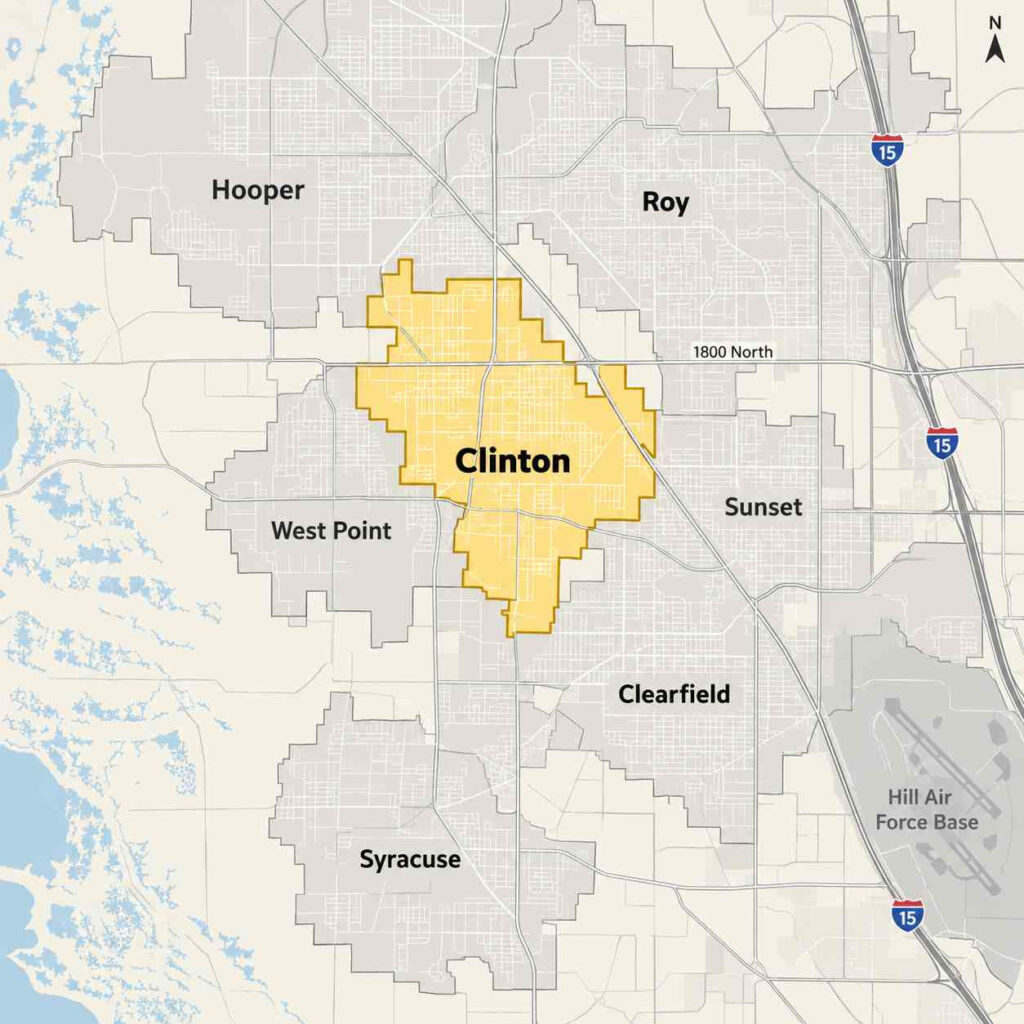
Clinton is the city that filled in. It went from a dry-farm town of 1,768 people in 1970 to over 23,000 today, inside 5.93 square miles. No lake frontage here: West Point and Hooper sit between Clinton and the marsh, Sunset and Clearfield are east, Roy is north.
That middle position shows up in the bugs, and it is why a Clinton pest problem does not look like a Syracuse one even though the two sit barely four miles apart with only West Point between them. We have serviced Utah homes for 29 years, and Clinton has its own signature: almost everything running high lives in the yard or on the outside wall, and almost everything running low needs an old core or an old tree.
The local picture
What Clinton’s service calls actually look like
First, what the numbers are. They come from our own records: 2,142 Clinton appointments set against the rest of our Utah work, with every ranking drawn from the 36 cities where we log enough volume for a fair comparison. It records what people call us about, not every insect in the city.
Spiders, wasps, ants and mice are the bulk of the work everywhere we service. Here is where Clinton separates:
- Wasps are more than one call in four here, third highest among those 36 cities. Only two run higher, and Farmington leads.
- Springtail calls run about two and a half times our service-area average, second only to Syracuse.
- Vole calls run roughly 70 percent above average, seventh highest.
- Elm seed bug calls run about 60 percent above average, ninth highest, and the sharpest break from Syracuse.
- Earwig calls run about half again our average, sixth highest.
Scroll the chart sideways to see the full scale →
Seven pests run meaningfully below our service-area rate here: box elder bugs, rats, flies, beetles, aphids, moths and snails. Ants are a little low too. The shape of that cold list is the interesting part. Clinton does not call us about much that lives indoors or in an aging city core.
Two things look like they account for most of it, though our records show the pattern rather than prove the cause: distance from the marsh, and the age of Clinton’s trees and yards, which sits between Syracuse’s and Bountiful’s.
Not sure what you are looking at?
Send us a photo. We will identify it and tell you whether it needs treating or not, free, usually the same day.
The Syracuse question
Why Clinton misses Syracuse’s mosquitoes
This is the comparison Clinton homeowners make most, usually because they have family there.
The Davis Mosquito Abatement District describes the two cities differently on its own pages, and that difference is most of the story. Clinton, it says, “is located just a few miles from prime marshland mosquito breeding sites.” Syracuse “is located just east of very productive mosquito breeding sites.” A few miles of built-out benchland turns out to matter a great deal.
Our records agree. Mosquito calls are about one percent of Clinton’s pest work, a third above our service-area average but nowhere near Syracuse, which runs close to four times it. Clinton is not a mosquito city. It is a city with a mild mosquito season.
That is not the same as nothing. The district reports finding West Nile Virus in mosquitoes trapped in Clinton every summer for over a decade. Most Clinton homes do not need a standing mosquito program and we will tell you so. The ones that do back onto open ground, hold irrigation water in a low spot, or carry dense shaded planting.
The big one
Wasps: more than one call in four
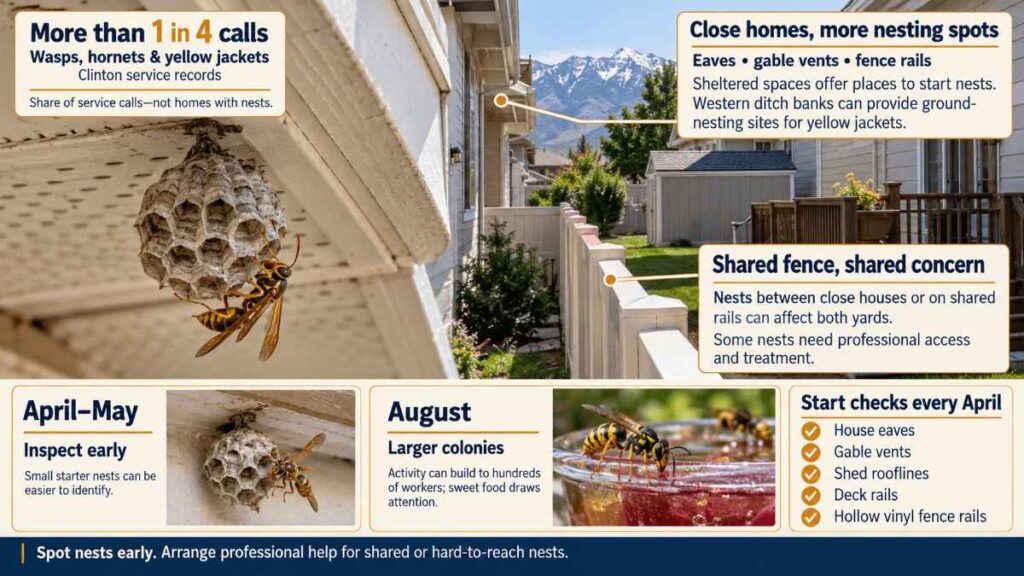
Spiders are our biggest single share here, like everywhere. Wasps, hornets and yellow jackets come second, and the gap between Clinton and everywhere else is wide enough that we plan routes around it.
Our best read is that density does the work. Twenty-three thousand people inside under six square miles means a lot of eave, fence rail and gable vent per acre. A paper wasp queen shopping in April for a dry, sheltered, south-facing void does not have to look far, and the open ditch banks on the western edge give yellow jackets their ground nests.
Small lots also create a problem lower-density Syracuse does not. A nest on a shared fence rail, or in the gap between two close houses, belongs to both yards. We treat plenty of Clinton nests neither neighbor could reach alone.
Timing is the part you control. A nest in May is one queen and a dozen cells. By August it is several hundred workers that turn aggressive around anything sweet. Every spring, check eaves and gable vents, the shed roofline, deck rails and hollow vinyl fence rails.
Elm seed bugs: Clinton’s nuisance bug arrives in July
Here is the cleanest sign that tree age drives this. Roy, over the Weber County line, has the second-highest elm seed bug share among the 36 cities we service at volume. Clinton is ninth. Syracuse is near the bottom. The three sit in a row, and the numbers step down with the age of the housing.
Elm seed bugs reached Utah in 2014 and breed on elm, so they need a mature canopy to build numbers. Clinton’s streets went in mostly through the 1990s and 2000s, long enough for street trees to amount to something. Syracuse’s newest subdivisions are not there yet, and Roy’s streets went in a generation before Clinton’s.
Recognizing them matters, because most people call them box elder bugs and get confused by the calendar. Elm seed bugs peak from mid-June through August, not October, and come in through window tracks rather than massing on a sunny wall. Treatment is a perimeter and window-surround job, done before the July push.
Earwigs and springtails: the moisture question
Both want constantly damp ground, and Clinton gives it to them. Clearfield, next door and home to our office, is our number one earwig city. Clinton is sixth, so the pattern crosses the border but weakens.
Springtails are the stronger signal. Clinton is our second-heaviest city for them, behind Syracuse. They are the tiny grey-black specks that hop when disturbed, found by the thousand in window wells and patio puddles. They do not bite or damage anything and cannot live indoors long. They tell you water is sitting where it should not.
Small lots with full irrigation, mulch run up to the foundation, and tight side yards that never see sun all hold moisture. The fix is as much drainage as treatment: shorten watering cycles, pull mulch back, point downspouts away from the wall.
Voles: the greenbelt problem
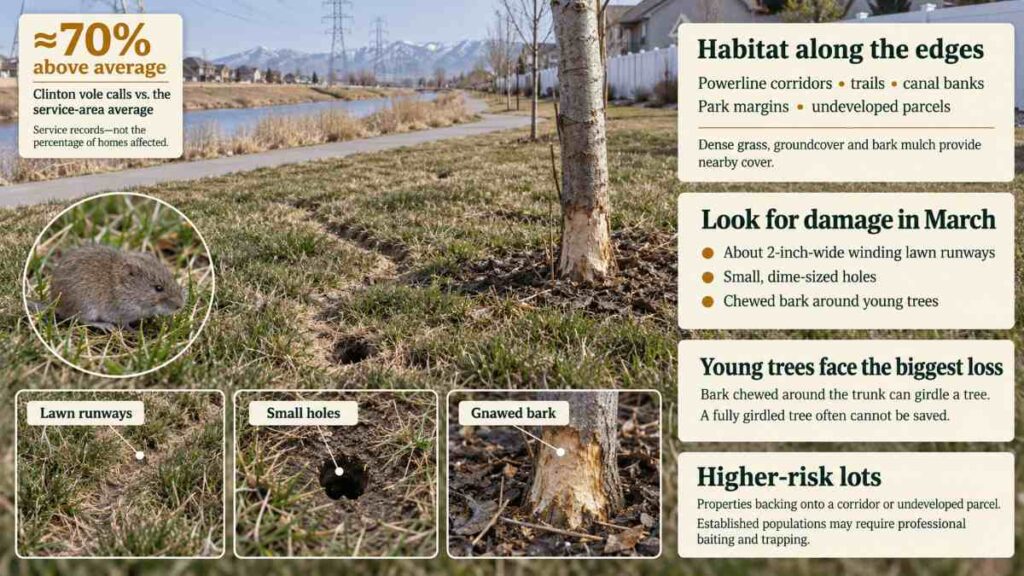
Vole calls run about 70 percent above our service-area average. Clinton has more edge habitat than its size suggests: the powerline corridor, the trail system, canal banks, park margins and the parcels never built on.
Meadow voles are the most common of Utah’s five species according to USU Extension, and they do not leave when the farm equipment does. They move into the nearest dense groundcover, usually your lawn or bark mulch. You rarely see the animal. In March you see two-inch winding runways, dime-sized holes and chewed bark around young trees. That last one is the costly part, because a girdled tree usually cannot be saved.
In our experience the worst damage lands on lots backing onto the corridor or an un-built parcel. We do not track results street by street and will not pretend otherwise. Established populations take baiting and trapping.
The other side of the list
What Clinton mostly does not call us about
Box elder bugs run at about 40 percent of our service-area rate, yet they are our second-biggest complaint in both Bountiful and Ogden. Clinton has mature trees, so age is not the whole answer. Our best read is species: these bugs need female seed-bearing boxelder trees, which belong to long-settled farmstead towns rather than 1990s subdivision plantings.
Rats run at under half our rate. Norway rats do best in older, plumbing-heavy urban cores, and Clinton’s housing and sewer lines are newer than that. Mice stay common, especially in fall near open ground.
Flies are the real surprise at about a third of our rate, given that Clinton is ringed by former farm ground and sits near the Hooper dairies. Moths, snails, beetles and aphids are low too. For a city with this much yard pressure, Clinton’s interior call volume is remarkably quiet.
Spiders, ants and mice remain the everyday work, and Clinton’s spiders are harmless.
A Clinton pest control calendar
What we are treating, and when. The highlighted row is where we are today.
| When | What matters in Clinton |
|---|---|
| March, April | Assess vole damage at snowmelt, check young trees for girdling, treat eaves before wasp nests establish. |
| May, June | Spiders and ants pick up, wasp nests go up, elm seed bugs begin moving. |
| July, August | Peak elm seed bug entry at windows, peak yellow jacket aggression, springtails spike with irrigation. |
| September, October | Wasp nests at maximum size, mice pressing indoors, spider webbing heaviest. |
| November to February | Rodent and interior work, and the months voles do their worst under the snow. |
Why a Clinton homeowner should call us
Why Clinton homeowners call Beeline
Our office is at 275 W 1700 S in Clearfield, a few minutes from the Clinton line and under fifteen from any Clinton address. We have run 2,142 appointments here, and Clinton sits on routes we work most weeks, so you are not waiting on a truck from the other end of the state. Locally owned, 29 years in Utah, 2,300+ five-star reviews, no hidden charges. Our quarterly service covers every pest on this page, and if something comes back between visits, so do we.
Get a free quote: (801) 544-9200, or text us at (385) 425-1766.
We also service nearby:


Before you book
Clinton pest control questions we get asked
My cousin in Syracuse complains about mosquitoes constantly. Why is it not like that here?
Distance from the water. The Davis Mosquito Abatement District describes Clinton as a few miles from prime marshland breeding sites, and Syracuse as sitting just east of them. West Point and Hooper are between you and the marsh. In our records Clinton mosquito calls run modestly above our service-area average, and Syracuse's close to four times it.
If Clinton's mosquito numbers are that low, can I skip mosquito service?
Most Clinton homes can, and we will say so rather than sell a program you do not need. The exceptions back onto open ground on the west side, hold irrigation water in a low spot, or carry heavy shaded planting. Worth knowing: the abatement district has found West Nile Virus in mosquitoes trapped in Clinton every summer for over a decade.
Something that looks like a box elder bug is pouring in through my windows in July. What is it?
Almost certainly an elm seed bug. Different insect, different schedule: they peak from mid-June through August and come in through window tracks, while box elder bugs mass on sunny walls in October. Clinton ranks ninth for them among the 36 cities we service at volume. Do not crush them indoors, because they smell like bitter almonds.
Clinton has plenty of mature trees. So why do I get so few box elder bugs?
Probably the species of tree rather than its age. Box elder bugs need female seed-bearing boxelder trees, mostly found in long-settled farmstead and canyon-mouth towns. Clinton's calls run at about 40 percent of our service-area rate. In Bountiful and Ogden box elder bugs are the second-biggest complaint we get.
Beeline is based in Clearfield, where earwig calls run highest of any city you service. Do Clinton homes get them too?
Yes, at roughly half Clearfield's rate. Clinton is sixth for earwigs among the cities we service at volume and Clearfield is first, so the pattern crosses the line and fades. The usual culprits are mulch against the foundation and a tight side yard that stays wet.
Clinton is surrounded by old farm ground and the Hooper dairies. Why do I barely see flies?
We cannot fully explain this one, and it is among Clinton's odder numbers. Fly calls here run at about a third of our service-area rate, well below Ogden and North Ogden. Whatever the reason, a Clinton pest program is almost entirely about the yard and the outside wall.
Three ways to get a Clinton quote
All of them free, all of them with a real person at our Clearfield office.
- 1Send us a photo(385) 425-1766. Fastest answer.
- 2Call us(801) 544-9200. Mon to Fri 7:30am to 7:00pm, Sat 7:30am to 4:00pm.
- 3Fill in the formSend a picture of the bug or the damage and we will tell you what it is and what it costs.