
Centerville, UT 84014 · 20 minutes from our Clearfield office
Pest Control in Centerville, Utah
Centerville is our number one ant city of the 36 we service at volume, and rat calls run about 1.7 times our rate while mice run at half. We treat for the city you actually live in.
Text (385) 425-1766 with a question or a photo of the bug, and we will get back to you, free, usually same day.
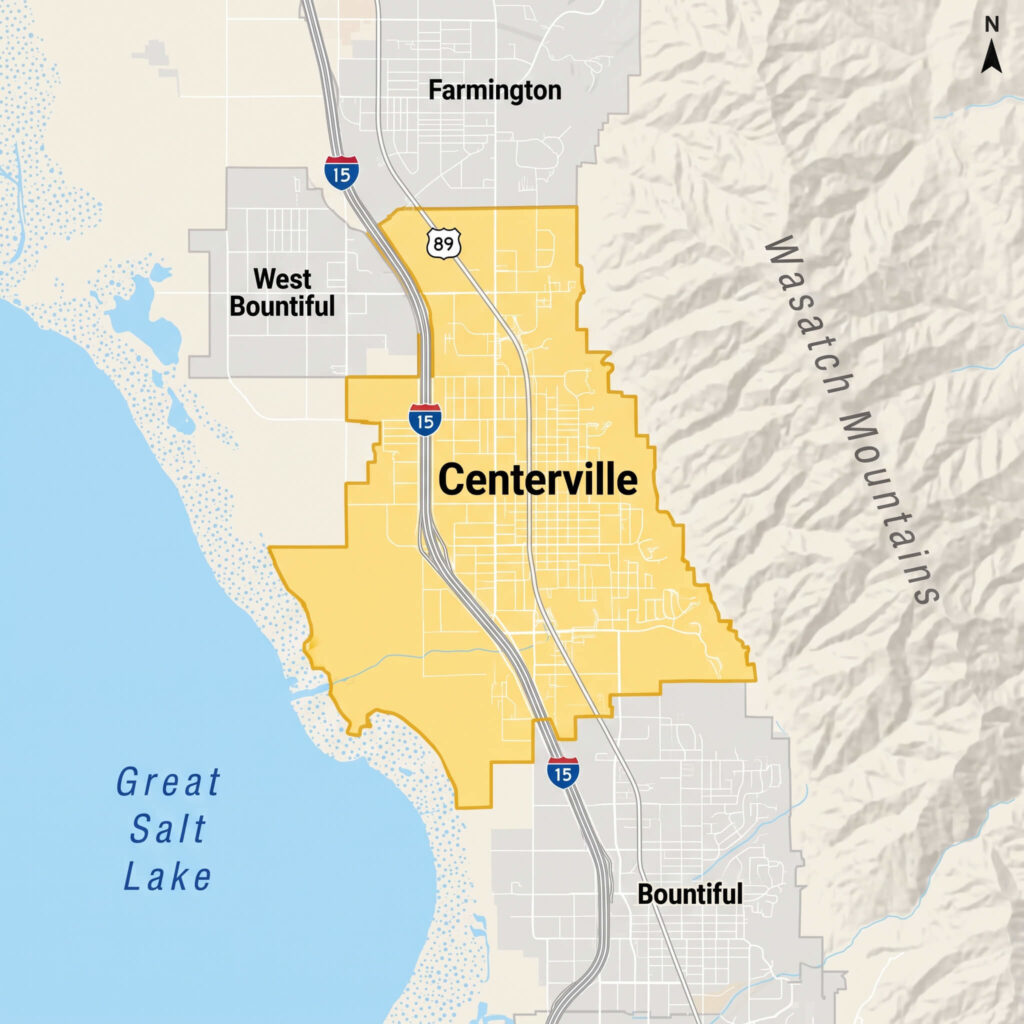
Centerville sits on a narrow shelf of ground between the Wasatch and Farmington Bay. Four creeks come off the mountain and run west through town. Thomas Grover settled it in 1847, and an 1850 survey found it sat squarely between Farmington and Bountiful, which is how it got its name. Most of what you see today went up between 1960 and 2000, wrapped around a much older core.
That mix of old bones and new subdivisions shows up in our service records, in one way we did not expect.
We work out of Clearfield, about 17 miles up I-15. On a decent morning that is a 20 minute drive, and we run Centerville on a regular route, so “we are already in the area” is usually literal.
The local picture
What Centerville actually calls us about
Everything below comes from Beeline’s own service records: 1,499 Centerville appointments carrying 1,688 pest codes. We compare Centerville’s mix against the rest of our Utah service area, with Centerville itself taken out of that comparison. Every rank is scoped to the 36 cities where we log at least 1,000 pest codes. Ranking a town with a dozen calls against a real market tells you nothing.
One caveat worth saying plainly. This is a record of what people call us about. It is not a census of the local insect population.
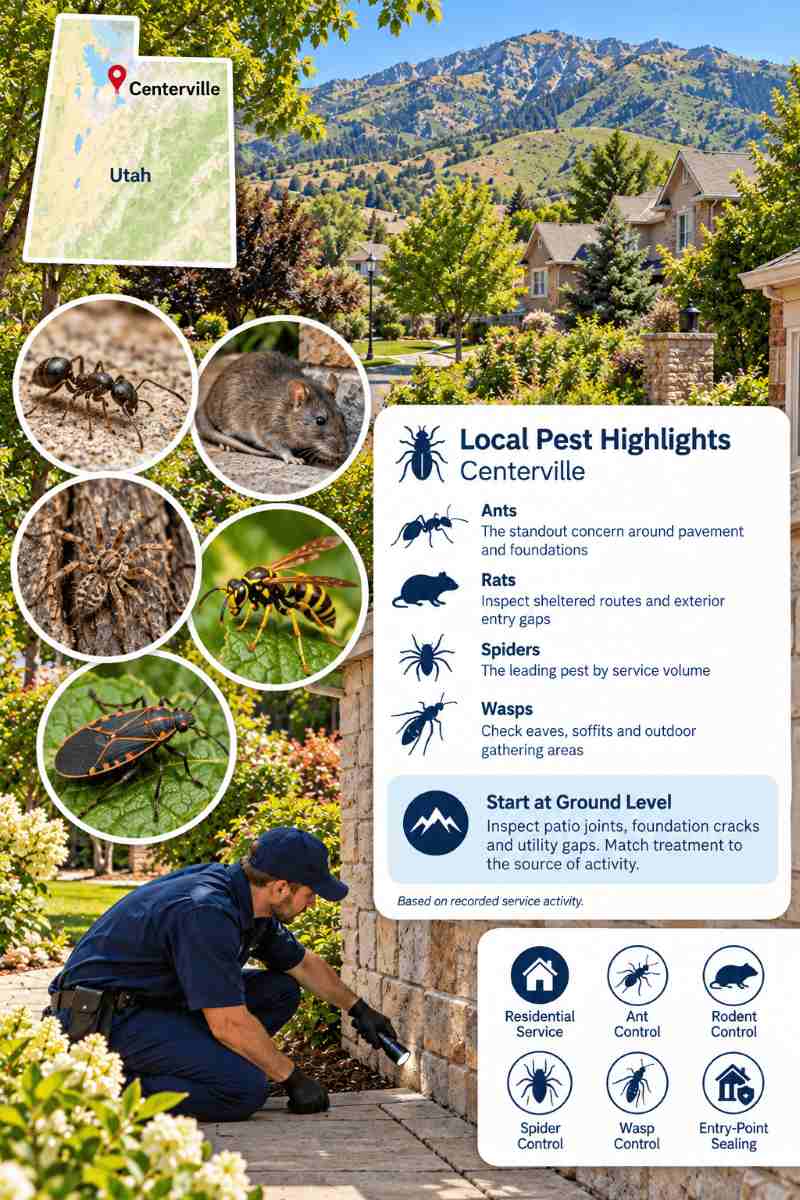
Scroll the chart sideways to see the full scale →
Not sure what you are looking at?
Text us a question or a photo of the bug. We will identify it and tell you whether it needs treating or not, free, usually the same day.
The big one
Centerville is our number one ant city
Ants are 19.4 percent of every pest code we log in Centerville. Across the rest of our service area the figure is 13.5 percent. That is about one and a half times the rate, and it is the highest ant share of any of the 36 cities we service at volume. Not top five. First.
It rests on 328 separate ant logs, so this is not a thin month playing tricks.
Two things we should be straight about. Spiders are still the single most common call in Centerville at 34.7 percent, same as nearly everywhere in Utah, and wasps edge ants on raw volume at 19.9 percent. So ants are not Centerville’s biggest number. They are Centerville’s most distinctive one, because that 19.4 percent sits further above the area average than any other city’s ant rate does.
The neighbors make the point. Bountiful, on Centerville’s south border, runs 15.6 percent ants. Farmington, just north, runs 12.0 percent. Both are substantial markets for us. Centerville still beats them.
Why the ants land here
Service records show correlation, not cause. What we can do is point at the things that line up.
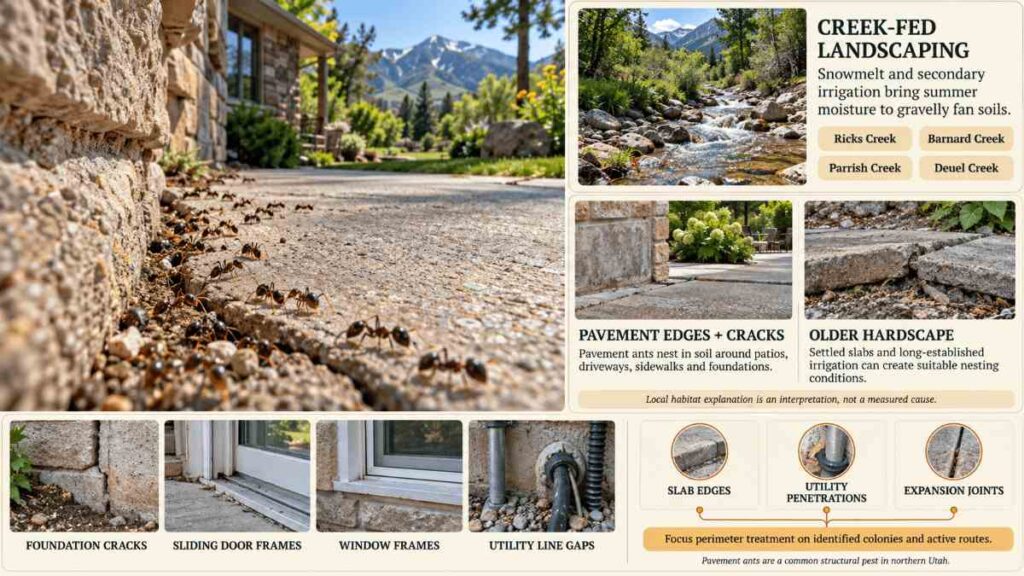
Centerville is built on the ground where four creeks leave the canyons. The city’s own water plan names them: Ricks Creek, Barnard Creek, Parrish Creek and Deuel Creek, carrying snowmelt down from the mountains and feeding secondary irrigation across town. That means gravelly, well drained fan soil with water moving through it all summer long.
Utah State University Extension calls pavement ants “northern Utah’s most common pest ant in and around homes and structures.” They nest, in Extension’s own words, “in soil along edges or in cracks around pavement, patios, driveways, sidewalks, and foundations.” Rocks, mulch and landscape timbers go on the same list.
Now look at Centerville. Six square miles, built tight, an 1850s core of old stone houses, and a lot of hardscape layered over creek fan gravel. Then a century and a half of ditch and secondary irrigation keeping that soil damp through August. Our best read is that the combination goes a long way toward explaining the gap.
The way in is ordinary: foundation cracks, sliding door frames, window frames, and the gaps where utility lines enter the house.
Rats up, mice down
Here is the second thing the data does that surprised us.
Rat calls in Centerville run about 1.7 times the rest of our area, 3.6 percent of codes against 2.1 percent. That is 7th highest of the 36 cities we service at volume. Mice go the other direction entirely. Mouse calls are half the area rate, 5.3 percent against 10.7 percent, which puts Centerville 33rd of those same 36. Near the bottom.
That looks contradictory until you check the other cities doing it. Holladay is our number one rat city and 32nd of 36 on mice. Millcreek is 2nd on rats and 34th on mice. Cottonwood Heights is 3rd on rats and 35th on mice. It is not a universal rule, and Salt Lake City manages to run high on both. But the pattern is real, and Centerville sits right in it.
Here is how we read it, and we will label this as field experience rather than measurement. Norway rats are an infrastructure and habitat story. They follow water, cover and structure: creek corridors, storm drains, older sewer lines, mature landscaping, fruit trees, woodpiles, pet food and backyard chicken coops. Centerville has every one of those, plus four creek channels running straight through town. None of that is about how clean anybody keeps their kitchen, and we would ask you not to read it that way.
Mice have a different trigger. They push indoors in fall off open ground, which is why Clearfield, with farm edge still in play, logs 15.4 percent mice against Centerville’s 5.3 percent. Centerville is six square miles and largely built out, so there is not much field left to send mice looking for your garage.
The other side of the list
What Centerville mostly skips
The quiet rows are as useful as the loud ones.
Box elder bugs. 5.7 percent of Centerville codes against 10.1 percent across the rest of the area, which is 27th of 36. This is the strange one, because Bountiful shares a border with Centerville and runs 16.2 percent, the second-highest box elder rate we record anywhere. Farmington on the other side runs 11.7 percent. Centerville sits between two box elder towns and gets a fraction of the trouble. Box elder bugs need female, seed-bearing boxelder trees nearby, so our read is that it comes down to which trees went in and when. We do not track tree inventories street by street, so take that as a reasonable explanation rather than a proven one.
Elm seed bugs. 1.1 percent against 2.9 percent, 31st of 36. Same logic, different tree.
Beetles. Last of all 36 cities. We will be honest that this row is thin, two logs across the year, so treat the direction as real and the exact figure as noise.
Flies. About half the area rate.
Two small signals worth a footnote
Bee calls run 1.6 times the area rate and rank 2nd of 36. Snail calls run 1.9 times and rank 9th. Both are interesting and both rest on small numbers: 21 bee logs and 14 snail logs. We would not build a service plan around either one. We raise them because the irrigation and creek story that fits the ants fits damp-loving snails too, and because Centerville’s older yards make decent bee habitat.
If what you have is honey bees, call us before you call anyone. We do not treat a honey bee colony that can be removed instead. Wasps, yellow jackets and hornets are a different conversation, and Centerville logs plenty of all three.
A Centerville pest calendar
| When | What matters in Centerville |
|---|---|
| March, April | Ants wake up and come looking indoors. USU Extension notes that indoor pavement ant problems are worst in spring and early summer, which matches our Centerville call pattern closely. This is the month to get ahead of it. |
| May, June | Ant swarms. First wasp queens scouting eaves, vents and soffits. Box elder bugs if you have the trees for them. |
| July, August | Wasp and hornet nests at full size. Spider activity climbing. Ants and snails working the irrigated beds hardest. |
| September, October | Wasps turn aggressive around food and garbage. Spiders peak. Rodent pressure begins, and in Centerville that means rats more often than mice. |
| November to February | Quiet outside, but rats keep working crawl spaces, garages and sheds straight through winter. So do spiders. |
How we handle Centerville
Because ants are the standout, our Centerville visits start at ground level: foundation lines, driveway and patio edges, walkway cracks, retaining walls, and anywhere irrigation keeps the soil damp. Baiting matters more than spraying, because the colony is the target and the foragers you see are not. That is how our ant control works here.
For rats we go looking for the route rather than the rat. Creek banks, drains, fence lines, the gap under a deck or shed, and the hole where a utility line enters the wall. Seal the route and the problem stops coming back.
We are locally owned, 25 years plus in Utah, with more than 2,300 five-star reviews. No hidden charges, no contract built to trap you.
Before you book
Centerville questions we actually get
Why do I have more ants than my sister in Farmington?
Because you probably do. Ants are 19.4 percent of our Centerville pest codes and 12.0 percent of our Farmington ones. Centerville has the highest ant share of the 36 Utah cities where we work at volume, and Farmington sits well down that list. Our best read is the creek fan soil, the secondary irrigation and the sheer amount of pavement and stonework in Centerville.
We are right next to Farmington Bay. Why are mosquitoes not our biggest problem?
They are not even slightly unusual here. Mosquito calls in Centerville run 0.94 times the rest of our area, which is dead average, 14th of 36. The Davis Mosquito Abatement District serves the communities of Davis County, and says the majority of its work takes place out on the wetlands spraying for mosquito larvae in the water. That public larval work probably has a lot to do with why the bay next door does not show up in our numbers.
Why does Bountiful get box elder bugs when we barely do?
Bountiful runs 16.2 percent box elder bugs, the second-highest rate of the 36 cities we service at volume. Centerville runs 5.7 percent and sits 27th. The cities share a border, so weather and elevation cannot explain it. Box elder bugs breed on female seed-bearing boxelder trees, so our best read is simply that Bountiful's older benches have more of those trees than Centerville's streets do.
Does a rat problem mean my house is dirty?
No, and we would push back on anyone who tells you otherwise. Centerville's rat rate tracks creek corridors, drains, older sewer lines, mature trees and outbuildings, not housekeeping. Some of the tidiest properties we service in Centerville are the ones backing onto a creek channel.
We moved here from Clearfield and we are seeing far fewer mice. Is that normal?
Completely. Clearfield logs 15.4 percent mice and Centerville logs 5.3 percent. Clearfield still has open farm edge pushing mice indoors every fall. Centerville is six square miles and largely built out, so that autumn wave is much smaller here.
Is it worth treating in March if I have not seen an ant yet?
In Centerville, yes, more than in most places we work. March and April are when ants move toward your foundation, and knocking a colony back before it establishes is far easier than chasing trails across a kitchen in July.
I have bees in a wall. Will you just kill them?
Not if they are honey bees and removal is possible. Call us and describe what you are seeing. Honey bee colonies get handled differently from wasps, yellow jackets and hornets, all of which we do treat, and all of which Centerville sees plenty of.
Why a Centerville homeowner should call us
Get a straight answer about your Centerville property
We are at 275 W 1700 S in Clearfield, about 17 miles and 20 minutes up I-15 from Centerville, and we are in town on a regular route most weeks.
Call (801) 544-9200, text (385) 425-1766, or email service@BeelinePestControl.com for a free consultation. Tell us which creek you are near. In Centerville that is usually the first useful thing we learn.
We also service nearby:


Three ways to get a Centerville quote
All of them free, all of them with a real person at our Clearfield office.
- 1Send us a photo(385) 425-1766. Fastest answer.
- 2Call us(801) 544-9200. Mon to Fri 7:30am to 7:00pm, Sat 7:30am to 4:00pm.
- 3Fill in the formSend a picture of the bug or the damage and we will tell you what it is and what it costs.