Pest Control in St. George, Utah

Pest control in st. George, utah

Almost everything Beeline treats in Utah is north of Cedar City. St. George is not.

We run Washington County on a regular route, we have logged 191 appointments in St. George so far, and one of our technicians now lives in the St. George area. Our office is still in Clearfield, 25+ years and counting, but nobody drives five hours to treat your house. The volume down here is modest today and growing.

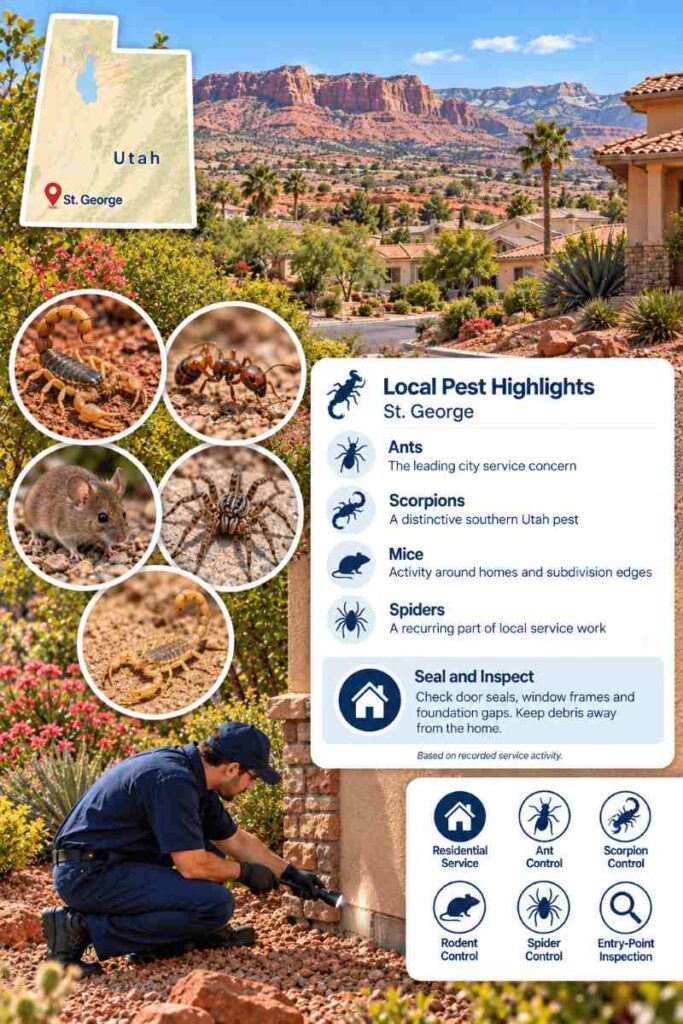
That matters more here than anywhere else we work, because the bugs are not the same bugs.

Because St. George Sits So Far Out, We Look at the Whole County

One hundred ninety-one appointments tells you what people call about, not stable rates for every pest. So the numbers below pool all of Washington County: 351 appointments carrying 305 logged pest codes across 14 towns: St. George, Washington, Hurricane, New Harmony, Ivins, Santa Clara, Pine Valley, Brookside, Springdale, La Verkin, Dammeron Valley, Toquerville, Veyo, and Central.

The table and the next two sections reflect county-level data, not city-level, recording what people call us about rather than a raw census of what lives in the dirt.

What Washington County actually calls us about Share of pest codes logged across 351 service appointments in Washington County, including St. George, Washington, Hurricane, Ivins and Santa Clara, compared with the rest of our Utah service area. This is area data, not St. George city data, because 191 city appointments is too few for stable per-pest rates. The multiple on the right is how many times more, or less, of the Washington County mix each pest is. Scorpions have no rest-of-area rate to divide by, so they are marked as present here and essentially absent everywhere else. These are our service records, not a survey of the local insect population.
Washington County Rest of our Utah service area

Scroll the chart sideways to see the full scale →

Share of Beeline service calls by pest: Washington County vs. the rest of our Utah service areaWashington County runs higher on ants, mice and bees, far lower on wasps and box elder bugs, and is the only part of our Utah service area with meaningful scorpion volume.0%10%20%30%Ants23.3%13.6%▲ 1.72xSpiders23.3%32.1%▼ 0.73xMice20.7%10.6%▲ 1.95xScorpions7.2%0.0%▲ only hereWasps7.2%16.8%▼ 0.43xBox elder bugs3.9%10.1%▼ 0.39xBees3.3%0.8%▲ 4.25x

Key Takeaway: St. George presents a unique Mojave Desert profile. Ants and mice run nearly double the regional rate, scorpions represent a localized hotspot found almost nowhere else in Utah, and traditional Wasatch Front pests like wasps and box elder bugs run surprisingly low.

Scorpions: Work We Do Here and Essentially Nowhere Else in Utah

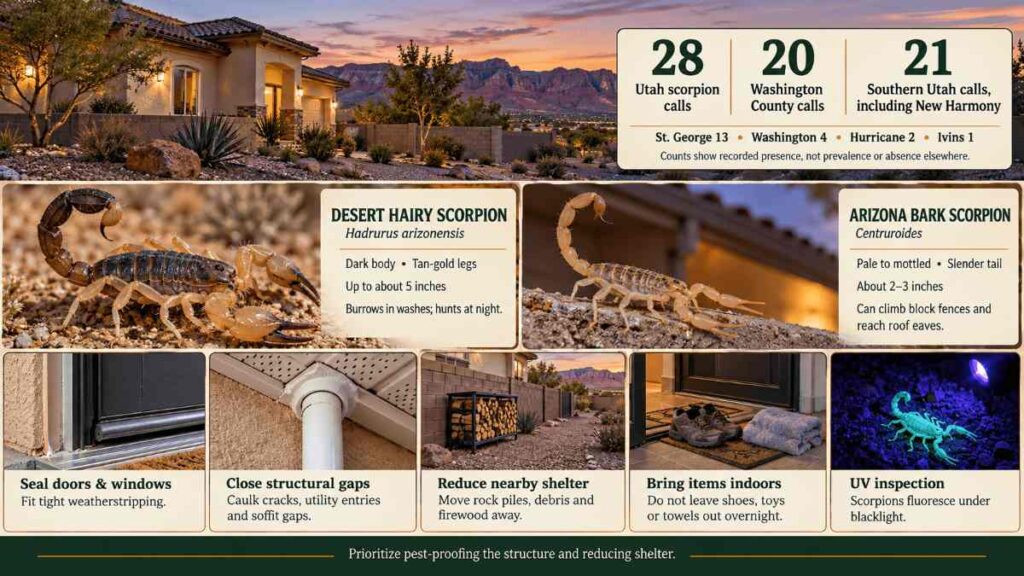
Our entire Utah service record contains 28 logged scorpion calls. Twenty are in Washington County: St. George 13, Washington 4, Hurricane 2, Ivins 1. Add New Harmony next door in Iron County and southern Utah holds 21 of the 28. The Wasatch Front, where we run tens of thousands of appointments, produced four scattered one-offs.

Normally we would not build a section on a count that small. But this is a presence, not a rate: scorpions are either in your part of Utah or they are not, and here they are.

Utah State University Extension lists nine scorpion species, most of them southern. Two are worth knowing:

    • Desert Hairy Scorpion (Hadrurus arizonensis): Dark body, tan-gold legs, up to about five inches, burrowing in washes and hunting at night. USU places it in southwestern Utah and the Park Service lists it at Zion. It stings if cornered but is not considered dangerous to a healthy adult.

    • Arizona Bark Scorpion (Centruroides): Two to three inches, slender tail, pale to mottled. USU calls it the only scorpion in Utah potentially harmful to people, with symptoms that usually subside within 48 hours and more concern for small children and older adults. Its Utah range is in the southern counties. If someone is stung and reacts beyond local pain, call Poison Control at 1-800-222-1222.

What Actually Works Against Scorpions

The University of Arizona’s IPM program is blunt: pest-proofing the structure cuts scorpion contact far more than spraying does. Bark scorpions climb, so they arrive over block fences and through roof eaves, not just under the door. USU’s list is the same:

Seal doors and window frames tight with weatherstripping.

Caulk foundation cracks, utility penetrations, and soffit gaps.

Pull rock piles, debris, and firewood stacks well back from the house.

Stop leaving shoes, toys, and towels outside overnight.

Pro Tip: Scorpions fluoresce under a blacklight. A UV flashlight inspection on a warm summer night will teach you more about your yard’s scorpion population than anyone can explain over the phone.

Scorpions work we do here and essentially nowhere else in utah

What Else Washington County Calls Us About

    • Ants: Are the biggest everyday job at 71 logged codes (23.3% of the county mix against 13.6% across the rest of our Utah service area, roughly 1.7 times our usual share).

    • Mice: Are close behind at 63 codes (20.7% against 10.6% elsewhere, close to double). That surprises people who file rodents under cold weather, but no hard winter ends the season here, so mice work subdivision edges all year long.

    • Spiders: Represent 71 codes (23.3%), sitting below our 32.1% service-area average.

    • Bees: Account for 10 codes, a soft signal at that count.

What Washington County Does Not Get

    • Wasps: Up north they are one of the two or three biggest things we treat all summer. Here they represent 22 logged codes (7.2% against 16.8% across the rest of our service area, well under half).

    • Box Elder Bugs: Account for 12 codes (3.9% against 10.1% elsewhere). They breed on female seed-bearing boxelder trees, and the Mojave does not grow them. Palms, oleander, mesquite, and rock mulch do not produce the October wall-massing that defines fall in Bountiful.

The reason is the ecoregion. According to Wikipedia’s entry on St. George, the city sits around 2,800 feet in the northeasternmost corner of the Mojave Desert, where the Mojave, the Great Basin, and the Colorado Plateau meet along the Virgin River: nine inches of rain a year, about 300 sunny days, and over 100 plants and animals that live nowhere else in Utah.

Which means there is no off-season. Up north we hand people a spring-to-fall calendar. Here, ants and scorpions ramp through spring, scorpions peak on warm summer nights, mice press indoors in fall and keep going, and January is slow rather than empty.

St. George Itself, in Its Own Numbers

On its own 191 appointments St. George logged 154 pest codes. Two things stand out:

    • Ants are the single most common call: 48 of those 154 codes (31.2% of the city mix against 13.6% across the rest of our service area). Call a pest company and the odds are better than one in four it is ants.

    • Scorpions represent 13 of the 154 codes: 8.4% of everything logged here, and a pest footprint that does not exist anywhere else on our map.

Spiders account for 40 codes and mice 25. Everything else sits under 10 logs, which is noise.

Why St. George Homeowners Call Beeline

Locally owned, 25+ years in Utah, 2,300+ five-star reviews, with no hidden charges. Our quarterly service covers everything on this page, scorpions included, and if something comes back between visits, so do we. With a technician living in the area, same-week scheduling across St. George, Washington, Hurricane, Ivins, and Santa Clara is standard.

Get a Free Quote: Call (801) 544-9200 or text us at (385) 425-1766.

St. George control questions we actually get asked

Do you really come all the way down to St. George?

Yes, on a regular route, and one of our technicians lives in the St. George area. We have logged 191 appointments in St. George and 351 across Washington County, and the number is growing. Our office and phones stay in Clearfield, but nobody drives down from Davis County to treat your house.

Do you charge more because I am in southern Utah?

No. Pricing matches the rest of our Utah service area, because the route is already running.

How often do you come out, and what if I get scorpions between visits?

Quarterly, and if something shows up between visits we come back and retreat at no extra charge. That applies to scorpions the same as to ants.

Are the scorpions here actually dangerous?

Mostly no, but one deserves respect. USU Extension names the Arizona bark scorpion as the only scorpion in Utah potentially harmful to people, and its range is in the southern counties. The larger desert hairy scorpion stings but is not considered dangerous to a healthy adult. If someone is stung and reacts beyond local pain, call Poison Control at 1-800-222-1222.

Why does everyone up north complain about wasps and box elder bugs when I barely see either?

Different desert. Wasps represent 7.2% of the codes we log in Washington County against 16.8% across the rest of our service area, box elder bugs 3.9% against 10.1%. Box elder bugs breed on female seed-bearing boxelder trees, which Mojave landscaping does not supply.

Why am I getting mice in the desert?

Because the season never ends. Mouse calls are 20.7% of the Washington County mix against 10.6% across the rest of our service area, close to twice the rate. Without a hard winter, rodents work subdivision edges all year instead of pushing in once in October.

Beeline Pest Control Services the entire state of Utah for over 29 years. Call now for your quick FREE quote.