Pest Control in Orem, Utah

Orem, Utah is the old Provo Bench, a shelf of ground above the valley floor that used to grow fruit. The orchards are gone and about 98,000 people live on top of them now, under Mount Timpanogos, in a city its own planners call essentially built out. According to the Orem Moderate-Income Housing Study, less than eight percent of Orem’s land was still undeveloped when the city last studied it, and the largest single slice of its housing went up in the 1970s. That matters more to your pest problem than anything else about Orem, and the pattern in our 2,240 pest control Orem Utah appointments here is not the one the city’s reputation would predict.

What Our Orem Service Records Actually Show

First, what these numbers are. They are our own service records: 2,240 Orem appointments and 2,398 pest codes, measured against the rest of our Utah work, with every ranking drawn from the 36 cities where we log enough volume for a fair comparison. This is what people call us about, not a count of the local insect population.

The headline is unusual, and it is the opposite of exotic. Orem has the most concentrated pest mix of any city we service at volume. Spiders, mice, ants, and wasps are 82 percent of everything logged here, against 73 percent across the rest of our service area, and nothing else in that 36-city set is higher. Four pests do nearly all the work.

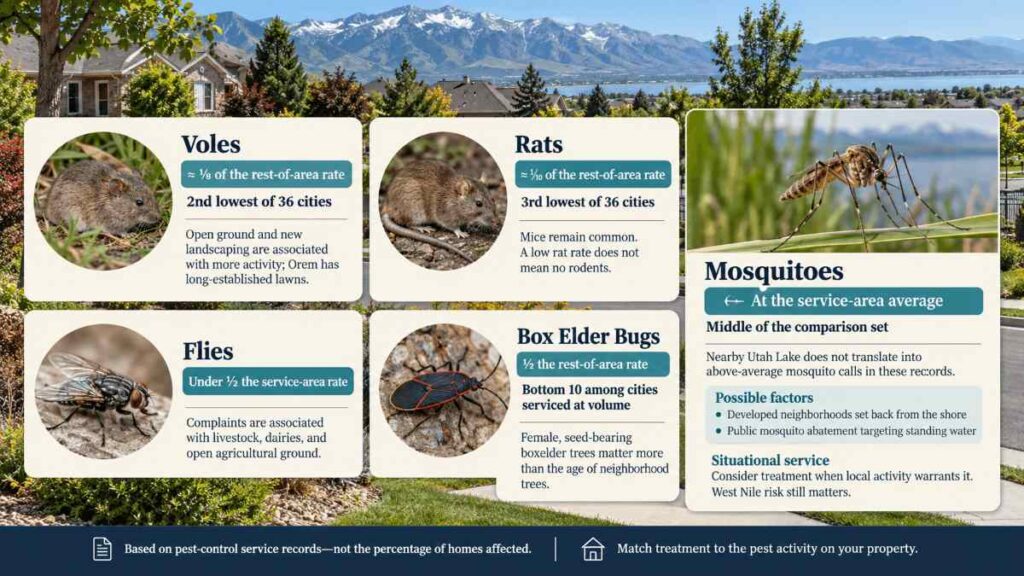
Within that, spiders are about two in five Orem calls, mouse calls run roughly 1.4 times our service-area rate, and earwig calls about 1.6 times. Aphids are the strange one, the highest share of any city in the set, on a small number of calls. The absences are just as sharp: vole, rat, fly, and box elder bug calls all run under half the rest-of-area rate, and three of those put Orem near the bottom of the 36 cities.

What Orem actually calls us about Share of pest codes logged across 2,240 Orem service appointments, compared with the rest of our Utah service area. The multiple on the right is how many times more, or less, of the Orem mix each pest is. Aphids sit on only 13 logged calls, so read that row as a tendency rather than a precise figure. These are our service records, not a survey of the local insect population.
Orem Rest of our Utah service area

Scroll the chart sideways to see the full scale →

Share of Beeline service calls by pest: Orem vs. the rest of our Utah service areaOrem runs higher on spiders, mice, earwigs and aphids, and far lower on rats, voles, flies and box elder bugs.0%10%20%30%40%Spiders40.3%31.9%▲ 1.26×Mice15.2%10.5%▲ 1.44×Ants13.4%13.6%· 0.99×Wasps13.1%16.8%▼ 0.78×Box elder bugs5.0%10.2%▼ 0.49×Earwigs4.8%3.0%▲ 1.60×Elm seed bugs2.3%2.9%▼ 0.79×Mosquitoes0.7%0.8%· 0.88×Aphids0.5%0.2%▲ 2.17×Flies0.5%1.2%▼ 0.45×Rats0.3%2.2%▼ 0.11×Voles0.3%2.0%▼ 0.13×

Key Observations: Spiders, mice, ants, and wasps account for 82% of all Orem service calls. High building density and 1970s housing stock drive house pests up, while lack of open agricultural fringe keeps voles and rats down.

Spiders, Mice and Ants: Orem’s Actual Workload

Spiders are 40 percent of what we log in Orem, third highest among the cities we service at volume. Orem has in quantity exactly what house spiders want: a deep stock of 1970s and 1980s homes with window wells, unfinished basement corners, wood fencing, and fifty years of settled foundation gaps. Our best read is that the age and density of the built environment does most of this, not the climate, since neighboring Provo sits lower on similar ground.

Mice follow the same logic. At 15.2 percent of Orem pest codes, mouse calls are top ten in that set. A mouse needs a gap the width of a pencil, and fifty years opens plenty of those around hose bibs, dryer vents, and garage door corners.

Ants land flat at 13.4 percent, almost exactly the service-area rate. Orem has a completely normal ant problem. Wasp calls run below average, bottom ten in that set, which fits lots smaller and more tightly built than the big-lot Davis County cities.

Earwigs: The One Yard Pest Orem Runs High On

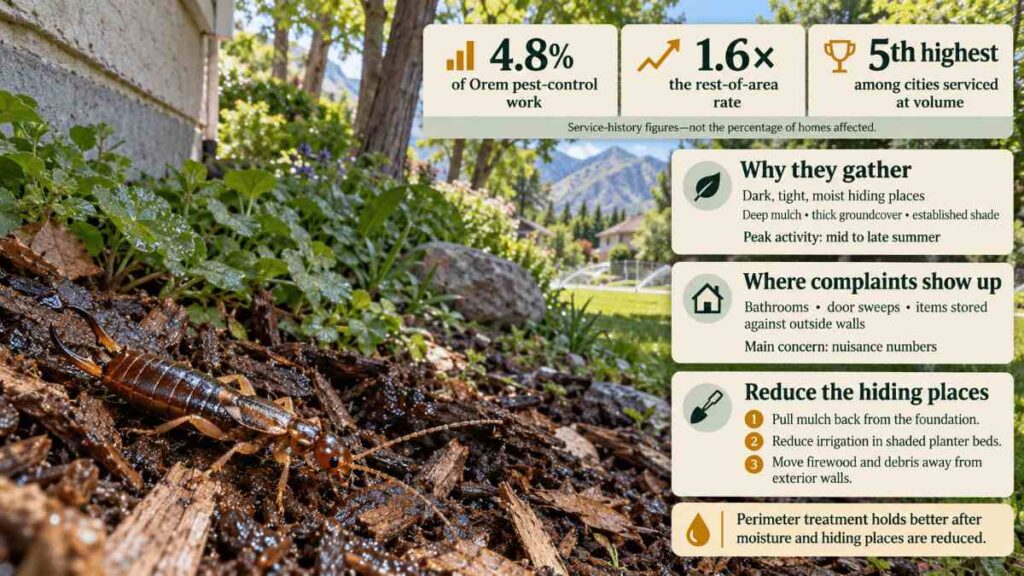
Earwigs are 4.8 percent of our Orem work, about 1.6 times the rest-of-area rate and fifth highest among the cities we service at volume. Clearfield is heavier, so Orem is not the leader, but it sits firmly in that top group.

Earwigs want what a mature Orem yard delivers. USU Extension describes them hiding in “dark, tight, and moist places during the daytime,” with densities peaking “in mid to late summer.” A fifty-year-old landscape is deep bark mulch, thick groundcover, long-established shade, and irrigation running the schedule it has run since the trees were small. That keeps ground damp under cover all summer, which is the whole requirement.

They are a nuisance rather than a threat, and the complaints are about volume: bathrooms, door sweeps, anything stored against an outside wall. The fix is as much moisture as treatment:

    • Pull mulch back from the foundation wall.

    • Cut irrigation on shaded planter beds.

    • Move firewood and debris piles off exterior walls.

A perimeter treatment holds far better once harborage is down.

Earwigs the one yard pest orem runs high on

Aphids: Orem Leads Our Service Area, and the Obvious Explanation Does Not Hold

Of the 36 cities we service at volume, Orem logs the highest share of aphid calls, roughly twice the rest-of-area rate. Be careful with it. In our dataset for pest control Orem Utah, the ranking rests on 13 logged calls, and the plausible range on a count that small is wide. The true rate is very likely above our service-area average, but the first-place finish could move either way next year.

The story that writes itself is the orchards. Orem grew fruit, Provo Bench meant bench orchards, and aphids are a classic fruit tree pest. We checked it, and it does not survive contact with the data. Provo sits immediately south, grew on the same bench, has the same orchard history, and runs aphid calls at roughly half our service-area rate, near the bottom of the comparison set. If orchard heritage drove aphid calls, Provo would look like Orem.

Our better read, and we will label it a read rather than a finding, is ornamental landscaping instead of fruit. What turns an aphid colony into a phone call is honeydew. USU Extension notes that aphids “exude honeydew onto plants, homes and cars,” and that sooty mold growing on it “can be unsightly.” A mature tree over a driveway in a tightly parked neighborhood makes a sticky car, which makes a call.

USU also says aphids “do not typically cause major tree/plant health issues,” and we will tell you so on the phone. When honeydew drops onto a patio every week, dormant oil in early spring on overwintering eggs beats chasing adults in July.

The Pests Orem Mostly Does Not Get

This is the more useful half of the data, because it tells you what not to buy:

    • Voles: Second lowest of the 36 cities we service at volume, about an eighth of the rest-of-area rate. Voles need open ground and new landscaping, which is why they run hot on the Utah County growth frontier, where Lehi is top ten. Orem has no building frontier left, and the lawns here have been lawns for decades.

    • Rats: Third lowest of the 36 cities, about a tenth of the rest-of-area rate. Norway rats concentrate in the older, denser, plumbing-heavy cores of the Salt Lake valley, where Holladay and Millcreek run many times Orem’s rate. Mice stay common, so do not read this as “no rodents here.”

    • Flies: Under half our service-area rate. Fly complaints track livestock, dairies, and open agricultural ground, and Orem has none of that left inside the city limits.

    • Box Elder Bugs: Half the rest-of-area rate and bottom ten among the cities we service at volume, which surprises people given Orem’s tree age. Age is not the requirement. These bugs need female, seed-bearing boxelder trees, and boxelder is a volunteer weed tree of river bottoms and fence lines rather than anything people plant in a front yard. Bountiful, where it grows along the creek corridors, runs about three times Orem’s rate.

About Utah Lake and Mosquitoes

Orem sits near the eastern shore of Utah Lake, and the standing assumption is that the lake makes this a mosquito city. Our records do not support that. Mosquito calls land right at the service-area average, middle of the comparison set.

Two things are probably going on. Orem’s developed area is set back from the shoreline, and the Utah County Health Department runs what the Daily Herald describes as the only public mosquito abatement program in the county, with 36 carbon dioxide-baited traps and drone-delivered larvicide on standing water, which hits the source before it reaches Orem backyards. West Nile virus is real here, with 16 Utah County human cases in a recent year, so this is no argument for ignoring mosquitoes. It is an argument that mosquito service in Orem is a situational add-on, not the main event.

The pests orem mostly does not get

An Orem Pest Control Calendar

March – April: Dormant oil window for aphid eggs on ornamental trees; seal rodent entry points; check eaves before wasp nests establish.

May – June: Spiders and ants pick up with the first real heat; earwig eggs hatch.

July – August: Peak earwig activity; peak aphid honeydew; peak spider web construction.

September – October: Spider webbing at its worst; mice press indoors; crucial window for older Orem homes.

November – February: Interior rodent control and structural exclusion.

Why Orem Homeowners Call Beeline

We run Orem on a regular route, so you are not waiting on a truck from the other end of the state. Our 2,240 appointments here are the proof: our technicians work these neighborhoods and know what Orem yards and Orem basements produce. Locally owned, 25+ years in Utah, 2,300+ five-star reviews, no hidden charges. Our quarterly service covers every pest on this page, and if something comes back between visits, so do we.

Get a Free Quote: Call (801) 544-9200 or text us at (385) 425-1766.

Orem pest control questions we actually get asked

Why is my car sticky under the tree out front when my sister in Provo never deals with this?

That is aphid honeydew, and Orem leads every city we service at volume for aphid calls while Provo sits near the bottom. We tested the obvious explanation, that leftover orchard trees drive it, and Provo contradicts it, since Provo has the same orchard history. Our read is Orem’s mature ornamental canopy over driveways. One caution: that ranking rests on a small number of calls, so treat it as a tendency, not a precise figure.

We live two miles from Utah Lake. Why does nobody in Orem complain about mosquitoes?

Because the data says they mostly do not. Mosquito calls land right at our service-area average, middle of the pack among the cities we service at volume. The built-up area is set back from the shoreline, and the Utah County Health Department runs the county’s only public abatement program, larviciding standing water before adults disperse. If you are bitten in your own yard at dusk, that is usually harborage on your property, not the lake.

My cousin in Lehi has vole runways all over his lawn every spring. Why does my Orem lawn never do that?

Because Orem ran out of new ground decades ago. Voles move in when pasture and hayfield become subdivisions, then stay in the greenbelts nearby. Lehi is top ten for vole calls among the cities we service at volume, and Orem is second from the bottom.

Are rats a problem in Orem?

Rarely. Orem is third from the bottom of the 36 cities we service at volume for rat calls, about a tenth of our service-area rate. Norway rats do best in older, denser, plumbing-heavy urban cores, and Holladay and Millcreek in Salt Lake County run many times Orem’s rate. Mice are a different story, so if something is in your wall, do not assume it is nothing.

Why do earwigs seem worse at our Orem house than they were at our old place?

Established landscaping is the likeliest reason. Orem is top five for earwig calls among the cities we service at volume, and earwigs need dark, tight, damp cover by day. A mature Orem yard with deep bark mulch and decades-old shade gives them that. Pulling mulch back from the foundation and trimming irrigation on shaded beds helps as much as a treatment does.

Our 1970s Orem house gets mice every fall. Is that normal for this city?

Very normal, and the housing age is why. The largest single slice of Orem’s housing stock was built in the 1970s according to the city’s own housing study, and fifty years opens gaps around vents, hose bibs, and garage door corners. Orem is top ten for mouse calls among the cities we service at volume, and exclusion work here is worth more than extra interior treatments.

Beeline Pest Control has served the state of Utah for over 29 years. Call now for your quick FREE quote.