
Draper, UT 84020 · on our regular Salt Lake County route
Pest Control in Draper, Utah
Vole calls in Draper run about two and a half times our rate elsewhere, fourth of the 36 cities we service at volume, while rats run at a third. We treat for the city you actually live in.
Text (385) 425-1766. Send a photo of the bug and we will tell you what it is, free, usually same day.
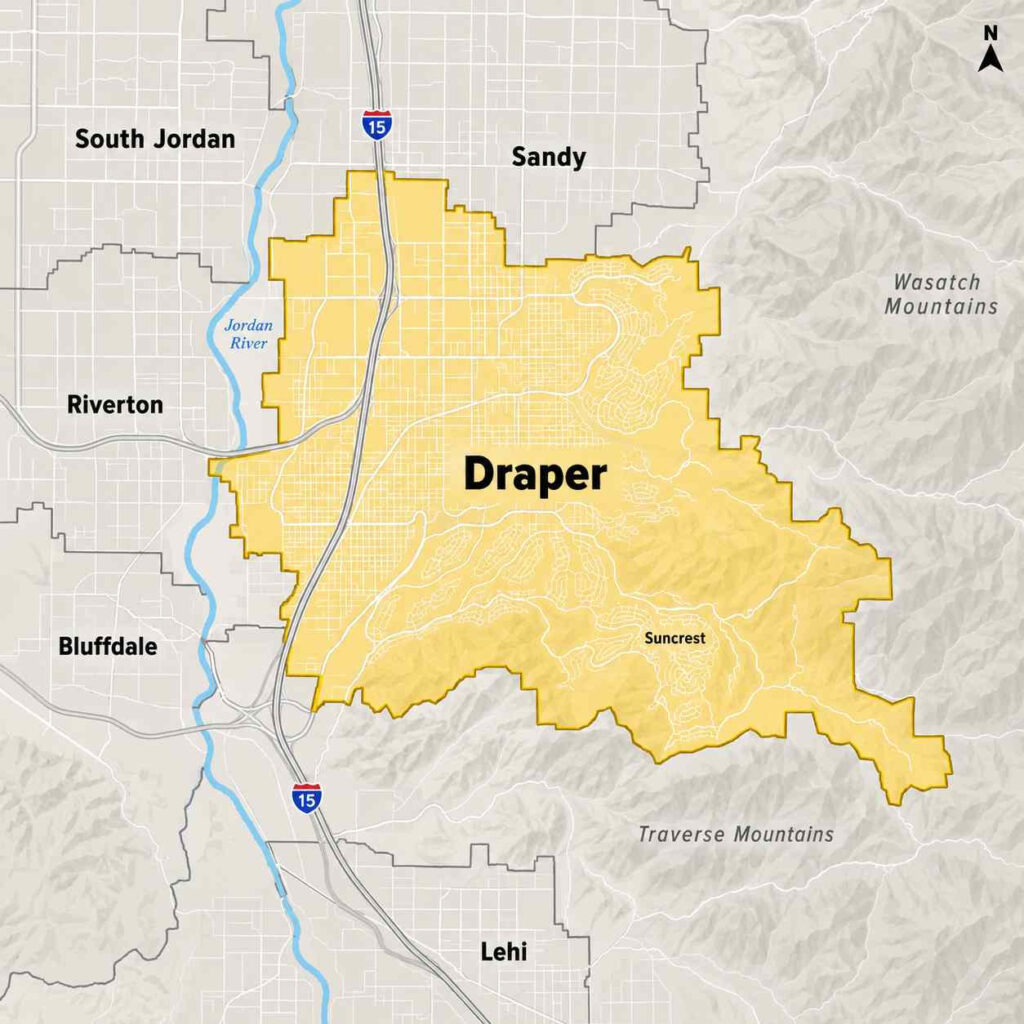
Draper is where the valley runs out. The city climbs the Wasatch foothills at the south end of Salt Lake Valley, and Draper City counts more than 5,000 acres of open space and over 150 miles of trails, the largest open space of any city along the Wasatch Front. Most of the housing is new: Draper had 7,257 residents in 1990 and 51,017 in 2020. Nearly every yard we treat here was farm ground or dry bench inside living memory.
Both facts show up in our service records, and Draper’s pest mix does not look like Sandy’s, one exit north.
The local picture
What Draper calls us about, and what it does not
These numbers come from our own appointment history: 2,057 service appointments in Draper, producing 2,200 pest log entries. We compare Draper against the rest of our Utah service area, and every ranking below is scoped to the 36 cities where we log at least 1,000 pest entries, so a town with a dozen calls never outranks a real market on a fluke. One caveat: this is a record of what people call us about, not a census of the insects living in Draper. What people call about is still what matters when you decide what to treat for.
Scroll the chart sideways to see the full scale →
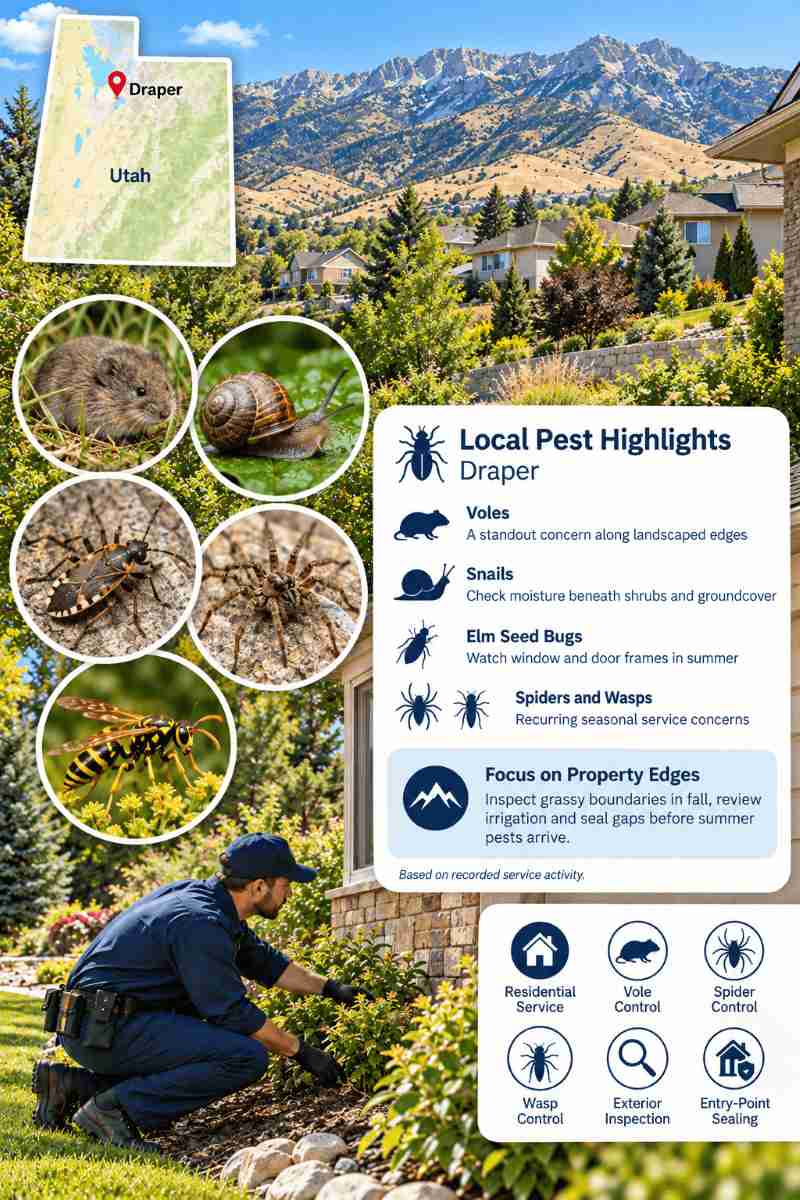
Draper’s top four are the same as nearly everywhere else we work: spiders, wasps, ants and mice. Its spider share is almost exactly the area average and its wasp share is slightly below. Those are not the interesting rows. The interesting ones are voles, snails and elm seed bugs on the high side, and rats, flies and earwigs on the low side.
Not sure what you are looking at?
Send us a photo. We will identify it and tell you whether it needs treating or not, free, usually the same day.
The big one
Voles: the problem that comes in off the open ground
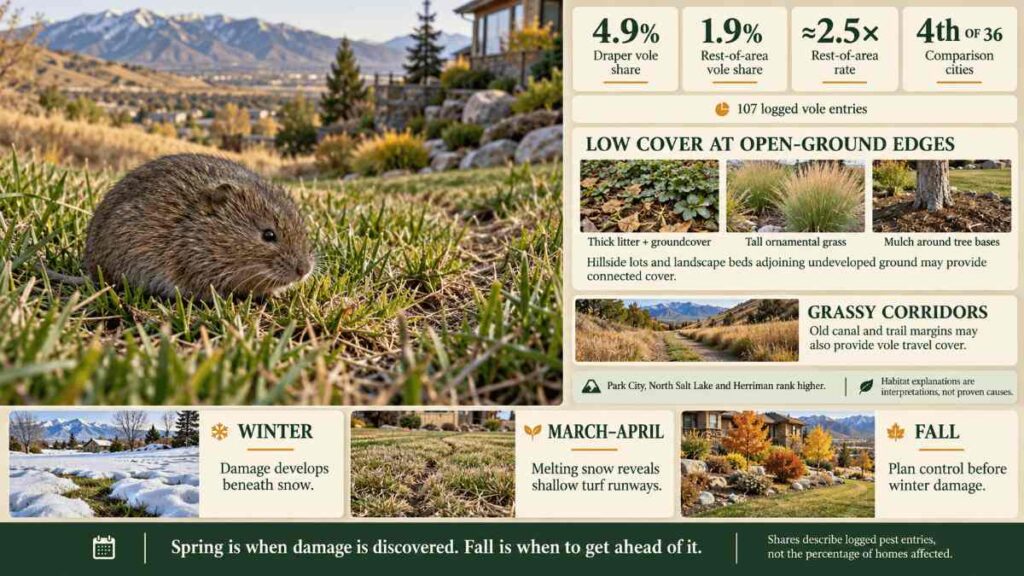
Vole calls make up 4.9 percent of everything logged in Draper against 1.9 percent across the rest of our service area. That is roughly two and a half times the rate, and it puts Draper fourth among the 36 cities we service at volume, on 107 logged entries.
Look at who is above Draper and the pattern writes itself: Park City, North Salt Lake and Herriman. Every one is a bench or foothill town where irrigated landscaping ends and dry open hillside begins. This is not a Draper quirk. It is what the edge of the mountains does, and Draper has more of that edge than almost anywhere else we work.
Utah State University Extension describes the habitat voles want as low cover: groundcovers, thick litter, tall grass in turf and mulch piled around tree bases. Draper supplies all of it, then puts it against thousands of acres of ungrazed open space. In our experience the newer hillside lots are the worst of it, because a big lot on a slope usually means deep landscape beds, long runs of ornamental grass and a property line touching undeveloped ground. That is field experience, not a measurement: we do not track results street by street.
The Draper Canal corridor is probably part of this too. Draper Irrigation converted from flood irrigation to pressurized pipe in 1994, and parts of the old right of way have since been kept for stormwater or turned into trail. What that leaves is a long, grassy, lightly maintained strip running across town, close to a textbook description of the cover voles travel and nest in. It goes a long way toward explaining why vole pressure here is not confined to houses nearest the mountain.
Most people find out in March or April, when the snow pulls back and the lawn turns out to be covered in shallow runways. The damage happened over the winter. The discovery is a spring event. Getting ahead of it means working in fall, not when the runways appear. Our vole service page covers how.
Snails: a watering problem more than a weather problem
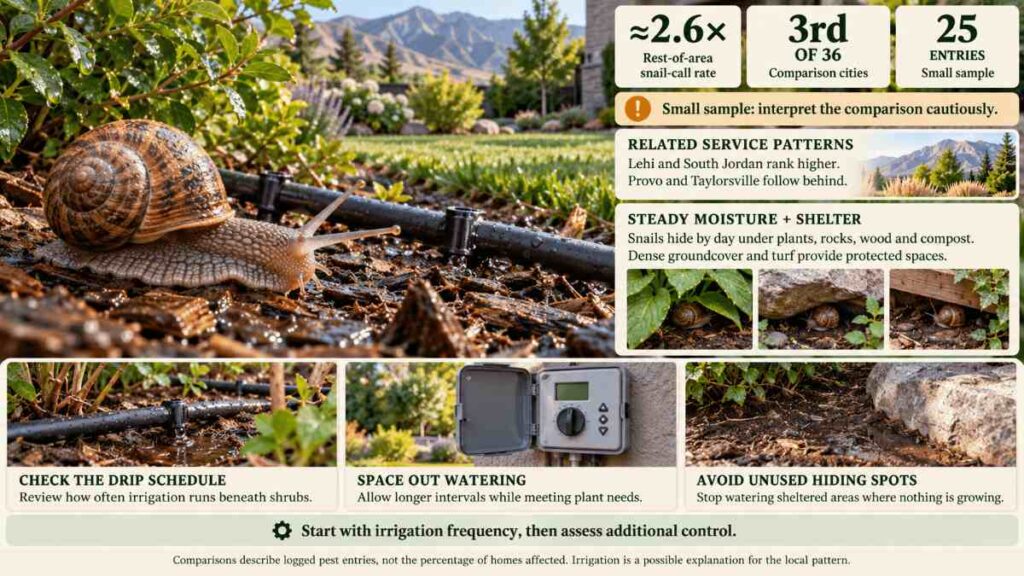
Snail calls run 2.6 times the rest of our area and rank Draper third among those same 36 cities. The honest caveat is that this sits on 25 logged entries. Treat it as a consistent pattern rather than a precise figure.
What makes it believable is the company Draper keeps. Above it are Lehi and South Jordan, just behind are Provo and Taylorsville, all south valley cities with newer, heavily irrigated landscaping. Utah is dry and snails need steady moisture, so here they get it from a sprinkler clock rather than from weather.
USU Extension is direct about this: snails and slugs are a more serious problem under high moisture conditions, they hide by day under plants, rocks, wood and compost, and dense groundcover and turf make ideal hiding places. The advice that follows is to stretch irrigation intervals as long as you can and stop watering hiding spots where nothing is growing anyway.
If you have snails in Draper, the first thing to check is not a product. It is how often the drip under your shrubs runs.
Elm seed bugs: the mid-summer one
Elm seed bugs are 4.8 percent of Draper’s log, about 1.7 times the rest of our area, seventh of 36 on 105 entries. This one is less about the bench and more about trees. Elm seed bugs feed on elm seeds, so they need mature elm nearby. Utah confirmed its first infestation only in July 2014, and they have spread fast since.
The behavior is what makes them a call rather than a curiosity. USU Extension puts peak nuisance activity from mid-June through August, when adults get driven off the host tree by heat and crawl or fly to the nearest structure for shade. There is one generation a year and the adults overwinter inside buildings, so a house that had them in July often has them crossing the windowsill in February. Treatment is mostly exterior and mostly about timing: hit the structure before the mid-June push.
The other side of the list
What Draper does not get
The low side of the chart is as useful as the high side, and it is the part no competitor’s city page will tell you.
Rats. Rat calls are 0.7 percent of Draper’s log against 2.2 percent across the rest of our area, about a third of the rate and 28th of 36. Sandy, which Draper borders on the north, runs 3.5 percent and sits eighth. Norway rats do well in older, denser neighborhoods with aging sewer and plumbing connections, and Draper mostly does not have that kind of core. Our best read on the gap is infrastructure age.
Flies. A third of the area rate, 32nd of 36. Flies track livestock, food waste and standing water at scale, and Draper’s farms left with the subdivisions.
Earwigs. Under half the area rate, 29th of 36. Earwigs want deep, damp, shaded litter. A sunny bench lot that drains well is a poor fit.
Mosquitoes. Just over half the area rate, on only nine logged entries. Draper is high, sloped and drains fast, and the flood irrigation that once stood in fields here ended when the canal went pressurized in 1994. Draper also sits inside the South Salt Lake Valley Mosquito Abatement District, which names the city in its service area and treats as a public service. If mosquitoes are your issue, call the district first. It costs nothing, and we would rather say so than sell you something you do not need.
When these show up in Draper
| When | What matters in Draper |
|---|---|
| March and April | Vole runways appear as the snow melts. Snails start as soon as the sprinklers come back on. |
| May and June | Spiders and wasps ramp up. Elm seed bug nymphs develop on the elms, with adults emerging in northern Utah by mid to late June. |
| July and August | Elm seed bugs hit peak nuisance and press on the house. Wasp nests reach full size. The busiest stretch of the year here. |
| September and October | Wasps turn aggressive as their food runs out. Voles hit their second breeding peak, which makes this the right time for vole work. |
| November to February | Mice indoors. Voles working under the snow against the bark of young trees, where you will not see it until spring. Overwintering elm seed bugs on warm days. |
Working in Draper
Beeline is locally owned and has treated Utah properties for more than 25 years. We run Draper on a regular route, and those 2,057 appointments are the proof rather than a marketing line. Our office is in Clearfield, our pricing has no hidden charges, and we have more than 2,300 five star reviews.
A Draper visit usually means a full exterior treatment for spiders, ants and wasps, plus whatever the property’s own edges call for. On a hillside lot that means the boundary between your landscaping and the open ground. On a mature lot it means the elms. Most location pages in this industry are shared copy with the city name swapped in. We built this one from our own service history instead.
Before you book
Draper pest control questions we actually get
Why do I have voles when my neighbors in Sandy do not?
Vole calls run about three times higher in Draper than in Sandy as a share of the work we do in each city, and Draper sits fourth among the 36 cities we service at volume. The difference is the bench. Draper has thousands of acres of open space pressed against irrigated yards, and voles move from the dry side to the watered side.
Does living near Corner Canyon or the Draper Canal trail make it worse?
In our experience, yes, for voles specifically, because both give you continuous cover running right up to a landscaped yard. We do not track results street by street, so we will not claim a measured difference. Lots with a property line against open ground are where fall vole work earns its keep.
Should I call Beeline about mosquitoes in Draper?
Usually no. Draper is inside the South Salt Lake Valley Mosquito Abatement District, which covers the city as a public service. Mosquito calls here run just over half the rate of the rest of our service area, which fits a high, well drained city that lost its flood irrigation in 1994. Call the district first.
Why are rat calls so much lower here than in Holladay or Cottonwood Heights?
Housing age, most likely. Rat calls are about 0.7 percent of what we log in Draper against roughly 8 percent in Holladay, first of the 36 cities we service at volume. Older, denser neighborhoods with aging sewer connections give Norway rats what they need. Draper was a farm town until the late 1990s, and its pipes and foundations are mostly newer than the problem.
My elm seed bugs come back every summer. Why?
They have one generation a year and overwinter as adults inside structures, so the ones you see in February are last July's. Draper runs seventh of 36 on elm seed bugs, and the reason is simply mature elm. Treatment timed to late spring, before the mid-June push, beats anything you do in August.
Do box elder bugs run high in Draper?
No, and this surprises people. Draper’s box elder share sits slightly below the area average, mid-pack among the 36 cities. Box elder bugs need female seed-bearing boxelder trees, which cluster in older Wasatch Front neighborhoods. Bountiful, Ogden and Salt Lake City run far higher. Draper’s trees are younger and more varied.
Snails in Utah? Really?
Really, and Draper ranks third of 36. It is a small sample at 25 logged entries, so call it a pattern rather than a precise number. Snails need steady moisture, and in a dry state that comes from irrigation rather than rain. The south valley cities with the newest, most heavily watered landscaping are the ones that call.
Why a Draper homeowner should call us
Get a Draper quote
We are in Draper most weeks. Call (801) 544-9200, text (385) 425-1766, or email service@BeelinePestControl.com for a free consultation. Locally owned, 25 plus years in Utah, no hidden charges.
Beeline Pest Control, 275 W 1700 S, Clearfield, UT 84015.
We also service nearby:


Three ways to get a Draper quote
All of them free, all of them with a real person at our Clearfield office.
- 1Send us a photo(385) 425-1766. Fastest answer.
- 2Call us(801) 544-9200. Mon to Fri 7:30am to 7:00pm, Sat 7:30am to 4:00pm.
- 3Fill in the formSend a picture of the bug or the damage and we will tell you what it is and what it costs.