
Taylorsville, UT · on our regular Salt Lake County route
Pest Control in Taylorsville, Utah
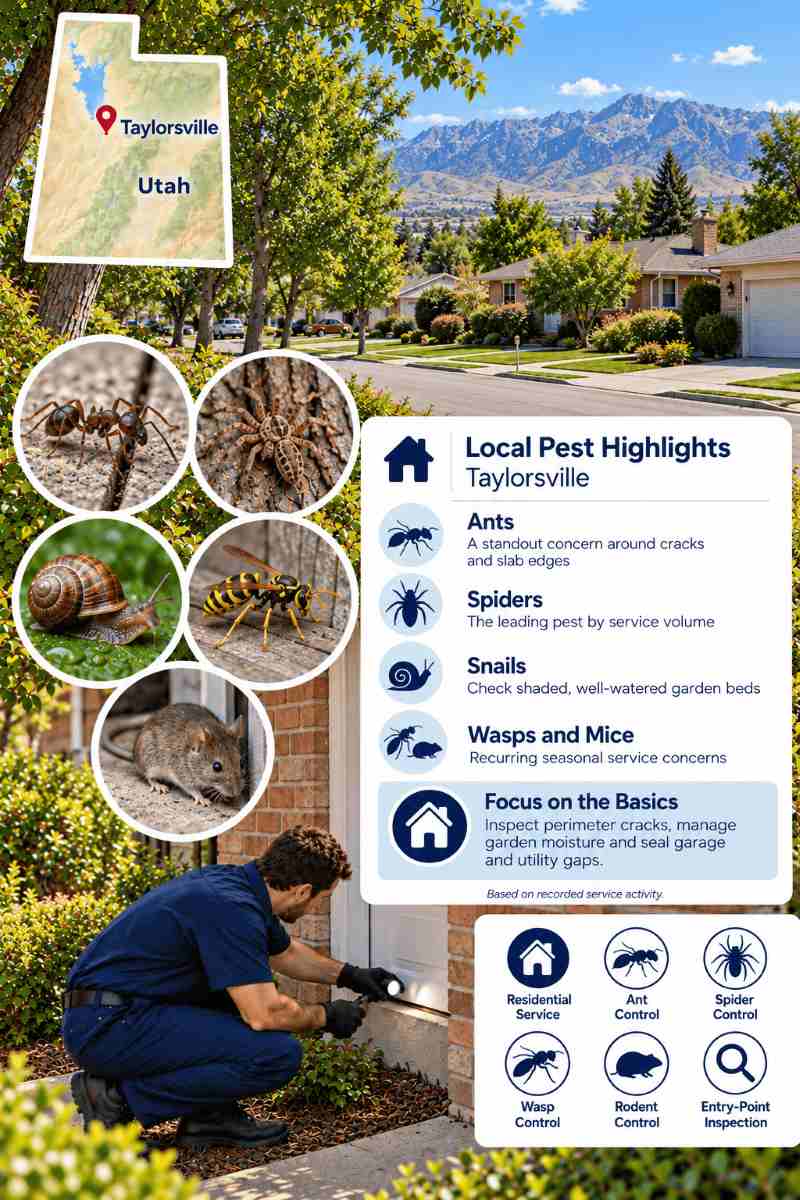
Taylorsville’s pest mix sits closer to our service-area average than almost any city we work in. Ants run about 1.3 times our rate, sixth of 36, and voles barely register. We treat for the city you actually live in.
Text (385) 425-1766. Send a photo of the bug and we will tell you what it is, free, usually same day.
Most pest control pages promise you that your city is special. Taylorsville, we have to be straight with you: it mostly is not.
We have logged 2,044 service appointments in Taylorsville. When we line that record up against the rest of our Utah service area, the Taylorsville pest mix lands closer to the middle than almost any other city we work in at volume. Same spiders. Same ants. Same wasps under the same eaves. The interesting parts are small, and most of them are things Taylorsville does not get.
That is genuinely useful if you live here. It means nobody needs to sell you a specialty program for a pest problem your neighborhood does not have.
The local picture
What 2,044 Taylorsville appointments actually show
Everything below comes out of Beeline’s own service records. Those 2,044 appointments produced 2,189 pest codes, because one visit can cover more than one problem. We compare Taylorsville’s share of each pest against the share across the rest of our service area, with Taylorsville itself taken out of that comparison. Every rank on this page is scoped to the 36 Utah cities where we log at least 1,000 pest codes, which is the only set big enough for a rank to mean anything.
One honest caveat up front. This is a record of what people call us about. It is not a census of the insects living in Taylorsville. A pest that bothers nobody never shows up in it.
Scroll the chart sideways to see the full scale →
Look down that multiple column and you will see how flat it is. Spiders, mice and earwigs all sit within about ten percent of the area rate. Bees land exactly on it. Rats, beetles and elm seed bugs are within a hair of average too. Across 23 pest categories, only one runs meaningfully hot.
Not sure what you are looking at?
Send us a photo. We will identify it and tell you whether it needs treating or not, free, usually the same day.
The big one
Ants: the one place Taylorsville runs above the pack
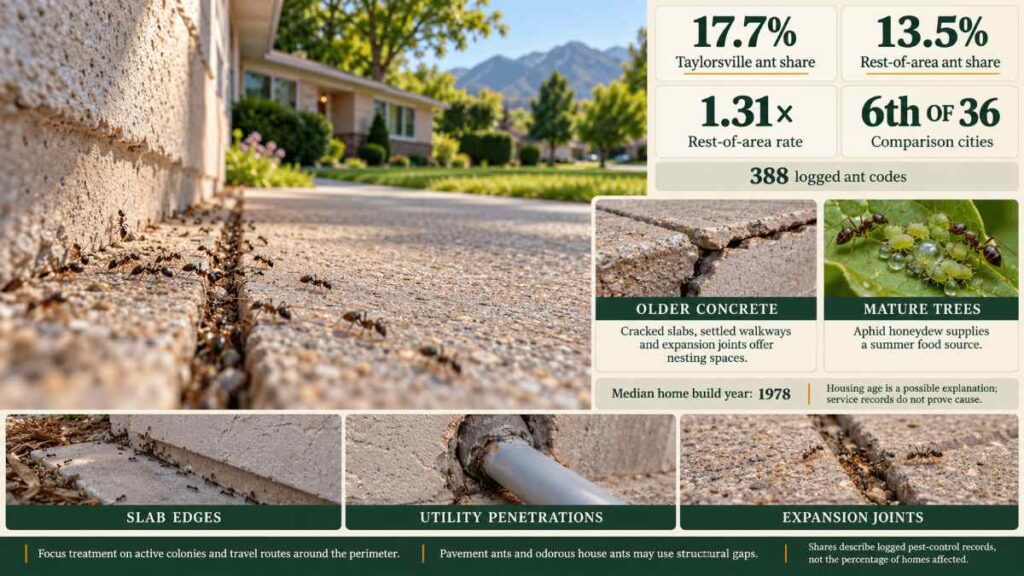
Ants are 17.7 percent of what Taylorsville calls us about, against 13.5 percent across the rest of our area. That is 1.31 times the area rate and sixth highest among the 36 cities we service at volume. It rests on 388 logged ant codes, so unlike most of the small signals on this page, it is solid.
Our best read on it is the age of the housing. Taylorsville’s median home was built in 1978, and the city’s own 2019 housing study found roughly half the housing stock went up between 1940 and 1980. Forty and fifty year old slabs and walks have had a long time to crack, settle and open up expansion joints. Pavement ants and odorous house ants nest in exactly those gaps, then follow a moisture line indoors. Mature trees help them along too, dropping aphid honeydew all summer.
What that means practically is that ant control in Taylorsville is usually a perimeter and crack problem rather than a yard problem. We treat the slab edge, the utility penetrations and the expansion joints, because that is where the colony actually lives.
Snails, and why we are careful about them
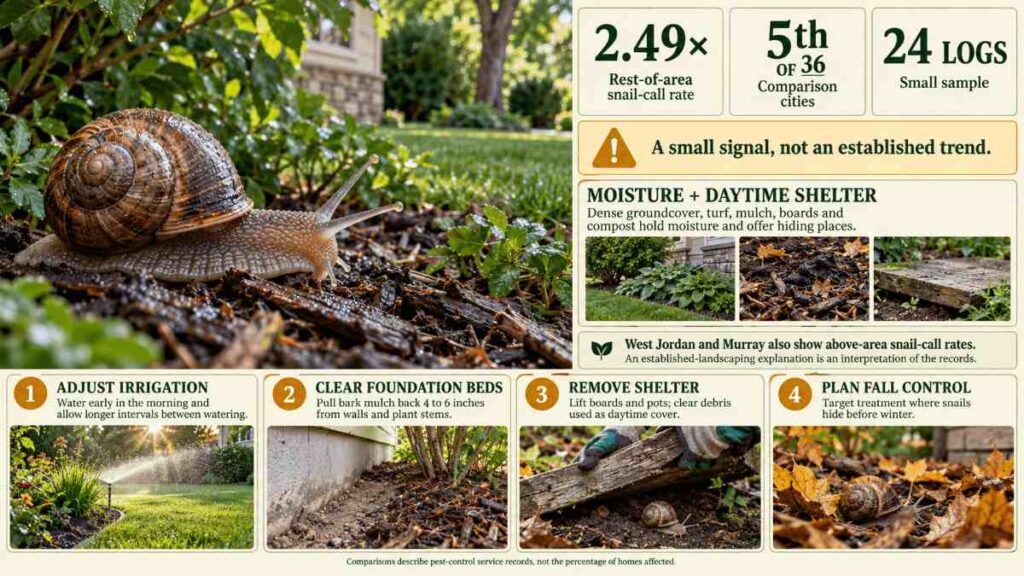
Snail calls are the only other thing running hot, at 2.49 times the rest of our service area and fifth among those 36 cities. It is also the smallest number on this page worth talking about: 24 logs.
We are not going to pretend 24 calls is a trend. Call it a nudge in a direction. But the direction fits what USU Extension says about slugs and snails in Utah, which is that water management is the whole ballgame. They are “always a more serious problem under high moisture conditions,” and they shelter in dense groundcover, turf, mulch, boards and compost. Taylorsville is a city of forty-plus year old yards with filled-in shrub beds, deep lawns and mature shade, and a lot of it still gets watered on the schedule it was planted on. That combination probably has a lot to do with it.
Our neighbors to the south and east show the same pattern in our records. West Jordan and Murray both run above the area rate on snail calls as well, so this is really a middle-valley, established-landscaping story rather than a Taylorsville one.
The fix is rarely chemical first. Stretch your irrigation intervals, pull mulch back a few inches from foundations and stems, lift the boards and pots the snails are sleeping under, and treat in fall. Fall matters because every snail removed then is a few hundred that never hatch next spring.
The other side of the list
What Taylorsville does not get
This is the better half of the story, and no other pest control page in this city will tell you any of it.
Voles. Vole calls run at 0.28 times the area rate, 32nd of 36. Voles are a new-landscaping pest. They move in where fresh sod, new shrub beds and irrigated turf meet open ground, which is why Park City, Draper and South Jordan all run well above average in our records and Taylorsville does not. The city’s housing study puts it plainly: Taylorsville’s “compact 10 square miles is mostly built-out.” There is almost no raw edge left for voles to come in from. If you have been quoted for vole work here, ask what they actually saw.
Springtails. Down at 0.41 times the area rate and 35th of 36, on only three logged calls. Springtails follow new construction: damp fill soil packed against a fresh foundation, new sod that has not knit yet, and the high moisture of a first season. A city whose last big building push wound down decades ago simply does not generate those calls.
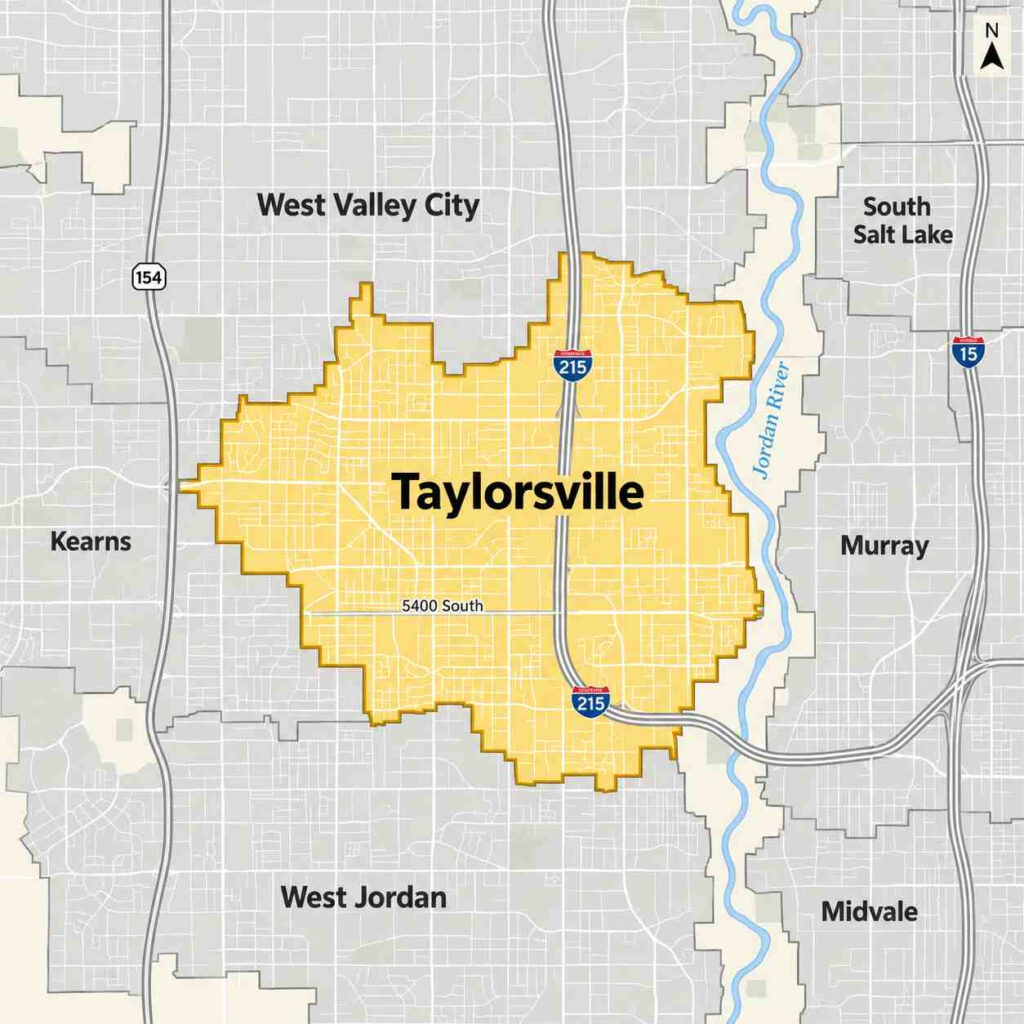
Mosquitoes. 0.42 times the area rate, 26th of 36, and this one has two things behind it. Taylorsville is inside the South Salt Lake Valley Mosquito Abatement District, which has been running larval control across most of Salt Lake County since 1952. The city also has very little standing water of its own. The Census tallies its 10.85 square miles as all land, with the Jordan River running along the eastern edge toward Murray rather than through a wetland in the middle of town. No marsh, no lake plain, no flood-irrigated pasture.
Box elder bugs. 6.1 percent of Taylorsville calls against 10.2 percent area-wide, which is 0.60 times the rate and 25th of 36. Box elder bugs need female seed-bearing boxelder trees nearby. The Davis County bench towns are full of them. The valley floor here is planted mostly in maple, ash, locust and fruit trees, and our best read on the gap is simply the tree inventory.
We will also mention one number we are deliberately not making a claim about. Gophers technically run very high here as a multiple, on seven logged calls. Seven is noise. We are not building you a gopher program out of it.
The ordinary majority, handled properly
Spiders are 36 percent of Taylorsville’s calls, the single biggest category, just as they are nearly everywhere we work. Wasps are 13.6 percent, actually a little under the area rate. Mice are 11.6 percent, right at average.
That is not a reason to shrug. It is a reason to be good at the basics: a treated perimeter band, swept eaves and soffits before wasp queens build, and sealed entry points at the garage, the dryer vent and the utility chases before the first cold snap. On a 1978 house those gaps are usually settled open, not sealed.
A Taylorsville pest calendar
| When | What matters in Taylorsville |
|---|---|
| March, April | Ants wake first and start trailing along slab cracks and driveway joints. This is the cheapest month of the year to deal with them. Overwintered box elder bugs come off the sunny south walls, fewer here than in Bountiful, but you will still see some. |
| May, June | Wasp queens start nests under eaves, in soffit corners and inside open patio umbrellas. Knocking a nest down the size of a golf ball in May saves you a nest the size of a football in August. Spider activity climbs. |
| July, August | Peak spider season, and the peak of the ant trail problem indoors as outdoor moisture dries up. Snails and slugs feed at night in shaded, well-watered beds. Earwigs turn up in window wells and under mulch. |
| September, October | Wasps get aggressive and food-focused, which is when most stings happen. This is also the month to treat for snails, before they lay. Start sealing for mice now, not in December. |
| November to February | Quiet outside. Mice, basement and crawl space spiders, and the odd overwintering box elder bug on a warm south window. Interior work and exclusion are the useful winter jobs. |
Before you book
Taylorsville pest control questions we actually get
Why do I keep getting ants when my neighbor on the next street does not?
Ant pressure in Taylorsville tracks slab and hardscape condition more than it tracks geography. Ant calls run about 1.3 times the area rate here, sixth among the 36 cities we service at volume, and in our experience the worst of it lands on older slabs with open expansion joints and settled walkways. Two houses a block apart can be very different.
Do I need mosquito service in Taylorsville?
Usually not as a standing program. Mosquito calls here run at about 0.42 times our area rate, and Taylorsville sits inside the South Salt Lake Valley Mosquito Abatement District's coverage. If you have a persistent problem it is almost always a yard-level source, a tarp, a clogged gutter, a planter saucer, not a neighborhood one.
My landscaper says I have voles. Should I be worried?
Be skeptical first. Vole calls here run at 0.28 times the area rate, 32nd of 36 cities we service at volume, because Taylorsville has essentially no open-ground edge left. Surface runways in the lawn after snowmelt are worth a look. A quote for an ongoing vole program usually is not.
Why do I see fewer box elder bugs here than my sister in Bountiful?
Because of trees, not luck. Box elder bugs breed on female seed-bearing boxelder trees, which are much more common along the Davis County bench. Box elder bug calls run at about 0.60 times our area rate in Taylorsville and roughly triple that in Bountiful.
Is the snail problem on my street real, or is my yard just wet?
Probably the yard. Taylorsville snail calls run about two and a half times the area rate, fifth among the 36 cities we service at volume, but that sits on only 24 logged calls, so we treat it as a direction and not a measurement. Mature, heavily irrigated landscaping is the common thread on the calls we do get.
Does the Jordan River make the east side of Taylorsville worse?
Not in any way we can prove. We do not track results street by street, so we will not claim one side of town measures worse than the other. What we can say is that the river corridor is the only real open water in the city, and in our field experience lots backing onto the parkway see slightly more of everything that likes damp cover.
Why does Taylorsville not get its own specialty program?
Because the data does not support one, and we would rather say that than sell you one. The Taylorsville mix is close to our service-area baseline on nearly everything. A thorough general program, done on schedule, covers this city well.
Why a Taylorsville homeowner should call us
Get it handled
We run Taylorsville on a regular route, and those 2,044 appointments are the proof. You are not waiting on a special trip.
Beeline Pest Control is locally owned, has been working in Utah for more than 25 years, and has over 2,300 five-star reviews. No hidden charges, and no upsell for a pest your street does not have.
Call (801) 544-9200, text (385) 425-1766, or email service@BeelinePestControl.com.
Office: 275 W 1700 S, Clearfield, UT 84015.
We also service nearby:


Three ways to get a Taylorsville quote
All of them free, all of them with a real person at our Clearfield office.
- 1Send us a photo(385) 425-1766. Fastest answer.
- 2Call us(801) 544-9200. Mon to Fri 7:30am to 7:00pm, Sat 7:30am to 4:00pm.
- 3Fill in the formSend a picture of the bug or the damage and we will tell you what it is and what it costs.